
In the design of high-end coordinate measuring machines (CMMs), structural material selection is not a secondary consideration—it is a defining factor in measurement accuracy, long-term stability, and system reliability. Among available materials, precision granite has emerged as the preferred foundation for advanced metrology systems, offering unique advantages in thermal stability and vibration damping that directly impact measurement precision.
This article examines how custom granite structures address the critical challenges of thermal deformation and vibration in CMM applications, providing engineers and metrology professionals with the technical foundation for optimal system design.
The Critical Role of CMM Structural Materials
Understanding the Measurement Foundation
A CMM base serves as the reference platform upon which all measurements are built. Any deformation, thermal drift, or vibration at this structural level propagates through the entire measurement system, introducing cumulative errors that can compromise accuracy at every level of operation.
For ultra-precision applications—such as semiconductor inspection, aerospace component verification, and precision tooling measurement—these deviations are unacceptable. The base material must therefore exhibit:
- Exceptional dimensional stability under varying conditions
- Minimal thermal expansion across operational temperature ranges
- High vibration damping capacity to isolate measurement processes
- Long-term structural integrity without degradation
The Limitations of Traditional Materials
Steel Structures:
Steel has long been used in precision machinery, but its properties present significant challenges for CMM applications:
Steel has long been used in precision machinery, but its properties present significant challenges for CMM applications:
- Coefficient of Thermal Expansion (CTE): 11-13 µm/m·°C
- High sensitivity to ambient temperature changes
- Thermal gradients induce warping and internal stress
- Residual stresses from manufacturing can cause gradual deformation
- Low inherent damping capacity requires auxiliary vibration systems
Cast Iron Structures:
Cast iron offers improved damping over steel but retains fundamental limitations:
Cast iron offers improved damping over steel but retains fundamental limitations:
- CTE: approximately 10-11 µm/m·°C
- Better damping than steel due to graphite microstructure
- Still susceptible to thermal expansion effects
- Long-term creep effects can compromise stability
- Requires protective coatings to prevent corrosion
Aluminum Structures:
Lightweight aluminum presents the greatest thermal challenges:
Lightweight aluminum presents the greatest thermal challenges:
- CTE: approximately 23 µm/m·°C
- Temperature change of 1°C causes 23 µm/m dimensional change
- Highly sensitive to thermal gradients
- Lowest damping capacity among structural materials
- Generally unsuitable for high-precision CMM applications
Granite’s Superior Thermal Stability
Understanding Thermal Expansion in Metrology
Temperature is perhaps the most significant environmental variable affecting measurement accuracy. In precision manufacturing environments, temperature fluctuations are inevitable—caused by HVAC systems, equipment heat generation, personnel movement, and daily environmental cycles.
The impact of thermal expansion on measurement accuracy is direct and cumulative:
Comparative Thermal Expansion Analysis:
| Material | CTE (µm/m·°C) | Expansion per 1°C per meter | Relative Performance |
|---|---|---|---|
| Aluminum | 23.0 | 23.0 µm | Baseline |
| Steel | 11-13 | 11-13 µm | ~2× better than aluminum |
| Cast Iron | 10-11 | 10-11 µm | ~2.3× better than aluminum |
| Granite | 4.5-9 | 4.5-9 µm | 3-5× better than steel |
Granite’s Thermal Characteristics
Precision granite exhibits thermal properties that make it ideal for metrology applications:
Low Coefficient of Thermal Expansion:
- CTE range: 4.5-9 × 10⁻⁶/°C
- Approximately 1/2 to 1/3 that of steel
- Approximately 1/4 to 1/5 that of aluminum
- Enables measurement stability under temperature variation
High Thermal Inertia:
- Heats and cools slowly due to low thermal conductivity
- Reduces sensitivity to short-term temperature fluctuations
- Dampens thermal cycling effects from environmental changes
- Provides thermal buffering capacity
Isotropic Thermal Behavior:
- Uniform expansion in all directions
- No directional thermal properties
- Predictable dimensional response
- Eliminates anisotropic deformation concerns
Near-Zero Thermal Hysteresis:
- Returns to original dimensions after thermal cycling
- Less than 0.2 µm/m after 10,000 thermal cycles (ISO 8512-2)
- No permanent deformation from temperature variation
- Ensures long-term measurement repeatability
Real-World Thermal Impact
Consider a CMM with a 2,000mm granite base experiencing a 3°C temperature change:
- Granite base expansion: 27-54 µm total
- Steel equivalent: 66-78 µm total
- Aluminum equivalent: 138 µm total
For a measurement tolerance of 10 µm, this difference is decisive. The granite base maintains measurement accuracy within specification, while steel and aluminum structures would require active temperature compensation or environmental control systems.
Vibration Damping: Granite’s Hidden Strength
The Vibration Challenge in Precision Measurement
CMM accuracy is highly sensitive to environmental vibrations—whether from nearby machinery, foot traffic, HVAC systems, or building resonance. These vibrations, often invisible and inaudible, can introduce measurement errors that are difficult to detect but significantly impact results.
Sources of Vibration in Manufacturing Environments:
- Production machinery and CNC equipment
- Forklift traffic and material handling
- HVAC fans and compressors
- Building structural resonance
- Adjacent facility operations
- Seismic and ground-borne vibrations
Granite’s Superior Damping Performance
Granite is one of the most effective natural vibration damping materials available for precision applications:
Damping Performance Metrics:
| Property | Granite | Cast Iron | Steel | Aluminum |
|---|---|---|---|---|
| Damping Ratio | 0.012-0.015 | 0.003-0.005 | 0.001-0.002 | 0.0001-0.0005 |
| Relative Performance | Excellent | Good | Fair | Poor |
| Vibration Attenuation (50-500Hz) | 95% | 60-70% | 20-30% | <10% |
| Q-Factor | <100 | 200-400 | 500-1000 | >1000 |
The Physics of Granite’s Damping Advantage
Granite’s exceptional vibration damping is rooted in its physical structure:
Heterogeneous Crystalline Structure:
- Composed of interlocking mineral grains (quartz, feldspar, mica)
- Grain boundaries disrupt mechanical wave propagation
- Internal friction converts vibration energy to heat
- Natural damping without auxiliary systems
High Density and Mass:
- Density: approximately 3,100 kg/m³ for premium black granite
- High mass provides inertial stability
- Resists external vibration disturbances
- Provides passive vibration isolation
Structural Homogeneity:
- Uniform crystalline distribution
- Consistent damping throughout the structure
- No directional variation in damping properties
- Predictable response to vibration input
Impact on Measurement Accuracy
The combined effect of thermal stability and vibration damping directly translates into measurable improvements in CMM performance:
- Reduced measurement uncertainty: Vibration-induced errors minimized
- Improved repeatability: Consistent measurements over time
- Enhanced reproducibility: Accurate results across operators and conditions
- Lower calibration frequency: Stable performance reduces recalibration needs
- Extended equipment life: Reduced wear from vibration stress
Custom Granite Structures: Engineered for Precision
Beyond Standard Configurations
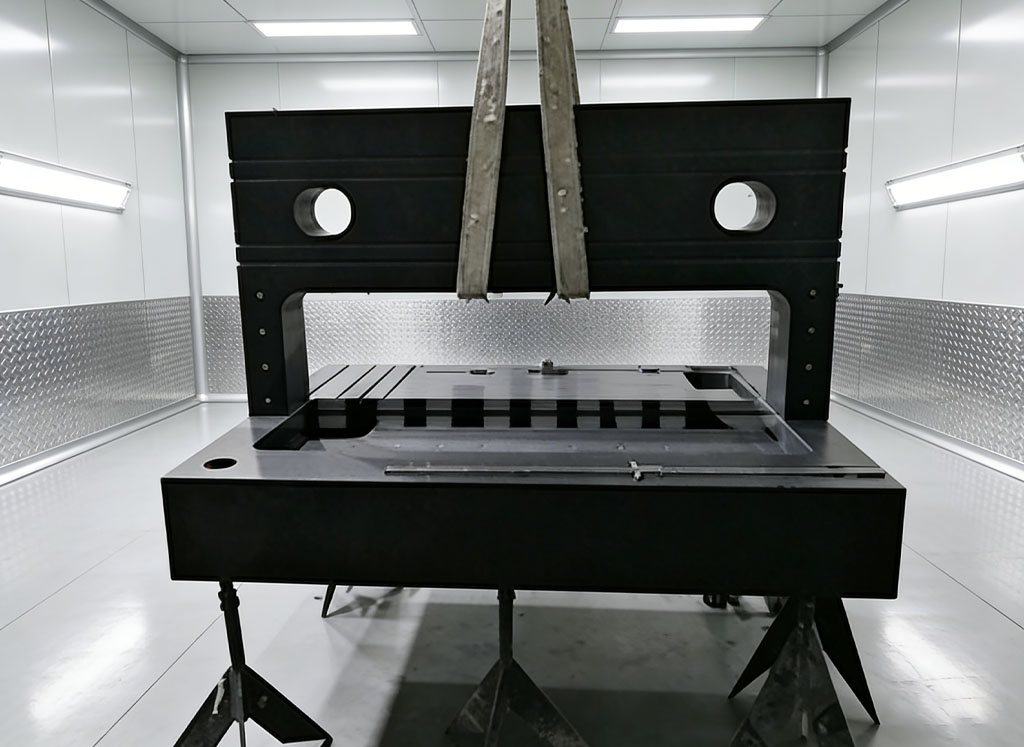
Custom granite structures offer significant advantages over standard, off-the-shelf components. By engineering granite components specifically for the CMM application, manufacturers can optimize performance characteristics that directly impact measurement accuracy.
Design Optimization Opportunities
Structural Geometry Optimization:
Custom granite structures can be designed with optimized geometries that enhance performance:
- Ribbed and honeycomb structures: Increased stiffness with reduced weight
- Strategic mass distribution: Optimized center of gravity and stability
- Integrated mounting surfaces: Machined features for component attachment
- Cable and air routing channels: Internal passages for service routing
- Custom hole patterns: Precision-drilled mounting and alignment features
Dimensional Specification:
Custom structures enable precise dimensional control:
- Flatness tolerances: Better than 1 µm achievable
- Parallelism specifications: Within 2-3 µm over 1,000mm
- Perpendicularity control: Within 3-5 µm
- Surface finish: Ra 0.1-0.4 µm achievable
Multi-Axis Integration:
Modern CMMs require integrated granite structures across multiple axes:
- Granite bases: Primary reference platform
- Granite bridges: Horizontal beam structures for bridge-type CMMs
- Granite columns: Vertical support structures
- Granite gantries: Portal frame configurations
- Granite Z-axis rams: Vertical measurement axis components
Material Selection for Custom Structures
Premium granite grades offer differentiated performance:
Standard Grade (G350):
- Suitable for general metrology applications
- Flatness: ±0.005mm/m²
- Cost-effective for standard CMM configurations
Ultra-Precision Grade (G650):
- Designed for high-accuracy applications
- Flatness: ±0.0015mm/m²
- Ideal for semiconductor and aerospace metrology
Premium Black Granite Properties:
- Density: >3,000 kg/m³
- Hardness: Mohs 6-7
- Water absorption: <0.1%
- Compressive strength: >200 MPa
Manufacturing Excellence: From Raw Material to Precision Component
The Granite Processing Journey
Creating precision granite structures for CMM applications requires sophisticated manufacturing processes:
Stage 1: Material Selection
- Quarry selection for premium black granite
- Material analysis for structural integrity
- Verification of mineral composition
- Assessment of homogeneity and freedom from defects
Stage 2: Stress Relieving
- Natural aging over extended periods
- Thermal cycling to release residual stresses
- Ensuring long-term dimensional stability
- Elimination of post-processing deformation
Stage 3: CNC Machining
- 5-axis milling for complex geometries
- Positional accuracy: ≤±0.01mm
- Capability for large-scale components (up to 20 meters)
- Integration of mounting features and service passages
Stage 4: Precision Grinding
- Diamond-wheel grinding for surface finishing
- Flatness achievement: <1 µm
- Surface roughness: Ra 0.1-0.4 µm
- Geometric accuracy verification
Stage 5: Manual Lapping
- Expert craftsman finishing for ultimate precision
- 30+ years experience requirements for master technicians
- Achieving nanometer-level flatness
- Quality verification at each stage
Stage 6: Quality Verification
- Laser interferometer measurement (Renishaw XL-80)
- Electronic level verification (Wyler systems)
- Surface profiling and analysis
- Certification traceable to national standards
Quality Standards and Certifications
Custom granite structures must meet stringent international standards:
- ISO 8512-2: Surface plate specifications
- ASME B89.3.7: Granite surface plate standard
- DIN 876: German precision standard
- JIS B7513: Japanese industrial standard
- GB/T 4987: Chinese national standard
Real-World Applications: Custom Granite in Action
Semiconductor Manufacturing
Semiconductor lithography demands the highest precision levels:
- Application: Wafer inspection and photolithography stages
- Requirements: Nanometer-level positioning accuracy
- Granite advantage: Vibration isolation enabling 0.12nm precision
- Thermal requirement: Stability within ±0.5°C
Aerospace Metrology
Aerospace components require large-scale precision measurement:
- Application: Turbine blade and structural component inspection
- Requirements: Large measurement volumes with micron accuracy
- Granite advantage: Thermal stability across large dimensions
- Custom designs: Bridge and gantry configurations for large parts
Automotive Manufacturing
Automotive quality control demands reliable, high-throughput measurement:
- Application: Powertrain and body component inspection
- Requirements: High accuracy with production-line integration
- Granite advantage: Durability and minimal maintenance
- Custom features: Integrated workholding and automation interfaces
Research and Calibration Laboratories
Metrology institutes and research facilities require ultimate precision:
- Application: Primary measurement standards and research
- Requirements: Highest achievable accuracy
- Granite advantage: Long-term stability and traceability
- Custom structures: Specialized configurations for unique applications
Environmental Considerations and Installation Best Practices
Optimal Operating Environment
While granite offers superior stability, optimal performance requires appropriate environmental conditions:
Temperature Control:
- Recommended: 20°C ±0.5°C for highest precision
- Acceptable: 20°C ±2°C for standard applications
- Avoid: Direct sunlight and HVAC discharge proximity
- Consider: Thermal gradients from equipment heat
Humidity Management:
- Recommended: 50-60% relative humidity
- Prevents condensation on measurement surfaces
- Reduces static electricity and dust attraction
- Protects associated electronic equipment
Vibration Isolation:
- Install on isolated foundations when possible
- Use anti-vibration mounting systems
- Separate from heavy machinery traffic
- Consider building structural characteristics
Installation Best Practices
Proper installation ensures granite structures achieve their designed performance:
Foundation Requirements:
- Level, stable foundation adequate for granite mass
- Isolation from building vibration sources
- Proper drainage and moisture control
- Structural capacity for granite weight (up to 100 tons for large structures)
Leveling and Alignment:
- Precision leveling supports for flatness maintenance
- Three-point support for smaller structures
- Distributed support for large bases
- Verification with electronic levels
Service Integration:
- Cable routing through designed channels
- Air supply connections for air bearings
- Integration with measurement systems
- Accessibility for maintenance
Total Cost of Ownership: Granite’s Long-Term Value
Initial Investment vs. Lifetime Value
While custom granite structures require higher initial investment than metal alternatives, the total cost of ownership analysis reveals compelling value:
Initial Cost Comparison:
- Granite: 30-50% higher than steel
- Ceramic: 40-60% higher than steel
- Aluminum: Lower initial cost but highest lifetime cost
Lifetime Cost Analysis (15-year horizon):
| Cost Category | Granite | Steel | Aluminum |
|---|---|---|---|
| Initial purchase | Higher | Baseline | Lower |
| Installation | Moderate | Moderate | Lower |
| Temperature control systems | Not required | Required | Essential |
| Vibration isolation systems | Minimal | Required | Essential |
| Maintenance (annual) | Very low | Moderate | Higher |
| Recalibration frequency | 1-2 years | 6-12 months | 3-6 months |
| Component replacement | Not expected | Possible | Likely |
| Scrap/rework from drift | Minimal | Higher | Highest |
Total 15-Year Cost:
- Granite: 12-20% lower than steel equivalents
- Granite: 25-35% lower than aluminum equivalents
Return on Investment Considerations
The investment in custom granite structures delivers ROI through multiple channels:
- Reduced calibration costs: Extended intervals reduce calibration expenses
- Minimized downtime: Stable performance reduces unexpected maintenance
- Lower scrap rates: Consistent accuracy reduces measurement-related defects
- Extended equipment life: Durable construction provides decades of service
- Operational flexibility: Thermal and vibration tolerance enables broader application
Selection Guidelines: Specifying Custom Granite Structures
Application Assessment
When specifying custom granite structures, consider:
Measurement Requirements:
- Required accuracy and tolerance specifications
- Measurement volume and component sizes
- Throughput requirements and automation integration
- Environmental conditions and constraints
Structural Requirements:
- Load capacity and distribution
- Geometric requirements and constraints
- Integration with other system components
- Service access and maintenance requirements
Environmental Factors:
- Temperature stability and variation
- Vibration environment and isolation
- Humidity and contamination concerns
- Space constraints and installation access
Supplier Qualification
Select suppliers with demonstrated capabilities:
- Minimum 10 years granite machining experience
- ISO 9001 certification and quality management systems
- On-site laser calibration capabilities
- Engineering support for custom designs
- Reference installations in similar applications
- Comprehensive documentation and traceability
Conclusion
Custom granite structures represent the state of the art in CMM structural design, offering unmatched thermal stability and vibration damping characteristics that directly translate into measurement accuracy. As manufacturing tolerances continue to tighten and quality requirements increase, the choice of structural material becomes a defining decision in CMM system performance.
The evidence is clear: granite’s thermal expansion coefficient of 4.5-9 µm/m·°C, damping ratio of 0.012-0.015, and natural stress-free state provide performance advantages that cannot be matched by steel, cast iron, or aluminum alternatives. When combined with custom engineering that optimizes geometry, mass distribution, and feature integration, granite structures deliver precision performance over decades of service.
For engineers designing high-end CMM systems and metrology professionals seeking measurement excellence, custom granite structures are not merely an option—they are the foundation upon which precision is built. The question is not whether to specify granite, but how to optimize the custom design for your specific application requirements.
In precision measurement, the foundation defines the accuracy. Granite defines the foundation.
Post time: Apr-17-2026