
In the globalized landscape of high-precision manufacturing, the demand for accurate and reliable measuring tools is universal. From aerospace and automotive to semiconductor and medical device industries, the integrity of products hinges on meticulous quality control, which in turn relies on the precision of metrology equipment. Among the most critical of these tools are those crafted from granite and advanced ceramics, materials celebrated for their exceptional stability and durability. For manufacturers and suppliers looking to export these sophisticated measuring instruments, understanding and adhering to stringent international quality standards is not merely a regulatory hurdle but a fundamental prerequisite for market access, customer trust, and competitive advantage.
The Imperative of International Standards in Precision Metrology
Precision measuring tools, such as surface plates, master squares, and specialized gauges made from granite and ceramic, serve as the bedrock of quality assurance. Their function as primary reference datums means that any deviation in their accuracy can propagate errors throughout the entire manufacturing process, leading to costly rework, product recalls, and reputational damage. Consequently, international standards bodies have established comprehensive guidelines to ensure the consistency, reliability, and interoperability of these tools across diverse geographical and industrial contexts.
These standards provide a common language for precision, enabling manufacturers to produce tools that meet globally recognized benchmarks and allowing buyers to procure equipment with confidence, knowing that a
“Grade 00” surface plate, for instance, will perform equivalently regardless of its origin. This harmonization is crucial for facilitating international trade and ensuring seamless integration into global supply chains.
Key International Standards for Granite Measuring Tools
For precision granite measuring tools, several international and regional standards dictate the requirements for material properties, manufacturing processes, and accuracy grades. The most prominent among these include ISO, DIN, and ASME.
ISO 8512: Global Harmonization for Surface Plates
The International Organization for Standardization (ISO) provides globally recognized guidelines that promote consistency and interoperability. For granite surface plates, ISO 8512 defines the specifications for requirements and testing. This standard outlines flatness tolerance grades, measurement uncertainty, inspection methods, and proper support systems and installation procedures. ISO 8512 typically classifies surface plates into grades such as Grade 0 (high precision), Grade 1 (inspection grade), and Grade 2 (workshop grade). Each grade specifies a maximum permissible deviation in flatness, usually as a function of the plate’s size. Compliance with ISO standards is often a prerequisite for international trade due to its widespread acceptance and emphasis on traceability and verification under controlled environmental conditions .
DIN 876: German Precision and Ultra-Precision Classification
Originating from Germany, DIN standards are highly respected, particularly in European and Asian industries. DIN 876 provides detailed guidelines for surface plates, covering flatness tolerances, material requirements, manufacturing processes, and inspection procedures. A key distinction of DIN 876 is its inclusion of a Grade 000 (ultra-precision) and Grade 00 (laboratory grade) classification, which represents an even higher level of precision than standard Grade 0 in many other systems. This makes DIN standards particularly relevant for the most demanding metrology applications. DIN standards are known for their strict tolerance definitions and are often preferred in high-end European manufacturing and metrology labs. Many manufacturers strive to comply with both ISO and DIN requirements to ensure broad market compatibility .
ASME B89.3.7: North American Benchmarks
In North American markets, the ASME B89.3.7 standard and the Federal Specification GGG-P-463c establish the primary compliance framework for granite surface plates. ASME B89.3.7 employs an alphabetic grading system, with Grade AA corresponding to laboratory-grade requirements (similar to DIN Grade 00), Grade A matching inspection-grade expectations (comparable to DIN Grade 0), and Grade B serving toolroom and workshop applications. While the specific tolerance calculations may differ from ISO or DIN, experienced manufacturers routinely produce products that satisfy multiple standards simultaneously, offering international buyers flexibility in specifying their requirements .
The Role of Ceramic Measuring Tools and Their Standards
While granite dominates the market for large reference surfaces, advanced ceramics are increasingly utilized for precision measuring tools that require exceptional hardness, wear resistance, and thermal stability, often in more compact forms or for specific applications. Ceramic materials like alumina, zirconia, and silicon carbide offer unique advantages that complement granite.
Advantages of Ceramic Measuring Tools
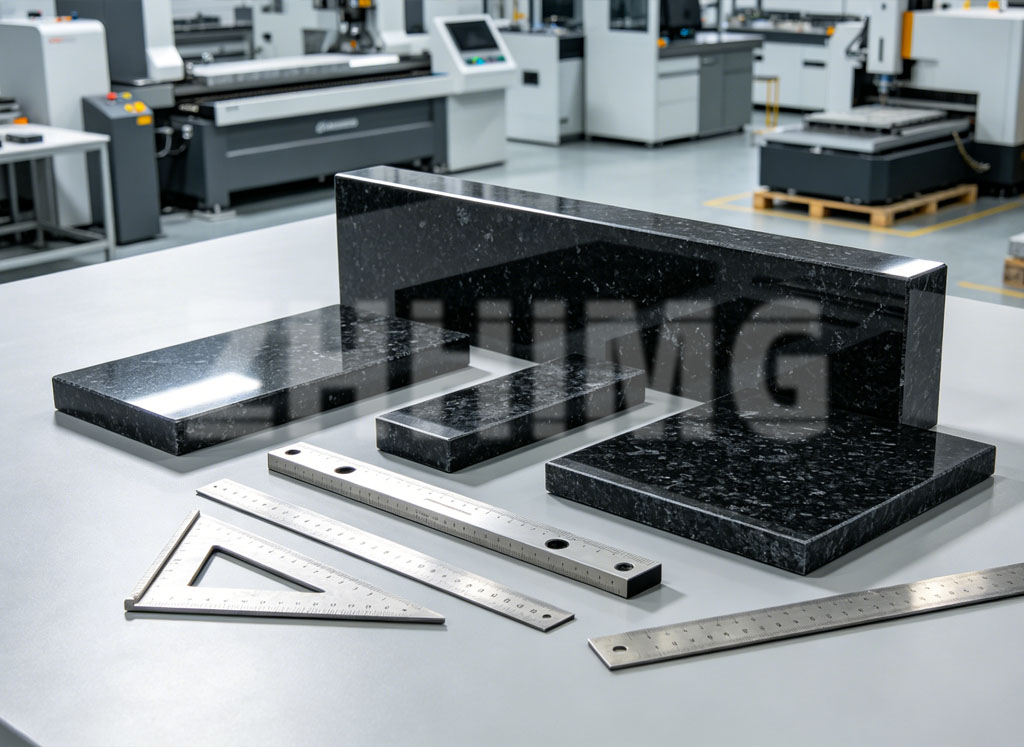
Ceramic measuring tools, such as gauge blocks, master squares, and specialized fixtures, offer several benefits:
•Extreme Hardness and Wear Resistance: Ceramics are significantly harder than granite and even hardened steel, providing superior resistance to wear and abrasion. This ensures an exceptionally long lifespan and maintains accuracy over prolonged use.
•Excellent Thermal Stability: Similar to granite, many technical ceramics exhibit very low coefficients of thermal expansion, making them highly stable across temperature variations. This is crucial for maintaining precision in fluctuating environments.
•Chemical Inertness: Ceramics are highly resistant to corrosion from acids, alkalis, and other chemicals, making them suitable for harsh industrial environments where metallic tools would degrade.
•Lightweight: Compared to granite, ceramic tools can be lighter for similar rigidity, which can be an advantage for portable or robotic metrology applications.
Quality Standards for Ceramic Measuring Tools
For ceramic measuring tools, standards often focus on material composition, dimensional tolerances, surface finish, and mechanical properties. While specific ISO or DIN standards might apply to certain ceramic products (e.g., gauge blocks), the overarching quality management systems, such as ISO 9001, are critical. ISO 9001 certification demonstrates a manufacturer’s commitment to consistent quality management processes, from material selection and production to final inspection and delivery. This is particularly important for high-performance ceramic components, where material purity and manufacturing consistency directly impact performance .
Manufacturing Excellence: The Foundation of Export Success
Meeting international quality standards for precision granite and ceramic measuring tools requires more than just adherence to specifications; it demands a robust manufacturing infrastructure, skilled craftsmanship, and rigorous quality control at every stage.
Material Selection and Processing
The journey begins with the meticulous selection of raw materials. For granite, this involves sourcing fine-grained, dense black granite with uniform crystallization and minimal internal flaws. For ceramics, it means selecting high-purity powders and employing advanced sintering processes to achieve optimal material properties. Subsequent processing, including CNC machining, lapping, and polishing, must be executed with extreme precision, often involving manual finishing by highly skilled technicians to achieve sub-micron tolerances .
Climate-Controlled Manufacturing Environments
Environmental control is paramount. Leading manufacturers operate in climate-controlled workshops where temperature and humidity are strictly regulated. This minimizes thermal expansion/contraction of materials during processing and ensures consistent measurement results. Some facilities even incorporate advanced vibration-dampening foundations to isolate precision operations from external disturbances .
Rigorous Inspection and Calibration
Every precision measuring tool must undergo comprehensive inspection and calibration. This involves using sophisticated metrology equipment such as electronic levels, autocollimators, and laser interferometers to verify flatness, straightness, squareness, and parallelism to the highest accuracy grades. A NIST-traceable calibration certificate, often accredited to ISO/IEC 17025, is essential for international acceptance, providing documented proof of the tool’s precision and compliance .
Navigating the Export Landscape: Beyond Technical Standards
Exporting precision measuring tools involves more than just meeting technical product standards. It also encompasses logistical, regulatory, and communication challenges.
Quality Management Systems (QMS)
For international buyers, a manufacturer’s adherence to a robust Quality Management System (QMS), typically certified to ISO 9001, provides critical assurance. An ISO 9001 certified QMS demonstrates consistent manufacturing processes, documented quality control procedures, traceability of materials and production, and a commitment to continuous improvement. This certification signals to global markets that the supplier operates under internationally recognized best practices .
Packaging and Logistics
Given the delicate nature of precision measuring tools, especially granite, specialized packaging is crucial to prevent damage during transit. This includes custom-fit crates, shock-absorbing materials, and environmental controls to protect against temperature extremes and humidity. Reliable international logistics partners with experience in handling high-value, fragile goods are indispensable to ensure safe and timely delivery to global destinations.
Regulatory Compliance and Documentation
Exporters must navigate a complex web of international trade regulations, customs requirements, and export control laws. This includes proper classification of goods, accurate customs declarations, and, in some cases, obtaining export licenses, particularly for dual-use technologies or sensitive applications. For instance, companies exporting to the U.S. defense sector might need to comply with ITAR (International Traffic in Arms Regulations) . Comprehensive documentation, including material certificates, calibration reports, and certificates of origin, is vital for smooth customs clearance and demonstrating compliance.
Communication and Customer Support
Effective communication is key to successful international trade. Manufacturers must have multilingual sales and technical support teams capable of addressing inquiries, providing technical assistance, and resolving issues across different time zones. Building strong relationships with international distributors and agents can also facilitate market penetration and provide localized support to end-users.
Conclusion
Exporting precision granite and ceramic measuring tools to a global market is a testament to a manufacturer’s commitment to excellence. It requires not only the mastery of advanced material science and manufacturing techniques but also a deep understanding and rigorous adherence to international quality standards such as ISO 8512, DIN 876, and ASME B89.3.7, alongside comprehensive quality management systems like ISO 9001. By consistently meeting these benchmarks, manufacturers can build trust, ensure product reliability, and unlock vast opportunities in the precision-driven industries worldwide. The ability to deliver tools that guarantee accuracy and consistency across borders is not just a business advantage; it is a fundamental contribution to the advancement of global manufacturing and technological innovation.
Post time: May-13-2026