
In the exacting world of manufacturing and quality control, precision is not merely a goal but an absolute necessity. The ability to accurately measure and verify dimensions is fundamental to ensuring product integrity, interchangeability, and adherence to stringent industry standards. While various materials have been employed in the construction of measuring instruments, granite has progressively emerged as the material of choice for high-precision tools such such as master squares, height gauge stands, and surface plates. Its inherent physical properties provide an unparalleled foundation for metrology, enabling manufacturers to achieve and maintain the tightest tolerances required by modern industrial applications.
The Foundational Advantages of Granite in Metrology
Granite’s widespread adoption in precision measuring tools is not coincidental; it stems from a unique combination of intrinsic properties that directly address the critical demands of accurate measurement. These properties collectively contribute to the superior performance and longevity of granite-based instruments.
Exceptional Dimensional Stability and Low Thermal Expansion
One of the most significant advantages of granite in metrology is its remarkable dimensional stability, particularly its very low coefficient of thermal expansion (CTE). Unlike metallic materials, which expand and contract noticeably with temperature fluctuations, granite exhibits minimal change in size. This characteristic is crucial in environments where ambient temperature cannot be perfectly controlled, as it ensures that the measuring tool itself remains dimensionally consistent. For instance, the CTE of granite is significantly lower than that of steel or cast iron, meaning that granite measuring tools maintain their accuracy over a wider range of thermal conditions. This inherent thermal stability is paramount for reliable measurements, as temperature-induced deformations in measuring equipment can introduce significant errors, compromising the integrity of quality control processes .
Superior Vibration Damping Capabilities
Precision measurements are highly susceptible to external vibrations, which can cause minute movements in the measuring instrument or the workpiece, leading to inaccurate readings. Granite possesses excellent natural vibration damping characteristics, far surpassing those of metals like cast iron. Its dense, crystalline structure effectively absorbs and dissipates mechanical vibrations, preventing them from interfering with the measurement process. This passive damping capability is invaluable in industrial settings where machinery operation can generate constant low-level vibrations. By minimizing the impact of these disturbances, granite measuring tools provide a more stable and reliable reference plane, contributing to higher measurement repeatability and accuracy .
Inherent Hardness, Wear Resistance, and Chemical Inertness
Granite is an exceptionally hard and wear-resistant material, typically possessing a Mohs hardness of 6 to 7. This characteristic allows granite measuring tools to withstand frequent use and repetitive contact with workpieces without significant wear or degradation of their precision surfaces. The durability of granite ensures that the accuracy of the tools is maintained over extended periods, reducing the need for frequent recalibration or replacement. Furthermore, granite is chemically inert, meaning it is resistant to corrosion, rust, and magnetization. Unlike cast iron, which requires regular oiling and maintenance to prevent rust, granite tools are virtually maintenance-free in this regard. This resistance to environmental factors makes granite an ideal material for use in diverse industrial environments, including those with high humidity or exposure to various coolants and lubricants . The absence of rust also eliminates the risk of transferring corrosive particles to delicate workpieces, further enhancing its suitability for quality control.
Key Granite Precision Measuring Tools in Quality Control
Granite’s advantageous properties have led to its application in a variety of essential precision measuring tools, each playing a critical role in ensuring the quality and accuracy of manufactured components.
Granite Master Squares
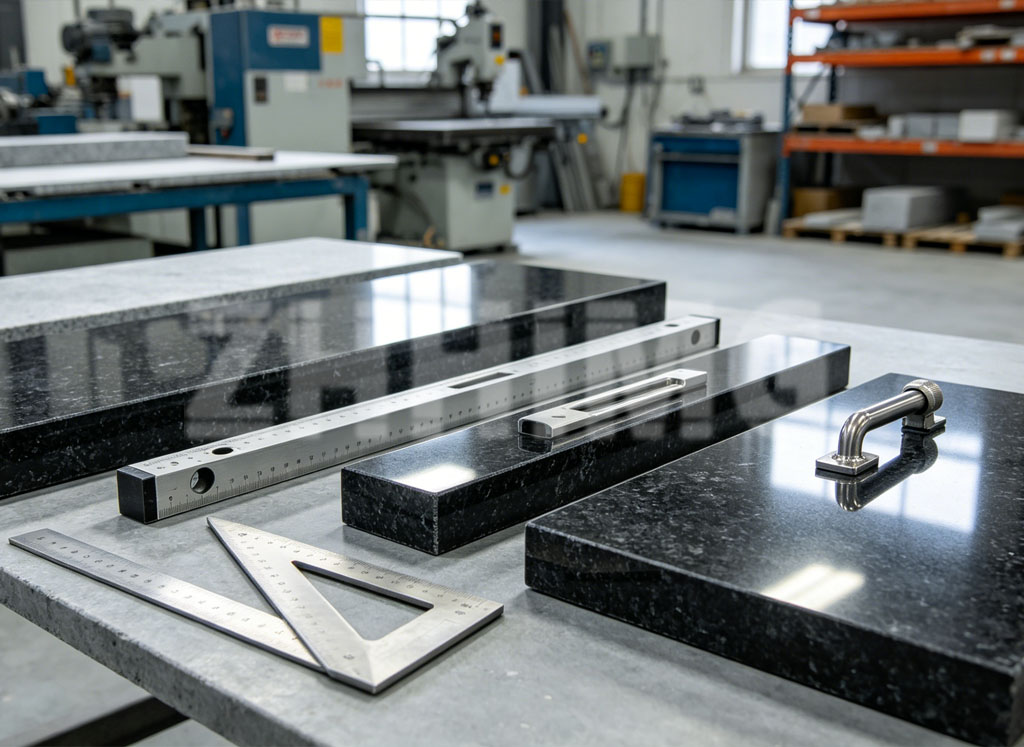
Granite master squares are fundamental reference tools used for accurately checking the squareness, parallelism, and straightness of machine tool axes (X, Y, and Z) and Coordinate Measuring Machines (CMMs). These tools are characterized by their exceptional stability and rigidity, providing an ultimate reference for squareness. Typically, master squares have five finished faces (one large face and four edges) that are precision-ground to be flat, square, and parallel. They are available in various grades, such as laboratory grade AA (e.g., 0.000025” per 6”) or inspection grade A (e.g., 0.000050” per 6”), depending on the required level of precision. The inherent stability of granite ensures that these squares maintain their geometric accuracy over time, making them indispensable for calibrating and verifying the alignment of critical machinery .
Granite Height Gauge Stands
While calipers are often handheld, height gauges require a stable and precise reference surface to ensure accurate vertical measurements. Granite height gauge stands provide this crucial stability. These stands are designed to be massive and rigid, minimizing any deflection or vibration that could affect the measurement. The flat, stable surface of a granite stand ensures that the height gauge operates from a true datum, allowing for precise determination of heights, depths, and steps. The thermal stability of granite also prevents the stand itself from expanding or contracting, which would otherwise introduce errors into the height measurements. This makes granite height gauge stands an essential component in quality control laboratories and on the shop floor for verifying the dimensions of components .
Granite Surface Plates
Although not explicitly mentioned in the title, granite surface plates are the foundational element upon which many precision measurements, including those with height gauges and squares, are performed. They serve as the primary reference plane for inspection and layout tasks. A granite surface plate is designed to be stiff, massive, and extremely flat, providing a stable, level surface that does not distort under load. The hardness of granite limits wear, ensuring that the plate maintains its flatness over many years of use. The accuracy of a surface plate is critical, and they are typically manufactured to exceed federal specifications like ASME B89.3.7, with flatness and repeat readings being paramount. Regular calibration of these plates is essential to maintain their precision, ensuring that all measurements taken upon them are accurate and reliable .
The Manufacturing Process: Crafting Precision from Nature
The creation of granite precision measuring tools involves a sophisticated manufacturing process that transforms raw granite into instruments of exceptional accuracy. This process is similar to that for granite machine components but with an even greater emphasis on surface finish and geometric accuracy.
1.Material Selection: Only the highest quality, fine-grained black granite, often sourced from specific quarries known for their superior material properties, is selected. This ensures minimal porosity and consistent density.
2.Rough Cutting and Stress Relieving: Large blocks are cut into approximate sizes, followed by a prolonged natural aging process and thermal cycling. This stress-relieving step is vital to prevent future dimensional changes in the finished product.
3.Precision Machining: Advanced CNC machines are used to shape the granite, creating the basic form of the measuring tool. This stage focuses on achieving close-to-final dimensions and geometries.
4.Lapping and Polishing: This is the most critical stage for achieving the required precision. Skilled technicians use specialized lapping machines and abrasive compounds to meticulously grind and polish the granite surfaces to achieve ultra-flatness and a fine surface finish. This iterative process involves continuous measurement and refinement until the desired flatness and squareness tolerances are met.
5.Calibration and Certification: Each finished tool undergoes rigorous calibration using highly accurate instruments like autocollimators, electronic levels, and interferometers. A NIST-traceable calibration certificate, often accredited to ISO/IEC 17025 standards, is provided, verifying the tool’s precision and compliance with international standards .
Impact on Quality Control and Industry Standards
Granite precision measuring tools have a profound impact on quality control across various industries, from aerospace and automotive to semiconductor manufacturing. Their use leads to several key benefits:
•Improved First-Pass Yield: By providing highly accurate and stable measurement references, granite tools enable tighter process control. This reduces manufacturing errors and rework, leading to improved first-pass yield and reduced production costs .
•Enhanced Product Reliability: Accurate measurements ensure that components meet design specifications, which directly translates to higher product reliability and performance in end-use applications.
•Compliance with Standards: The precision offered by granite tools facilitates compliance with stringent international quality standards, which is crucial for global trade and customer confidence.
•Reduced Maintenance and Long-Term Economy: The durability and chemical inertness of granite tools result in minimal maintenance requirements, eliminating costs associated with rust prevention and frequent recalibration. This contributes to superior long-term economics compared to metallic alternatives .
Conclusion
Granite precision measuring tools, including master squares, height gauge stands, and surface plates, represent the pinnacle of metrological accuracy and reliability. Their inherent properties—exceptional dimensional stability, superior vibration damping, and resistance to wear and corrosion—make them indispensable assets in modern quality control. As industries continue to demand ever-increasing levels of precision, the role of granite in providing the foundational accuracy for measurement and inspection will only grow. These tools are not just instruments; they are the silent guardians of quality, ensuring that every component, from the smallest microchip to the largest aerospace part, meets the uncompromising standards of a precision-driven world.
Post time: May-13-2026