
In the pristine silence of a Class 1 cleanroom, where semiconductor wafers are etched with nanometer precision or where life-saving medical devices are assembled, the environment is controlled down to the smallest particle. In these high-stakes settings, the machinery must be flawless. At the heart of this machinery—beneath the robotic arms, linear motors, and laser sensors—lies a component that is often overlooked but absolutely critical: the precision granite base.
While it may look like a simple block of stone, a high-grade granite component is a marvel of engineering. Its journey from a raw geological formation to a polished, micron-accurate structural element is a testament to the fusion of natural durability and advanced manufacturing. This article takes you behind the scenes of precision granite manufacturing, tracing the rigorous path from the quarry to the final application, and revealing why this material remains the gold standard for stability in the modern world.
Step 1: The Origin – Geological Selection and Sourcing
The journey begins millions of years ago, deep within the Earth’s crust. Not all stone is created equal. For industrial applications, we do not simply dig up “rocks”; we source specific geological formations that meet strict mineralogical criteria.
The Material Science of Stone
The ideal granite for precision applications must possess specific characteristics:
The ideal granite for precision applications must possess specific characteristics:
- Fine Grain Structure: Large crystals can lead to surface pitting during polishing and inconsistent wear. We look for igneous rock with a uniform, fine grain.
- Low Porosity: To prevent moisture absorption, which can cause swelling or warping, the stone must be dense. High-quality granite typically has an absorption rate of less than 0.1%.
- Quartz Content: A high quartz content (often found in “Black Galaxy” or “G654″ granite) provides exceptional hardness and abrasion resistance.
Quarrying with Care
Once a deposit is identified—often in regions known for their specific “Black” or “Grey” granites—the extraction process begins. Unlike construction aggregate, precision stone cannot be blasted with high-impact explosives, as the shockwaves would create micro-fractures (internal stress) that would ruin the material’s stability.
Once a deposit is identified—often in regions known for their specific “Black” or “Grey” granites—the extraction process begins. Unlike construction aggregate, precision stone cannot be blasted with high-impact explosives, as the shockwaves would create micro-fractures (internal stress) that would ruin the material’s stability.
Instead, we utilize diamond wire saws or controlled channel drilling. This “soft extraction” method ensures the raw blocks, or “荒料” (huāng liào), remain internally stress-free. These massive blocks, often weighing several tons, are then transported to the processing facility, marking the beginning of their transformation.
Step 2: The Transformation – The 7 Stages of Machining
Once the raw blocks arrive at the factory, the real engineering begins. Transforming a rough block of stone into a precision granite component requires a blend of heavy industrial power and delicate, artisanal craftsmanship.
Here are the 7 critical steps in our manufacturing process:
1. Rough Cutting (Sawing)
The massive blocks are too large to be processed as a whole. Using large-diameter diamond circular saws or multi-blade gang saws, we cut the block into smaller, manageable slabs or “blanks” that approximate the final dimensions.
The massive blocks are too large to be processed as a whole. Using large-diameter diamond circular saws or multi-blade gang saws, we cut the block into smaller, manageable slabs or “blanks” that approximate the final dimensions.
- Precision Note: At this stage, we leave “excess stock” (usually a few millimeters) on all sides to allow for material removal during the subsequent grinding phases.
2. Stress Relief (Aging)
This is a step often skipped by lower-quality manufacturers but is vital for high-end applications. Although granite is naturally stable, the cutting process introduces surface stress. The blanks are allowed to “rest” or are subjected to vibration aging techniques. This ensures that any internal tension is released before fine machining begins, guaranteeing the component will not warp years down the line.
This is a step often skipped by lower-quality manufacturers but is vital for high-end applications. Although granite is naturally stable, the cutting process introduces surface stress. The blanks are allowed to “rest” or are subjected to vibration aging techniques. This ensures that any internal tension is released before fine machining begins, guaranteeing the component will not warp years down the line.
3. Precision Grinding (Milling)
This is where the stone becomes a machine part. Using CNC (Computer Numerical Control) milling machines equipped with diamond grinding wheels, we machine the granite to near-net shape.
This is where the stone becomes a machine part. Using CNC (Computer Numerical Control) milling machines equipped with diamond grinding wheels, we machine the granite to near-net shape.
- The Process: We machine specific features such as mounting holes, threaded inserts (using specialized epoxy or mechanical locking), and T-slots.
- Tolerance: We control dimensions to within ±0.05mm at this stage.
4. Lapping (Coarse Grinding)
To achieve a flat surface, the component undergoes lapping. This involves rubbing the stone surface against a large, flat reference plate (often made of cast iron) using an abrasive slurry (usually silicon carbide or diamond grit).
To achieve a flat surface, the component undergoes lapping. This involves rubbing the stone surface against a large, flat reference plate (often made of cast iron) using an abrasive slurry (usually silicon carbide or diamond grit).
- Goal: This removes the cutter marks left by the CNC machine and begins the process of flattening the surface to within microns.
5. Fine Grinding and Polishing
For components used in cleanrooms, surface finish is critical. A rough surface can harbor bacteria or shed particles. We progress through finer and finer grits—moving from 400 grit up to 3000 grit.
For components used in cleanrooms, surface finish is critical. A rough surface can harbor bacteria or shed particles. We progress through finer and finer grits—moving from 400 grit up to 3000 grit.
- The Result: The surface transforms from a dull grey to a high-gloss black. The surface roughness (Ra) can reach as low as 0.2μm, creating a mirror-like finish that is easy to clean and chemically resistant.
6. Inspection and Calibration
Before leaving the factory floor, every component must pass rigorous metrology. We use electronic level meters, laser interferometers, and Coordinate Measuring Machines (CMM) to verify:
Before leaving the factory floor, every component must pass rigorous metrology. We use electronic level meters, laser interferometers, and Coordinate Measuring Machines (CMM) to verify:
- Flatness: Ensuring the surface is planar (e.g., within 5 microns per meter).
- Parallelism: Ensuring the top and bottom surfaces are perfectly parallel.
- Perpendicularity: Ensuring side edges are at exact 90-degree angles.
7. Cleaning and Packaging
The final step is preparation for the journey to the customer. The component is ultrasonically cleaned to remove all grinding dust and oils. It is then wrapped in anti-static, dust-free protective film and packed in reinforced wooden crates with shock-absorbing foam. This ensures the “clean” surface remains pristine until it is installed in the cleanroom.
The final step is preparation for the journey to the customer. The component is ultrasonically cleaned to remove all grinding dust and oils. It is then wrapped in anti-static, dust-free protective film and packed in reinforced wooden crates with shock-absorbing foam. This ensures the “clean” surface remains pristine until it is installed in the cleanroom.
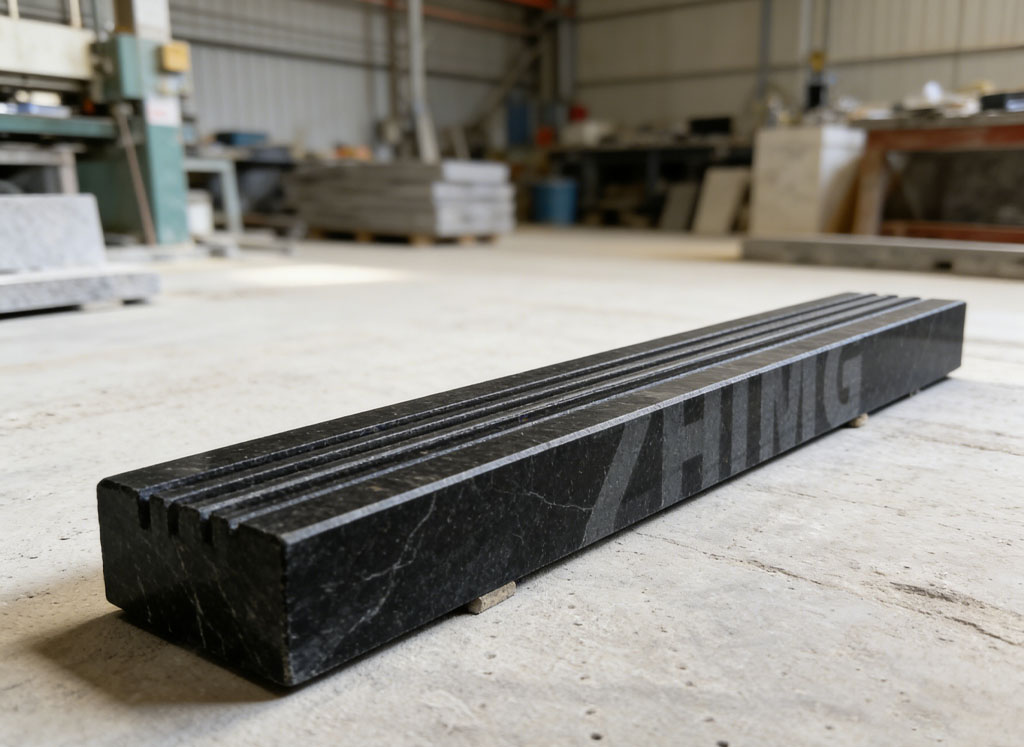
Step 3: The Standard – Quality Control and Testing
In precision granite manufacturing, “close enough” is a failure. We adhere to international standards (such as DIN 876 or ASTM C615) to ensure every part performs as expected.
Key Quality Metrics
| Parameter | Standard Requirement | High-Precision Standard |
|---|---|---|
| Flatness | 10μm / 1000mm | 2-5μm / 1000mm |
| Surface Roughness | Ra 1.6μm | Ra 0.2μm (Mirror) |
| Density | 2.6 – 2.8 g/cm³ | > 2.9 g/cm³ (Black Granite) |
| Hardness | Mohs 6.0 | Mohs 7.0 |
| Thermal Expansion | 6.0 × 10⁻⁶/°C | 5.4 × 10⁻⁶/°C |
The “Zero-Stress” Guarantee
One of our most critical quality checks is for internal defects. We utilize ultrasonic testing to detect hidden fissures or voids within the stone. A single micro-crack could lead to catastrophic failure under the high loads of a linear motor. Only stone that passes this “sonic” test is approved for cleanroom equipment.
One of our most critical quality checks is for internal defects. We utilize ultrasonic testing to detect hidden fissures or voids within the stone. A single micro-crack could lead to catastrophic failure under the high loads of a linear motor. Only stone that passes this “sonic” test is approved for cleanroom equipment.
Step 4: The Destination – Applications in the Cleanroom
Why go through such an arduous process? Why not use steel or aluminum? The answer lies in the application.
The Semiconductor Industry
In wafer lithography, the machine must align layers of circuitry with nanometer precision. If the base expands due to heat from the motors, the alignment is lost. Granite’s low thermal expansion coefficient ensures the machine stays aligned, regardless of temperature fluctuations.
In wafer lithography, the machine must align layers of circuitry with nanometer precision. If the base expands due to heat from the motors, the alignment is lost. Granite’s low thermal expansion coefficient ensures the machine stays aligned, regardless of temperature fluctuations.
Medical and Biotechnology
In MRI machines or CT scanners, magnetic interference is a major issue. Steel is magnetic; granite is not. Using a granite component as the patient table or equipment base ensures the magnetic field remains undistorted, leading to clearer images and accurate diagnoses.
In MRI machines or CT scanners, magnetic interference is a major issue. Steel is magnetic; granite is not. Using a granite component as the patient table or equipment base ensures the magnetic field remains undistorted, leading to clearer images and accurate diagnoses.
Aerospace and Metrology
Coordinate Measuring Machines (CMM) use granite guides to measure other parts. Because granite is non-corrosive and does not rust, it maintains its accuracy for decades without the maintenance required by metal guides.
Coordinate Measuring Machines (CMM) use granite guides to measure other parts. Because granite is non-corrosive and does not rust, it maintains its accuracy for decades without the maintenance required by metal guides.
Conclusion: Stability You Can Build On
The journey from a raw quarry block to a polished component in a high-tech cleanroom is long and demanding. It requires a deep respect for the material and a mastery of precision engineering.
For 20 years, we have refined this process, bridging the gap between natural geology and industrial necessity. When you choose our precision granite components
Post time: Apr-20-2026