
In the world of high-precision manufacturing, from semiconductor fabrication to aerospace component machining, the difference between success and failure is often measured in microns. While much attention is paid to the sophistication of the machine tool itself—the spindle, the controller, the servo motors—the foundation upon which these machines rest is frequently overlooked. Yet, it is the base that dictates the ultimate stability of the system.
For decades, steel and cast iron have been the traditional standards for machine bases. However, as tolerance requirements tighten and environmental variables become harder to control, the industry is witnessing a decisive shift toward natural granite. This article explores the physics behind this transition, analyzing why granite machine bases are becoming the non-negotiable choice for a true precision equipment foundation.
The Physics of Stability: Thermal Expansion Coefficients
The primary enemy of high-precision equipment is thermal instability. Every material expands when heated and contracts when cooled. In a machine base, even microscopic changes in dimension can lead to significant geometric errors at the point of operation.
The Steel Challenge
Steel is a robust material with high tensile strength, but it suffers from a relatively high coefficient of thermal expansion (approximately 11.5 to 12.0 × 10⁻⁶/°C). In a typical workshop environment where temperatures can fluctuate by several degrees throughout the day due to sunlight, HVAC cycles, or nearby machinery, a steel base will physically change shape. This phenomenon, known as “thermal drift,” forces the machine to constantly compensate, often leading to scrapped parts or the need for lengthy warm-up cycles.
Steel is a robust material with high tensile strength, but it suffers from a relatively high coefficient of thermal expansion (approximately 11.5 to 12.0 × 10⁻⁶/°C). In a typical workshop environment where temperatures can fluctuate by several degrees throughout the day due to sunlight, HVAC cycles, or nearby machinery, a steel base will physically change shape. This phenomenon, known as “thermal drift,” forces the machine to constantly compensate, often leading to scrapped parts or the need for lengthy warm-up cycles.
The Granite Advantage
Natural granite, specifically high-quality black granite used in metrology, offers a thermal expansion coefficient that is roughly half that of steel (approximately 5.4 to 6.0 × 10⁻⁶/°C).
Natural granite, specifically high-quality black granite used in metrology, offers a thermal expansion coefficient that is roughly half that of steel (approximately 5.4 to 6.0 × 10⁻⁶/°C).
To visualize the impact:
- Scenario: A 1-meter base experiences a temperature rise of 5°C.
- Steel Expansion: The material expands by approximately 60 microns.
- Granite Expansion: The material expands by approximately 27 microns.
In the context of a precision equipment foundation, this difference is monumental. Granite’s low thermal conductivity also means it reacts slowly to temperature changes, smoothing out rapid fluctuations that would otherwise shock a metal base. This inherent stability ensures that the machine geometry remains constant, regardless of minor environmental variances.
The Silent Killer: Vibration Damping and Dynamic Stability
Vibration is the second major factor degrading precision. Whether it is the rhythmic thumping of a forklift outside, the hum of a compressor, or the internal forces generated by the machine’s own motors, vibration creates “noise” in the measurement or machining process.
Rigidity vs. Damping
Steel is incredibly rigid. It resists bending under load, which is a positive trait. However, rigidity does not equal damping. Steel acts as an excellent conductor of vibration; if the floor shakes, the steel base shakes. It tends to ring or resonate, amplifying specific frequencies rather than absorbing them.
Steel is incredibly rigid. It resists bending under load, which is a positive trait. However, rigidity does not equal damping. Steel acts as an excellent conductor of vibration; if the floor shakes, the steel base shakes. It tends to ring or resonate, amplifying specific frequencies rather than absorbing them.
Granite, conversely, possesses a unique internal crystalline structure that gives it superior damping capabilities.
Vibration Damping Test Data
To understand the magnitude of this difference, we look at comparative damping tests often conducted in materials science laboratories. When a material is subjected to an impulse (a strike), the time it takes for the vibration to decay is the measure of its damping capacity.
To understand the magnitude of this difference, we look at comparative damping tests often conducted in materials science laboratories. When a material is subjected to an impulse (a strike), the time it takes for the vibration to decay is the measure of its damping capacity.
- Test Setup: A standardized impulse hammer strikes a beam of Steel vs. a beam of Granite of equivalent stiffness.
- Measurement: Accelerometers measure the decay of the vibration amplitude.
Results:
- Steel/ Cast Iron: The vibration amplitude decays slowly. In many cases, cast iron (often used to improve upon steel) has a damping capacity roughly 1/10th that of granite.
- Granite: The vibration energy is absorbed almost instantly by the internal friction of the crystal structure.
Data indicates that granite has a damping coefficient roughly 10 times greater than cast iron and significantly higher than steel. In practical terms, this means a granite machine base acts as a massive shock absorber. It isolates the precision components from the chaotic environment of the factory floor, ensuring that the cutting tool or measuring probe interacts with the workpiece in a state of near-perfect stillness.
Material Characteristics: A Comparative Analysis
Beyond thermal and vibrational properties, the physical nature of the materials dictates their longevity and maintenance requirements.
| Feature | Steel / Welded Steel | Natural Granite |
|---|---|---|
| Corrosion | Prone to rust; requires painting or coating. | Inert; immune to rust and coolants. |
| Magnetism | Magnetic (can interfere with sensors). | Non-magnetic (ideal for electronics). |
| Surface | Can deform/warp over time (stress relief). | Stays flat; no internal stress. |
| Repair | Can be re-welded/machined. | Can be re-lapped/polished. |
| Weight | Heavy. | Very Heavy (High mass stability). |
The “Stress-Free” Nature of Stone
Steel bases are typically fabricated by welding plates together. This process introduces significant internal residual stresses. Over years of use, these stresses relieve themselves, causing the base to warp or twist slightly. Granite is a natural material formed over millions of years; it is effectively stress-free. Once machined, it will not warp due to internal forces, guaranteeing geometric accuracy for decades.
Steel bases are typically fabricated by welding plates together. This process introduces significant internal residual stresses. Over years of use, these stresses relieve themselves, causing the base to warp or twist slightly. Granite is a natural material formed over millions of years; it is effectively stress-free. Once machined, it will not warp due to internal forces, guaranteeing geometric accuracy for decades.
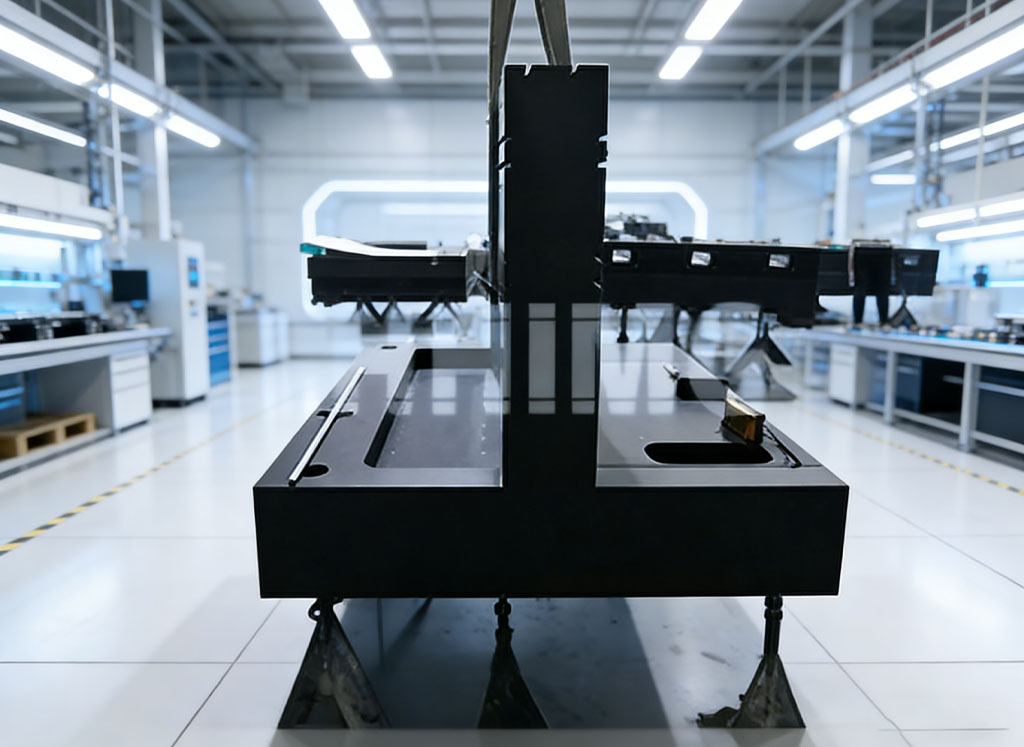
20-Year Application Case Study: The Metrology Lab Upgrade
To illustrate the real-world impact of switching from steel to granite, we examine a longitudinal case study of a Tier-1 automotive metrology laboratory.
The Challenge (Year 0)
A quality control center was experiencing inconsistent data from their Coordinate Measuring Machines (CMMs). The lab was housed in a facility that was not perfectly climate-controlled (fluctuating between 18°C and 24°C daily). The CMMs were mounted on massive, fabricated steel bases.
A quality control center was experiencing inconsistent data from their Coordinate Measuring Machines (CMMs). The lab was housed in a facility that was not perfectly climate-controlled (fluctuating between 18°C and 24°C daily). The CMMs were mounted on massive, fabricated steel bases.
- Symptoms: Measurement repeatability errors of ±5 microns.
- Downtime: Machines required 2-hour warm-up periods every morning.
- Maintenance: The steel bases required annual repainting due to coolant spills and humidity-induced corrosion.
The Intervention
The facility decided to retrofit their most critical CMMs with granite machine bases sourced from high-density quarries (specifically “Black Galaxy” or similar fine-grain granites).
The facility decided to retrofit their most critical CMMs with granite machine bases sourced from high-density quarries (specifically “Black Galaxy” or similar fine-grain granites).
The Results (Year 1 to Year 20)
-
Immediate Stability (Year 1):
The thermal mass and low expansion coefficient of the granite immediately reduced thermal drift. The warm-up time was reduced from 2 hours to 15 minutes. Repeatability improved to ±1.5 microns without software compensation. -
Vibration Isolation (Year 5):
A new stamping press was installed in the adjacent bay. Machines on steel bases began showing vibration artifacts in their data. The machines on granite bases showed zero degradation in performance. The granite absorbed the ground-borne vibrations that the steel bases transmitted. -
Longevity and TCO (Year 10-20):
Two decades later, the steel bases showed signs of wear at the mounting points and slight surface degradation. The granite bases, however, were inspected and found to be within their original calibration tolerances. Because granite does not rust or corrode, the surface remained pristine despite exposure to cleaning agents.
Conclusion of Case Study:
Over a 20-year lifecycle, the Total Cost of Ownership (TCO) for the granite solution was lower. While the initial capital expenditure for granite is higher due to the difficulty of machining stone, the savings in reduced scrap rates, lower energy consumption (less need for aggressive HVAC), and zero maintenance (no repainting) provided a clear ROI.
Over a 20-year lifecycle, the Total Cost of Ownership (TCO) for the granite solution was lower. While the initial capital expenditure for granite is higher due to the difficulty of machining stone, the savings in reduced scrap rates, lower energy consumption (less need for aggressive HVAC), and zero maintenance (no repainting) provided a clear ROI.
Why Granite is the Future of Precision
The choice of a machine base is not merely a structural decision; it is a performance decision. As we push the boundaries of what is possible in manufacturing—moving toward nanometer-level tolerances—the limitations of steel become apparent.
Key Takeaways for Equipment Manufacturers:
- Thermal Invariance: Granite’s low expansion coefficient ensures your machine is accurate at 9 AM and at 4 PM, regardless of the sun’s position.
- Vibration Damping: The superior damping ratio of stone creates a “quiet” environment for your sensors and spindles.
- Permanence: Granite does not age, warp, or rust. It is a permanent reference plane.
Conclusion
In the equation of high-precision engineering, the variable of stability must be constant. Steel, while versatile, introduces variables through thermal expansion and vibration transmission. Granite eliminates them. For manufacturers looking to build the ultimate precision equipment foundation
Post time: Apr-20-2026