
Air bearings let a stage move with no contact, no friction and no wear. The air film is only a few micrometers thick, so the surface it rides on decides how accurate and smooth the motion is. For this reason, precision granite is the standard guide material for air bearing stages in semiconductor, metrology, laser and optical inspection equipment.
How an Air Bearing Works
An air bearing floats a pad or carriage on a thin film of pressurized air. Because nothing touches, there is no stick-slip, no particle generation from sliding wear and no lubricant. The film is only as uniform as the gap that contains it, so the mating guide surface must be extremely flat and smooth. Typical air gaps are around 5–10 µm, according to one air bearing manufacturer’s installation instructions.
Why Granite Is the Preferred Material
Dimensional stability. Granite has a thermal expansion coefficient of roughly 6 × 10⁻⁶/K, about half that of steel (about 12 × 10⁻⁶/K), and it conducts heat slowly. Heat from motors and electronics therefore changes the gap geometry less than it would on a steel guide.
Vibration damping. Granite damps vibration more effectively than metals. This helps keep floor vibration and motor-induced vibration out of the air film and the motion.
Lappable to high flatness. Fine-grained black granite can be lapped to micron-level flatness over large areas, and the result can be verified with electronic levels, autocollimators or laser interferometers.
No rust, no residual stress. Granite does not corrode, and as a natural material it is free of the internal stress that welded or cast metal structures can hold.
Non-magnetic. This suits optical, semiconductor and measuring equipment.
| Property | Black granite | Steel / cast iron | Aluminum |
|---|---|---|---|
| Thermal expansion (approx., ×10⁻⁶/K) | about 6 | about 11–12 | about 23 |
| Vibration damping | High | Lower | Low |
| Corrosion | None | Needs coating | Needs treatment |
| Achievable flatness | Very high by lapping | High, but long rails are harder | Lower |
| Cost for large size | Moderate | Moderate | Moderate |
Values are typical figures for comparison. Exact values depend on the material and grade.
What the Guide Surface Must Deliver
Requirements follow from the bearing type, the air gap and the accuracy target of the stage, so there is no single universal number. Use these rules of thumb from air bearing manufacturers:
- • Local flatness under the bearing should be small compared with the air gap. Specialty Components recommends less than one-third of the minimum air gap. New Way recommends staying below 50% of the designed gap.
- • Surface finish of about 16 µin Ra (about 0.4 µm) or better is a common recommendation.
- • Overall flatness and straightness over the full travel set the stage’s accuracy. Typical precision stages target a few micrometers or better.
- • Parallelism and perpendicularity between guide zones matter for multi-axis stages.
Always follow your bearing supplier’s data sheet. Granite is a porous-surface material compared with ceramic or glass, so check that your bearing type suits it. Flat pad bearings are commonly used on granite.
Typical Applications
- • Semiconductor inspection and wafer handling stages
- • Femtosecond and picosecond laser processing machines
- • CMM and optical measuring machines
- • AOI and industrial CT equipment
- • XY tables and linear motor stages
- • Linear guide and lead screw measuring equipment
How to Specify a Granite Air Bearing Guide
Include these items in your RFQ or drawing:
- 1.Drawing in DWG, STEP or PDF format
- 2.Guide zones with flatness, straightness, parallelism and Ra values for each zone
- 3.Support conditions for measurement, such as support points
- 4.Bearing type and air gap, so the supplier can check suitability
- 5.Inserts, holes, slots and mounting interfaces
- 6.Operating temperature and environment
- 7.Inspection report and calibration traceability requirements
Clear zone-by-zone requirements reduce cost. Tightening every surface to the same level adds time and expense without improving the stage.
Why Work With ZHHIMG®
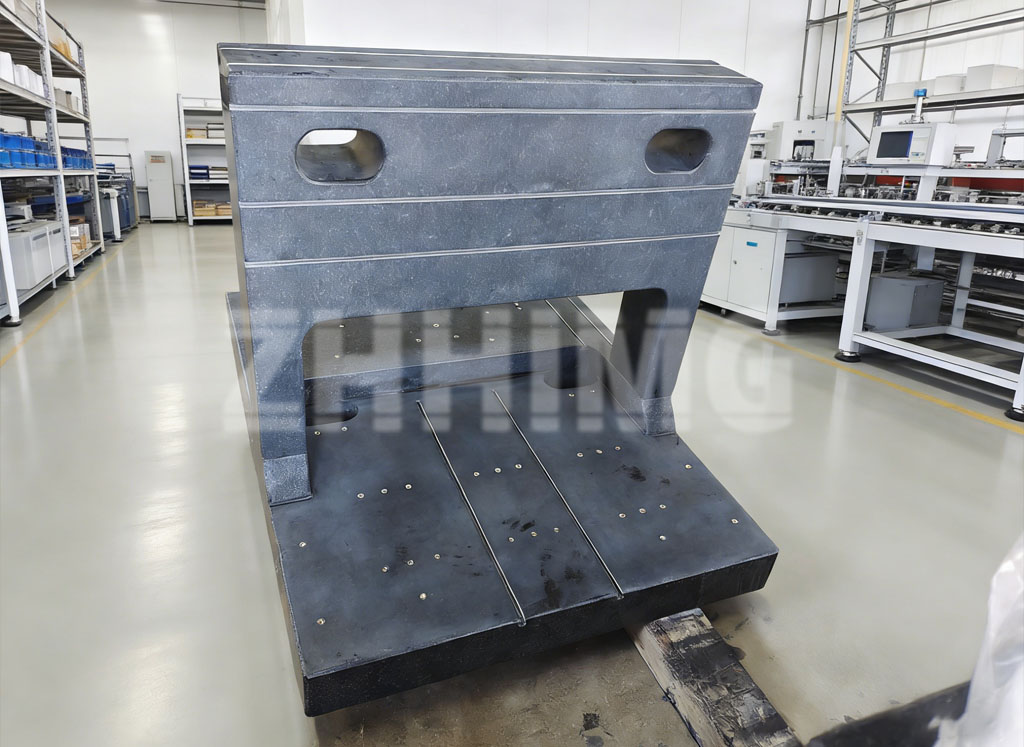
ZHHIMG® makes precision granite components, assemblies and air bearing structures from high-density black granite (approx. 3,100 kg/m³). Our lapping craftsmen finish surfaces by hand, and we inspect them with calibrated instruments such as WYLER electronic levels and Renishaw laser interferometers, in a temperature- and humidity-controlled measurement room. We can also assemble granite parts in a clean environment.
Read more on our site: [Granite Air Bearing: Principles, Applications, and Why Material Matters] and [Precision Granite Air Bearings: Design, Manufacturing and Inspection].
FAQ
Can any granite be used for air bearings?
No. Use dense, fine-grained granite with low porosity, and ask for material data.
What flatness do I need?
It depends on the bearing’s air gap and the accuracy of your stage. Ask your bearing supplier for the guide surface requirements.
Is granite better than ceramic?
Ceramic offers higher stiffness and lower thermal expansion, but it costs much more at large sizes. Granite is the cost-effective choice for large stages.
Can you make a granite guide with air bearing pads installed?
Send us your drawing and requirements, and our engineers will review the design.
Request a Quote
Send your drawing, tolerances and application, and we will review the design and quote a granite air bearing guide.
Post time: Nov-25-2026