
Granite is one of the best materials for air-bearing guideways and stages because it can be lapped extremely flat, it is stable over time and temperature, and it damps vibration while the air film keeps moving parts from touching it. This guide explains how a granite air-bearing system works and what to decide when you design or buy one.
How an Air Bearing Works
An air bearing floats a moving part on a thin film of pressurized air, so the part never touches the guide surface. Clean, dry compressed air is fed through a porous pad or a pattern of tiny orifices into the gap between the bearing and the guide. The air film carries the load and keeps the two surfaces apart, typically by only a few micrometres to a few tens of micrometres.
Because there is no contact, an air bearing has:
- No friction or stick-slip, so motion is smooth down to very small steps.
- No wear, so the guide keeps its accuracy for years.
- No lubricant, which suits cleanrooms and vacuum-adjacent equipment.
- Averaging of surface errors, because a pad spreads its load over a patch of surface and smooths out small local bumps.
The flip side is that the air film is thin. The bearing can only be as straight and as smooth as the surface it rides on, so the guide surface and the pad have to be made with great care. That is where the choice of guide material becomes critical.
Why Granite Suits Air-Bearing Guideways
Flatness and straightness. Granite can be ground and then hand-lapped to very flat, straight surfaces. Since an air bearing copies the shape of its guide, a flat granite rail or table gives straight, repeatable motion without needing correction in software.
Smooth, hard finish. A lapped granite surface is hard and fine-grained, which gives the pad a consistent gap. The air film also keeps the surfaces from touching in normal operation, so wear is not an issue.
Stability. Granite does not creep or release stress, so the guide keeps its straightness over time. Its low thermal expansion and slow response to temperature change limit drift in the gap and in the stage’s position.
Damping. The granite body absorbs vibration that an air film, which has little damping of its own, would otherwise pass on. This is useful in inspection and laser equipment, where quiet motion matters.
Size and cost. Long guideways and large tables can be made in one piece, which avoids joints. For equal size and flatness, granite is usually cheaper than ceramic.
Where other materials fit.
| Material | Good for | Watch out for |
|---|---|---|
| Black granite | Large bases, long guideways, tables, gantries | Brittle; needs inserts for fixings |
| Alumina or silicon-carbide ceramic | Light moving parts, very stiff beams and carriages, vacuum | Cost, size limits and low damping |
| Hardened steel or aluminum with coating | Compact stages and special shapes | Rust, thermal expansion and wear of coatings |
Many high-end stages combine them, using a granite base and guideway with a ceramic or aluminum carriage. See also our comparison of granite, cast iron and ceramic machine bases.
Design Considerations
| Topic | What to decide | Why it matters |
|---|---|---|
| Guide flatness and straightness | The tolerance over the full travel, in micrometres | Motion error follows the guide’s shape, so this sets the stage’s straightness |
| Surface finish | A roughness value for the working face | A rough surface makes the air gap uneven and noisy |
| Air gap | The designed film thickness | A smaller gap gives more stiffness but demands a flatter guide and cleaner air |
| Air supply | Pressure, flow, filtration and dryness | Moisture, oil or particles can block the bearing or scratch the surface |
| Preload | Vacuum, magnets, opposed pads or gravity | Preload sets stiffness and stops the bearing from lifting off |
| Load and stiffness | The moving mass, the cutting or inspection forces and the allowed deflection | The film can be soft, so check stiffness against the load |
| Stage layout | Single axis, XY or gantry; flat or box guide | Determines how many surfaces must be ground to a common reference |
| Mounting and inserts | How the granite is supported and where fixings sit | Poor support bends the guide and spoils its straightness |
| Environment | Temperature range and cleanliness | Gap and position change with temperature |
Typical working values are a supply pressure of a few bar and a film thickness of a few micrometres to some tens of micrometres, but they differ by bearing design, so take figures from your bearing supplier.
Design the granite and the bearing together. The best results come when the granite maker and the bearing maker agree on the surface flatness, the finish, the pad size and the mounting points before drawings are frozen. Changing the pad layout later usually means regrinding the guide.
Check the whole error budget. The guide’s straightness is only one term. Add pad manufacturing errors, thermal drift, air-pressure variation and the support’s effect on the granite, and test the total against your requirement.
Typical Configurations and Applications
| Configuration | Description | Typical use |
|---|---|---|
| Single-axis air-bearing guideway | One granite rail with an air-bearing carriage | Linear measurement, scanning, straightness reference |
| XY air-bearing stage | Two crossed axes over a granite base | Wafer and panel inspection, laser micro-machining |
| Gantry on granite base | A granite or ceramic beam moving over a granite table | CMMs, large-area inspection, precision drilling |
| Air-bearing rotary table on granite | A rotary stage mounted on a granite base | X-ray and CT inspection, roundness measurement |
| Flat-bed air-bearing table | A large lapped granite table with floating carriers | Optical inspection, coating and printing equipment |
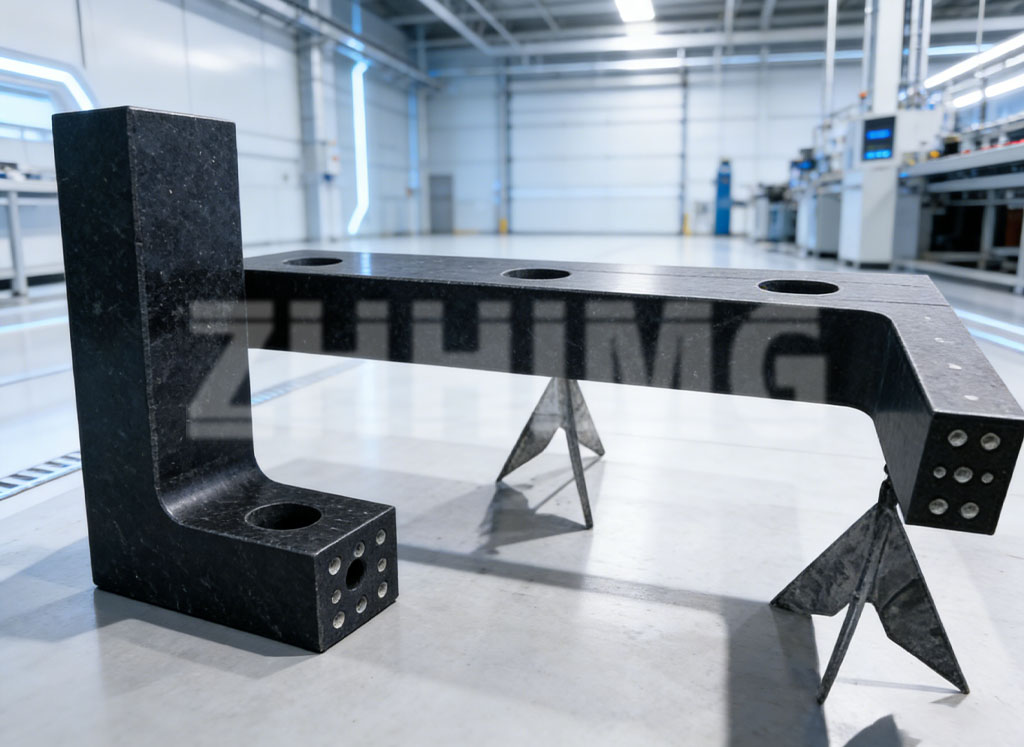
| Air-bearing base component | A granite part that carries bearing surfaces | OEM machines that integrate their own motors and encoders |
In each case, a granite base and guide give the quiet, flat, stable reference, while the moving carriage is made from a light, stiff material.
Example fields:
- Semiconductor and wafer-inspection equipment
- Femtosecond and picosecond laser machines
- Coordinate measuring machines and profilometers
- Optical and AOI inspection
- X-ray and industrial CT systems
- Linear-motor platforms and XY tables
ZHHIMG produces granite air-bearing base components and granite assemblies for these machines. Look at the granite component range for examples.
What to Send for a Quote, and Common Mistakes
Send these details with your enquiry:
- A drawing or sketch with the main dimensions and the working surfaces marked.
- The required flatness, straightness and parallelism, and the length over which they apply.
- The surface finish required on the bearing faces.
- The air-bearing type and pad size, and the gap and preload you plan to use.
- The moving mass, the maximum acceleration and the forces on the stage.
- The mounting method: where the granite will be supported and where inserts and holes go.
- The operating temperature and cleanliness class.
- The quantity, the delivery date and the packing and shipping destination.
Common mistakes to avoid:
- Specifying flatness without a length. A tolerance means little unless it states the length and the measuring method.
- Ignoring the support. A good granite guide can still bend if it sits on three poorly placed points.
- Setting the roughness too loose or too tight. Too rough upsets the air film; too smooth and expensive adds cost with no benefit. Ask the bearing maker for the recommended finish.
- Dirty or wet air. Moisture and particles damage both the pad and the granite surface; use filtration and a dryer.
- Changing the pad layout late. This often means regrinding the guide.
- Forgetting temperature. Measure and use the stage in similar conditions, otherwise the results will not match.
Frequently Asked Questions
Why use granite instead of metal for an air-bearing guide? Granite lapps flat, does not rust and does not raise burrs, it is stable over time and damps vibration. Metal guides need coatings, rust protection and often a more controlled environment.
Do air bearings wear the granite surface? In normal operation the film keeps the surfaces apart, so there is no wear. Wear can occur at start-up, shut-down or if the air supply fails, so good designs include a safe landing surface and an air-pressure monitor.
Can ceramic be used instead of granite? Yes, ceramic is stiffer and lighter, and suits moving parts. It costs more and is harder to make in large sizes, so many systems use granite for the base and ceramic for the carriage.
What flatness can be achieved on a granite guide? It depends on the length, the width and the measuring method. State your requirement and the measurement length in your enquiry, and ask the supplier for a sample inspection report.
Does ZHHIMG make the air bearings themselves? ZHHIMG makes the granite air-bearing base components and assemblies. Please confirm with the team whether your project also needs the bearing pads and how they are supplied.
Conclusion
An air bearing can only be as good as the surface it floats on. A lapped granite guide gives the flat, stable, quiet reference that makes air-bearing stages accurate and repeatable. Agree the flatness, finish, support and bearing layout early, and test the whole error budget, not just the guide.
Post time: Nov-13-2026