
Semiconductor, CMM and laser equipment use black granite bases because granite keeps its shape, absorbs vibration and resists temperature drift better than most structural materials. But the benefit depends on the quality of the stone and how it is machined and measured, so buyers should know what to ask for. This article explains both.
The Accuracy Problem a Machine Base Has to Solve
In a wafer inspection tool, a coordinate measuring machine (CMM) or a picosecond laser, the moving parts are positioned to micrometres or better. Anything that shifts the base by a fraction of that amount shows up directly in the result:
- Floor and motor vibration moves the stage or the optics while a measurement is being taken.
- Temperature change makes the structure grow or shrink, so the same point reads differently at 9:00 and at 15:00.
- Slow creep or internal stress changes the geometry over months, so a machine that was accurate at delivery drifts out of calibration.
- Magnetic or electrical interference disturbs encoders, linear motors and sensitive detectors.
A base that is stiff, quiet, thermally slow and geometrically stable removes most of these problems before the software has to compensate for them. That is why the base is often the first design decision, not the last.
Five Reasons Black Granite Works
1. Dimensional stability. Granite is a natural igneous rock that formed under pressure over a very long time, so it has no residual casting or welding stress to relax. Parts keep their geometry for years, which keeps the machine inside its calibration interval.
2. Vibration damping. Granite absorbs vibration energy much better than steel and aluminum, so stages settle faster and noise from motors, pumps and the floor does not ring through the structure. In semiconductor and optical inspection this shortens settling time and improves repeatability.
3. Thermal behavior. Granite has low thermal expansion and low thermal conductivity. It changes size slowly, and it does so by a small amount, which gives a temperature-controlled room more time to do its work.
4. Flat, lapped surfaces. Granite can be ground and lapped to very flat reference surfaces, including the precise faces used by air bearings and linear guides. A stable, wear-resistant surface keeps the bearing gap consistent.
5. Non-magnetic and non-corroding. Granite does not interfere with linear motors, encoders or electron-beam and magnetic sensors, and it needs no paint or plating, which also helps in cleanroom environments.
What granite does not do. It is brittle, so it should not be used where it will take hard impacts, and threaded fixings need bonded inserts. Designers handle both with sound support and insert design, and they pair granite with ceramic or carbon fiber on fast-moving axes where low mass matters more than damping.
Where Granite Bases Are Used
| Equipment | What the granite base provides | Typical granite parts |
|---|---|---|
| Coordinate measuring machines (CMM) | Stable reference plane and quiet structure for probing | Base, bridge beam, gantry, columns |
| Semiconductor and wafer inspection | Low vibration and thermal drift during imaging | Machine base, XY stage base, portal frames |
| Femtosecond and picosecond laser machines | Quiet platform so the beam stays on the programmed path | Base, gantry, cross beam |
| AOI, X-ray and industrial CT | Stable geometry and no magnetic interference | Base, rotary-stage bases, detector supports |
| Linear-motor and XY stages | Flat, damped base for fast, precise motion | Base plates, guideway bases |
| Air-bearing stages and guideways | Flat, wear-free surfaces for the air film | Bearing base, air-bearing components |
| PCB drilling and inspection machines | Vibration control at high feed rates | Base, bridge, table |
| Profilometers, vision systems, tool-inspection machines | Reference surface for optical or contact measurement | Base, column, plate |
| Perovskite coating and lithium-battery inspection equipment | Flat, stable base for large-area coating or scanning | Large base plates, beams |
The same logic applies to many other precision machines: if accuracy is limited by vibration, drift or geometry, a granite base is a likely candidate.
What Separates a Good Granite Base from a Poor One
Two bases can look identical and have the same drawing, yet perform very differently. The differences lie mainly in four areas.
The stone. Precision bases use dense, fine-grained black granite, with a density of about 3,000–3,100 kg/m³ for the best grades. Lighter or coarser stone, and especially marble, is more porous, absorbs moisture and wears faster, so it holds geometry less well. Because the stones look alike, only a material certificate and a density check tell them apart.
The processing. A precision base is cut, ground and then lapped in stages. Rough machining removes most of the stone; fine grinding sets the geometry; and lapping brings the working surfaces to the final tolerance. Skilled lapping is still largely manual work, and the results depend on the technician’s experience.
The environment. Final grinding and measurement need a temperature-controlled, vibration-isolated room. A heavy concrete floor with isolation trenches, quiet cranes and stable temperature give measurements that can be trusted. If the room is not controlled, the reported accuracy is not reliable.
The measurement. You can only claim an accuracy you can measure. Good suppliers use calibrated instruments such as electronic levels, laser interferometers, high-resolution indicators and roughness testers, with calibration certificates traceable to a national metrology institute. They also record the results for each base.
For more complex parts there is one more factor: assembly. Bases with bonded inserts, air-bearing surfaces or machined pockets often need to be assembled and checked in a clean, temperature-controlled room, so the supplier’s assembly capability matters as well as its machining.
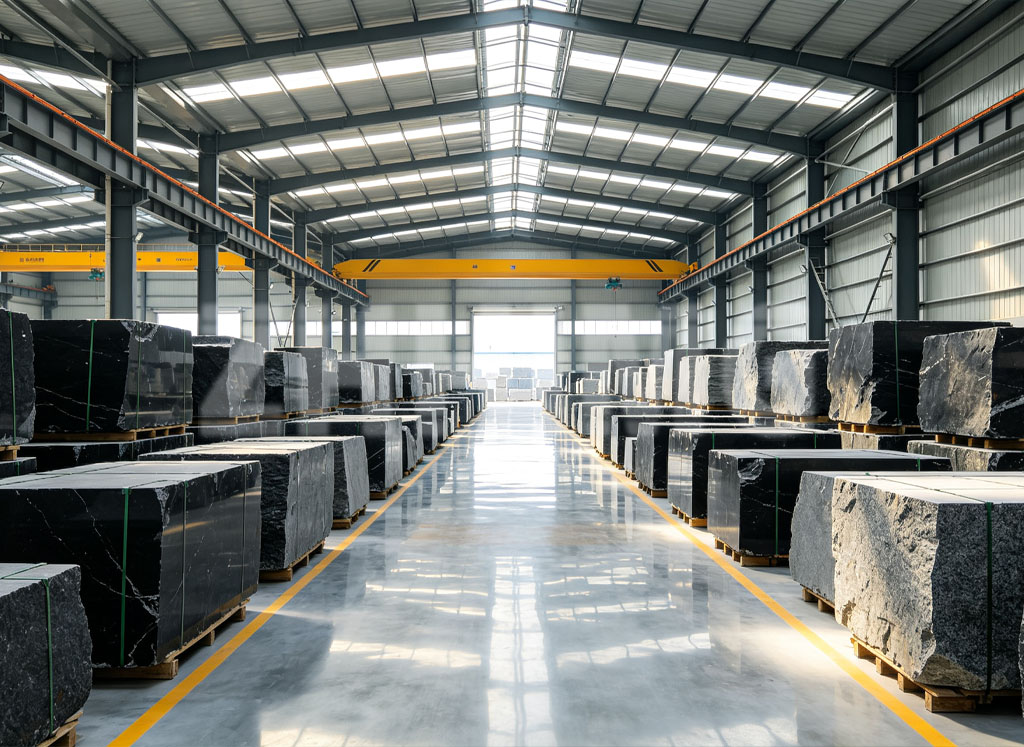
Pre-Purchase Checklist: Questions to Ask Your Supplier
| Question | What a good answer looks like |
|---|---|
| What stone is used, and what is its density? | Named black granite, a density figure (about 3,000–3,100 kg/m³ for precision grades) and a material certificate |
| What flatness, parallelism and squareness can you hold, and to which standard? | Numbers in micrometres, with the standard and edition named |
| How and where are the parts measured? | Calibrated instruments, a temperature-controlled room and written inspection records |
| Are the instruments traceable? | Current calibration certificates traceable to a national metrology institute |
| What is the largest single piece you can make? | A stated length, width, thickness and weight, plus the equipment that handles it |
| Can you supply inserts, air-bearing surfaces and assemblies? | Yes, with drawings, assembly checks and a clean-room option where needed |
| What quality and safety systems do you hold? | Current ISO 9001, ISO 14001 and ISO 45001 certificates, and CE marking where it applies |
| How do you pack and ship heavy parts? | Export-grade crating, shock protection and a handling guide |
| What is the lead time, and what is the process for revisions? | A schedule by stage and a named contact |
Two habits save a lot of trouble. First, ask for a sample inspection report before you place the order. Second, state your tolerance and the temperature at which it applies, because accuracy figures without a reference temperature are not comparable.
Frequently Asked Questions
Why is black granite used instead of gray granite or marble? Black granite for precision work is denser and finer-grained, so it is stiffer, less porous and holds a finer lapped surface. Marble and coarse gray stone are softer and absorb more moisture, which hurts long-term stability.
Does granite really reduce vibration compared with steel? Yes. Granite damps vibration much faster than steel or aluminum, which is why it is the standard base for CMMs and many inspection systems. For the exact figures on your machine, check the damping data for the material and the structure.
Can granite bases be made with threaded holes and complex shapes? Yes. Threaded inserts are bonded into drilled holes, and pockets, slots, through holes and T-slots can be machined. Complex shapes cost more than flat plates and need careful design to avoid thin, weak sections.
How large can a granite base be? Large machines can machine single granite pieces of many metres. ZHHIMG can machine single pieces up to 100 tonnes and 20 m in length, with widths up to 4,000 mm and thickness up to 1,000 mm.
What information do you need for a quote? A drawing or the main dimensions, tolerances, load, mounting points and the application. See the ZHHIMG granite component range or send your files for a review.
Conclusion
Black granite earns its place in semiconductor, CMM and laser equipment because it keeps its shape, damps vibration and changes slowly with temperature. The material is only half the story: a base performs as promised when the stone is dense and certified, the machining and measuring happen in a controlled environment, and the supplier can show records that prove it.
Post time: Nov-13-2026