
Ask a motion engineer what limits a precision machine and the answer is rarely the motor or the encoder — it is the interface between moving and stationary parts. Sliding guides stick-slip, rolling guides ripple, and every mechanical contact writes its own signature into the motion profile. The air bearing removes that contact entirely, floating the stage on a film of air a few micrometres thick. But an air bearing is only as good as the surface it rides on, which is why granite air bearing platforms have become the default architecture for nanometre-level motion.
What Is an Air Bearing?
An air bearing supports a moving stage on pressurised air instead of rolling or sliding contact. Orifices or porous media feed air into shallow pockets beneath the carriage; the resulting film — typically 3–10 µm thick — carries the load with no metal-to-metal contact. Friction is essentially that of air viscosity alone. The consequences are transformative: no stick-slip, no wear particles, no lubricant, negligible heat generation from the guide itself, and motion smoothness measured in nanometres rather than micrometres. The trade-off is demanding: with a gap of a few micrometres, the bearing amplifies every flaw of the surface beneath it.
Why Does the Guideway Surface Matter?
An air bearing averages the geometry it flies over. A local bump of one micrometre in the guideway becomes a one-micrometre vertical motion of the payload — there is no compliance to absorb it. Air-gap variation also modulates the film pressure, producing roll, pitch and height errors that no controller can fully cancel, because they appear as real geometric motion. Guideway quality therefore sets the floor on achievable accuracy, whatever the drive or feedback may promise.
Why Is Granite Used for Air-Bearing Guideways?
Flatness and surface finish. Hand-lapped granite reaches flatness below 1 µm over a metre and sub-micron straightness on rail faces, with surface roughness of Ra 0.1–0.4 µm. Just as important, granite laps to a microtexture of fine, hard, sharp crystals — an ideal substrate for air films, which need a surface that is both smooth and microscopically textured enough to stabilise the film without suction or chatter. There is no burr, no plating and no coating to peel into the air gap.
Thermal stability. With a thermal expansion coefficient of roughly 5–6 × 10⁻⁶/°C, granite guideways keep their geometry through cleanroom temperature cycles that would visibly bend a steel rail. Air gaps of a few micrometres demand dimensional stability measured over hours, not minutes — granite provides it passively.
Vibration damping. The same internal damping that stabilises optical benches (roughly ten times that of steel) prevents the machine structure from ringing at the air film’s natural frequencies, keeping the bearing stable rather than self-excited.
Hardness and wear-free operation. At Mohs 6–7 granite resists scratches from stray particles, and since the stage never touches the rail, there is nothing to wear out — decades of duty cycles without geometry change.
Air Bearing + Linear Motor + Granite Platform
The modern ultra-precision stage is a triad: air bearing granite guides define the geometry, ironless linear motors generate contact-free force, and high-resolution encoders close the loop. The three are symbiotic. Linear motors are non-contact, matching the frictionless bearing; but they add heat and magnetic attraction — which granite’s thermal stability and non-magnetic nature neutralise. The result is a motion axis with no contact anywhere in the force path, limited only by the quality of the granite geometry and the control bandwidth.
Applications
- Semiconductor equipment: wafer inspection and lithography stages where scanning smoothness at nanometre scale directly decides yield; granite base, guide rails and Z-columns as one lapped system.
- CMM and coordinate metrology: air-bearing bridges that glide over granite tables with repeatable, wear-free geometry — the measurement reference and the bearing surface are the same material.
- Optical inspection: autofocus and scan axes free of stick-slip, so image stitching stays sub-pixel accurate.
- Laser processing: ultra-precision laser and semiconductor granite platforms where beam pointing tolerances of a few µrad punish any vibration signature.
- Precision measurement: gravimeters, roundness machines and straightness benches that must isolate the measurement from the machine.
- Nanometre positioning and ultra-precision XY stages: multi-axis stacks flying on granite, achieving sub-50 nm positioning over hundreds of millimetres of travel.
Specifying a Granite Air-Bearing Guideway
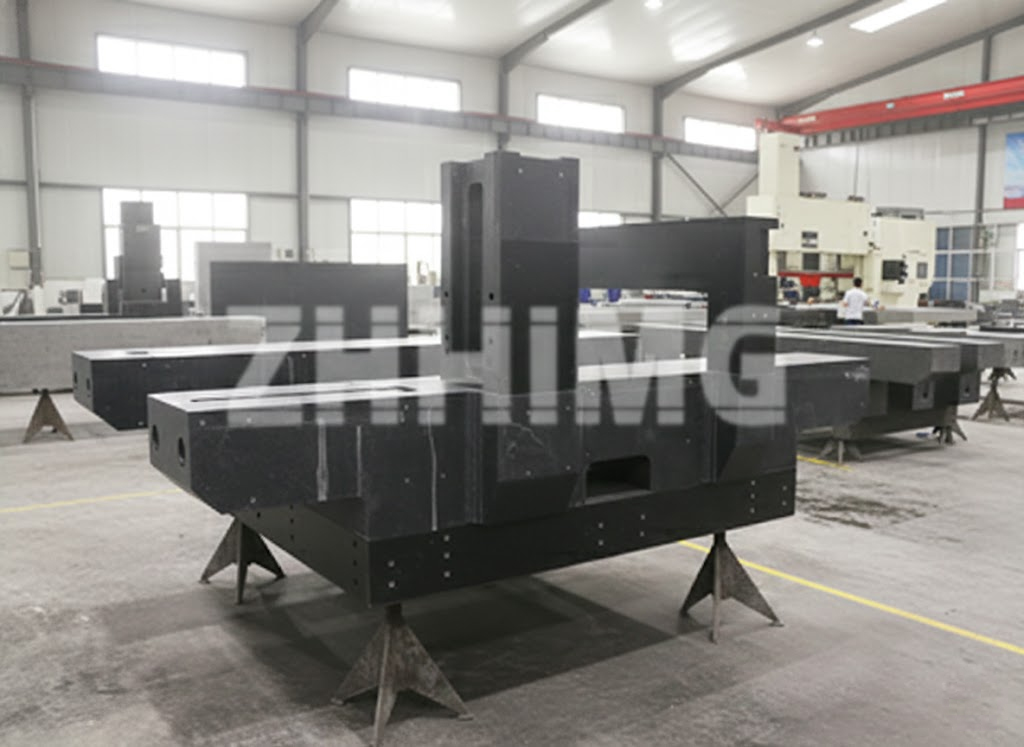
What actually matters on the drawing: flatness and straightness of the rail faces (with measurement uncertainty stated), surface roughness Ra, the match between rail and carriage lapping, insert and orifice machining quality, and the flatness of the mounting interface that couples the rail to its base. Because air gaps live in the micrometre range, a “nice” rail bolted onto an unflat base becomes a bad rail — the whole assembly must be lapped and verified as a system, which is why air-bearing granite is bought as an engineered assembly rather than as stone. Our ultra-precision granite solutions cover rails, bases, carriages and matched assemblies with documented, traceable geometry.
ZHHIMG® machines and laps granite air bearing guideways, bases and matched stage assemblies for semiconductor, metrology and laser OEMs. Send us your stage concept — we will return a manufacturable granite geometry with achievable flatness, finish and mounting scheme.
Post time: Sep-29-2026