
Granite Air Bearings Explained: Design Principles, Applications and Precision Requirements
Where a measurement or a process must happen without mechanical contact, the air bearing is the enabling component — and granite is the structure that makes it meaningful. Engineers searching for a granite air bearing solution are usually past the research phase: they have a stage to build, a spec to meet, and questions about flatness, gap and air supply that determine whether the system works. This guide explains how granite air bearings are designed, what the granite actually contributes, how porous and orifice designs differ, and what information a manufacturer needs before quoting a custom project.
1. What Is a Granite Air Bearing?
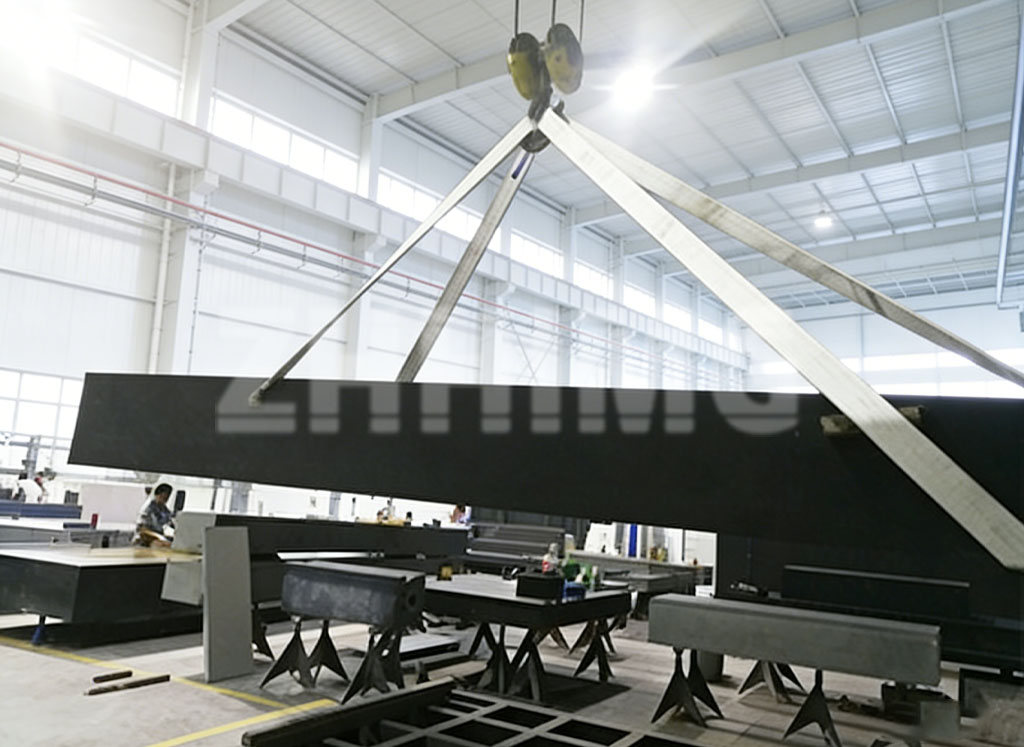
A granite air bearing is not a bearing made of granite. It is a motion or support system in which a thin film of pressurized air — typically a few micrometres to a few tens of micrometres thick — carries the moving element without solid contact, while granite provides the reference structure the film works against. In a linear stage, that structure is usually a granite base with lapped guide surfaces or an inserted rail; in a rotary table, a granite plate; in inspection equipment, a granite platform carrying the air pads themselves.
The division of labour is worth stating clearly: the air film removes friction, wear and stick-slip; the granite provides dimensional stability, damping and a geometry that stays where it was lapped. Neither substitutes for the other. This is why air bearing projects are bought as matched sets — the bearing pads, the granite structure and the air system are designed against each other, and mixing components from different sources transfers the integration risk to the buyer.
2. How Air Bearings Work in Precision Motion Systems
Pressurized air enters a recess or porous region in the bearing pad and escapes through the narrow gap between pad and guide surface. The restriction at the gap creates pressure that supports the load; the moving element floats, never touching. Three consequences follow:
Friction is almost zero and speed-independent. A linear motor can drive the carriage without fighting stiction, which is why air bearing stages achieve smooth velocity at low speed — where ball and roller guides struggle.
There is no wear from motion. The only moving “part” is air, so repeatability does not degrade with cycles the way mechanical guides do.
The air film averages errors. A pad riding on a film integrates the local geometry it passes over, which mildly filters high-frequency surface errors — a real effect, but one that must not be used as an excuse for poor guideway geometry, because the film also transmits low-frequency form errors straight through to the carriage.
The design trade sits in the film gap: larger gaps tolerate geometry errors and contamination better but demand more air and reduce stiffness; tighter gaps raise stiffness and resolution but raise the flatness and surface-quality requirements on the granite accordingly.
3. Why Granite Is Used as an Air-Bearing Reference Structure
Granite earns its role through four properties acting together:
Stability: no residual stress relaxation, no creep — a lapped guide surface stays lapped. For an air bearing whose performance depends on maintaining a micron-scale gap, a structure that drifts is fatal.
Damping: the stone dissipates vibration that would otherwise modulate the film gap; a quiet structure is part of a quiet stage.
Geometry capability: large faces can be lapped to tight flatness, and rails, seats, air-bearing bores and inserts can be machined into the same block — one structure carrying guide surface, mounting features and datum in a single geometry. A typical example is a granite base with a machined air-bearing bore matched to a thrust pad.
Practicality: no corrosion, no lubrication, and mass that adds inertia damping to external disturbances.
The honest limits: weight drives handling and frame design, features are constrained by what diamond machining can reach, and lead time for large low-defect blocks is real. Where systems need lighter structures, mineral casting appears in auxiliary roles — but for the primary air-bearing reference, granite remains the industry standard.
4. Flatness, Straightness, Air-Film Gap and Surface Quality
These four requirements are related but not identical, and specifications should name each one:
Flatness applies to faces — the base surface the pads ride over, and the mating surfaces of the pads themselves. Typical air-bearing guide surfaces are specified in the low-micrometre range, with tighter values where the design demands a finer gap. The right number comes from the gap design, not from a brochure maximum.
Straightness applies to guide paths — how far the lapped rail or track deviates from an ideal line over travel. For a granite air bearing stage, straightness of the guideway maps largely into the carriage’s trajectory; the air film filters a little and transmits the rest.
Air-film gap is the design variable that ties everything together: load capacity, stiffness, air consumption and allowable geometry error all follow from it. Ask your supplier to state the design gap and the geometry tolerances derived from it, as a pair.
Surface quality is the finishing layer: the lapped texture of the working faces affects both film stability and the visual and tactile standard of the surface. Deep scratches, open pores or chips in the working zone act as local leak paths. For this reason, material selection and lapping discipline — not only final flatness — belong in the acceptance criteria.
One clarification buyers appreciate: the geometric accuracy of the granite components does not by itself equal the positioning accuracy of the finished stage. Encoding, drive, control and structural dynamics all contribute. Specify both layers separately.
5. Air Supply, Porous Media and Orifice-Based Designs
Not all air bearings are the same structure, and a supplier should say plainly which type they build:
Orifice-based designs feed the film through discrete machined holes or slots, usually into a recess. They are robust to manufacture, tolerant of some contamination, and well understood; their characteristic weakness is non-uniform pressure distribution, which designers manage with recess geometry and multiple feed points.
Porous-media designs feed the film through a permeable material — the entire pad face acts as thousands of distributed orifices. This gives excellent pressure uniformity and high damping, at the cost of a porous insert that demands cleaner air and careful handling: clogging a porous pad is a service event, not a design option.
Grooved and slot designs occupy the middle ground, with shallow machined channels distributing pressure along a line or pattern.
The air supply conversation is the same for all types: clean, dry, regulated air with filtration appropriate to the gap size. Water and particles are the enemies of every air bearing; a specification that omits air quality omits the most common field-failure cause. When you compare suppliers, ask which design they propose for your load and travel, and why — a manufacturer who offers only one architecture will find only one answer.
6. Typical Applications in Metrology, Optics and Semiconductor Equipment
Metrology: CMMs and inspection systems use air-guided carriages over granite bases to combine reference geometry with friction-free motion — the classic pairing of a precision granite base and components with air pads.
Optics and laser systems: lens inspection, wavefront measurement and laser processing stages need smooth sub-micron motion without vibration injection; the granite structure’s damping and the air film’s silence address the same requirement from two directions.
Semiconductor equipment: wafer inspection and metrology stages ride granite air-bearing platforms where cleanliness matters as much as accuracy — no lubricant to outgas, no wear particles to generate.
Across these fields the pattern repeats: wherever motion must be smooth, contactless and stable over years, a granite structure and an air film are the default answer.
7. What Information Is Needed for a Custom Air-Bearing Project?
A custom project quotes faster and better when the inquiry carries the following:
| Information | Why the manufacturer needs it |
|---|---|
| Load and mass to be supported, including moving vs static | Sets bearing size, number of pads and film gap design |
| Travel length and motion direction | Determines guideway length, straightness spec and pad arrangement |
| Required positioning or straightness accuracy of the system | Separates component geometry specs from system specs in the quote |
| Air supply available (pressure, quality, filtration) | Decides feasibility of porous vs orifice design and filtration scope |
| Environment: cleanliness, temperature range, vibration | Affects material grade, gap choice and installation requirements |
| Delivery scope: granite only, pads only, or integrated assembly | Defines who owns the integration risk and the acceptance test |
Points two and three deserve emphasis for first-time buyers: decide early whether you are buying granite components to your own stage design, or an assembled and tested system against a motion specification. The two purchases have different drawings, different acceptance criteria and different responsibilities — agreeing the scope before the quote prevents the most common dispute in this product class. ZHHIMG supplies both models, from lapped granite structures with machined bearing interfaces to assembled and inspected granite bases ready for stage integration.
Send us your load, travel and accuracy targets, and our engineers will propose the structure, the bearing architecture and the verification plan together — because in air bearings, none of them can be specified honestly in isolation.
Frequently asked questions
Do air bearings wear out?
The bearing itself does not wear from motion — there is no contact. Practical degradation comes from air contamination, clogged porous media, accidental contact or damaged guideway surfaces, all of which are maintenance and handling issues rather than cycle-life limits.
What air quality does a granite air bearing need?
Clean, dry, regulated air with filtration matched to the film gap; water and particles are the main causes of field problems. The specific filtration class should come from the bearing supplier as part of the specification.
Can I buy the granite base separately from the bearing pads?
Yes, but the geometry specifications of the base must then be derived from the pad design — gap, pad area and stiffness determine the flatness and surface finish required. Ideally, pad and granite specifications are exchanged between the two suppliers, or the whole set is bought from one source.
How flat must a granite air-bearing surface be?
It follows from the design gap: the tighter the gap, the tighter the flatness. Typical air-bearing guideway surfaces are specified in the low-micrometre range, but the correct number for your project should come from the bearing design, not from a generic standard.
Post time: Oct-21-2026