
Granite vs. Cast Iron vs. Mineral Casting: Which Material Is Best for Precision Machine Bases?
It is the wrong question asked the right way — and every engineering team asks it. There is no single “best” machine base material; there is a best match between material behaviour and what your machine must do, in your environment, at your volume. The useful comparison is not a ranking but a set of verified properties read against a load case. This guide compares the three dominant candidates for a granite vs cast iron machine base decision — precision granite, cast iron and mineral casting — across thermal behaviour, damping, manufacturability, maintenance and application fit, with the honest limits of each material stated up front.
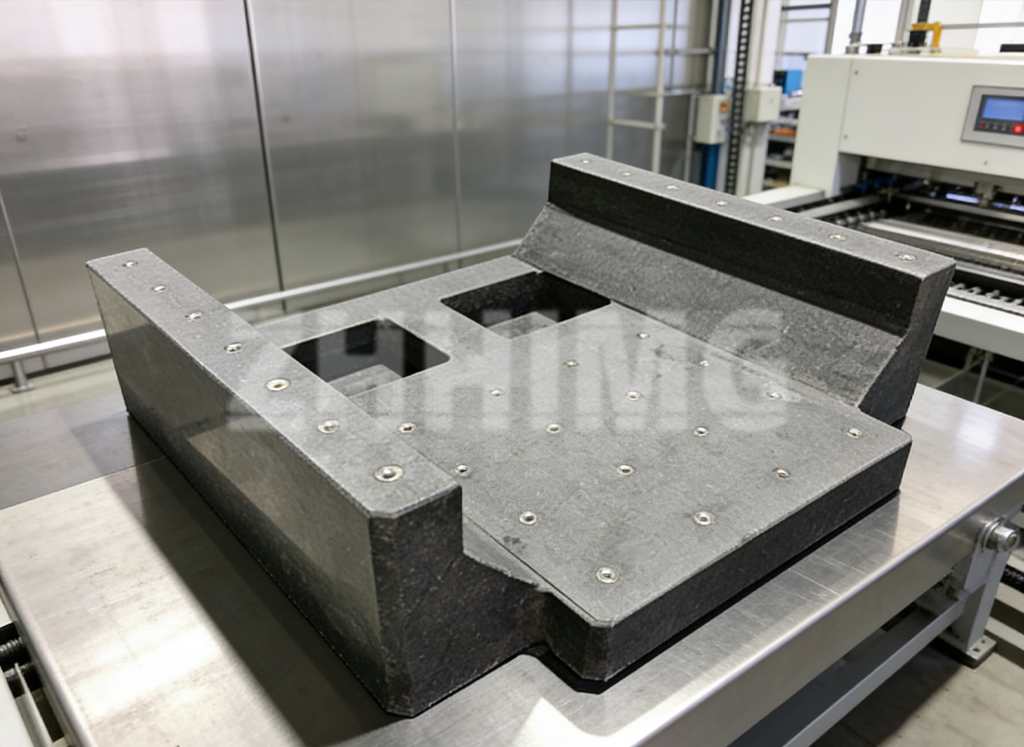
1. Why Machine Base Material Matters
The base is the quiet authority over everything bolted to it. Every axis alignment, every scale reading, every repeatability figure the machine will ever quote is referenced to the geometry of the base — and that geometry is hostage to four material behaviours: thermal expansion, vibration damping, structural deflection and long-term stability. Change the material and you change the machine’s personality: how it reacts when the shop warms up in the afternoon, how it rings when a heavy part is set down, how it behaves in year five.
Material choice also decides what the base costs to make — not just per kilogram, but per feature. Holes, inserts, flats, rail seats and datum faces each carry a different price tag on different materials. A rational comparison therefore weighs performance and manufacturability together, which is exactly how the sections below are organized.
2. Thermal Expansion and Dimensional Stability
Granite: natural stone is a thermal slow-thinker. Its thermal conductivity is low and its expansion coefficient, depending on the specific stone, sits in a low range — but the dependable property is not one magic number, it is the combination of slow response and freedom from internal stress. Granite carries no residual stress from casting or welding, so a lapped surface does not relax or creep over the years. Ask any supplier for the material datasheet of the specific stone they use; values differ between quarries and colors.
Cast iron: thermal conductivity is high and expansion is roughly an order of magnitude higher than granite, so an iron base responds faster and moves more per degree. That is not automatically disqualifying — machine tools with active thermal compensation and symmetric structures manage iron successfully — but it means the thermal design burden shifts to the machine builder. Stress relief after casting is essential; insufficient relief shows up as gradual geometry drift.
Mineral casting: epoxy granite formulations are engineered for low thermal expansion, and the casting cures at low temperature so residual stress is inherently limited. Behaviour still depends on the specific formulation and cure discipline — a reason to qualify the supplier’s process, not just the datasheet. In practice, mineral casting and granite are closer to each other thermally than either is to iron.
3. Vibration Damping and Structural Rigidity
This is where the three materials part ways most clearly — and where honest engineering resists slogans.
Cast iron is stiff in the classic sense: high elastic modulus, so deflection under load is predictable and low for a given section. But it rings. Damping within the material itself is modest, which is why iron machine bases rely on mass, ribbing and sometimes added damping layers. For roughing operations and metal-cutting dynamics, iron’s stiffness and toughness remain the industry default for good reasons.
Granite offers a lower modulus than iron — an equal-span granite section deflects more than an equal iron section — but its mineral structure dissipates vibration internally instead of transmitting it. Combined with the high mass typical of granite bases, this produces the quiet environment metrology equipment needs. The design implication: granite bases are usually built in thicker sections, and rigidity must be engineered through geometry and support layout, not assumed from material tables.
Mineral casting is the damping leader among the three — the polymer-bonded mineral matrix converts vibration into heat efficiently, and manufacturers of production machine frames use it for exactly this reason. The same logic applies to the granite vs mineral casting question: for damping-critical dynamics in series-built equipment, mineral casting earns its place; for the highest lapped flatness on large reference faces, granite remains the reference. How much better one damping figure is than another depends on formulation, section and the test method — demand test data with conditions stated rather than accepting multiplier claims.
4. Weight, Machinability and Design Flexibility
Weight: granite and iron are both heavy; mineral casting is the lightest of the three for equal volume. Where floor loading, transport or moving axes matter, mass is a cost — but where stability against external disturbance matters, mass is an asset. The same property cuts both ways.
Machinability and features: iron is the most forgiving — complex shapes come out of the mould, and subsequent machining is conventional. Granite is worked by diamond tooling; holes, inserts, flats and rail seats are all achievable to tight tolerance, but design should respect the material’s nature: generous wall sections, inserts bonded or press-fitted, sharp internal corners avoided. Mineral casting is formed in a mould, which makes it the natural choice for series production with many identical bases — integrated inserts, conduit channels and mounting bosses can be cast in — while one-off prototypes carry mould costs that granite or iron may not justify. Critical functional surfaces on mineral castings still receive machining or grinding afterwards.
Lead time logic follows the process: machined granite needs stock blocks and diamond machining hours; iron needs pattern and casting plus stress relief; mineral casting needs a mould plus cure time. Series volume, not material preference, usually decides which of these is cheapest.
5. Corrosion Resistance and Long-Term Maintenance
Granite does not corrode, does not rust and needs no coating. Its maintenance reality is simpler than the alternatives: keep it clean with appropriate cleaning fluid, protect edges from impact, and re-lap only when calibration says so. Chipped granite does not raise a burr; the defect is visible and can be dressed.
Cast iron rusts the moment humidity and time cooperate. Paint, plating or oil films are part of the maintenance budget for the machine’s whole life, and any chip or wear-through becomes a corrosion entry point. Burrs raised by impact on iron can also cut hands and falsify measurements until dressed.
Mineral casting shares granite’s indifference to corrosion — no coating needed — and its low conductivity reduces condensation behaviour in fluctuating shops. Its long-term question is not corrosion but formulation durability: qualified, properly cured formulations have decades of service in the field, which is why supplier process discipline belongs in the qualification checklist.
6. Material Comparison by Application
| Criterion | Precision Granite | Cast Iron | Mineral Casting |
|---|---|---|---|
| Thermal behaviour | Low conductivity, slow response; verify with the specific stone’s datasheet | Higher conductivity and expansion; depends on grade and thermal design | Low expansion by formulation; verify with supplier data |
| Vibration damping | Good inherent damping; confirm with test data for the geometry | Material and structure dependent; often needs mass/ribbing strategy | Strong damping from formulation and structure; request test conditions |
| Complex structures | Diamond machining plus insert design | Casting plus conventional machining | Mould-formed with cast-in features; critical faces machined after |
| Corrosion and maintenance | None; cleaning and edge care only | Rust protection for life of machine | None; formulation durability is the long-term question |
| Best fit | Metrology, precision motion stages, CMM structures, lapped datum faces | Traditional machine tools and load-bearing structures | Damping-critical structures, series-built equipment frames |
Read the table as a routing guide, not a scoreboard. The same semiconductor inspection machine may sensibly use granite for its metrology frame and mineral casting for auxiliary structures; a heavy cutting machine may combine iron structures with granite inspection stations. Hybrid designs are common precisely because each material holds its own territory.
7. How to Select a Material for Your Machine Design
Work the decision in this order:
First, define what the base must promise: positioning accuracy targets, environmental conditions, the accuracy class of surfaces that must be lapped or ground, and the load and dynamics it will see. These requirements eliminate materials faster than any comparison chart.
Second, classify the requirement: is the base primarily a metrology reference (granite’s territory), a dynamic load-bearing structure for cutting (iron’s), or a damping-critical frame in series production (mineral casting’s)? Mixed needs point toward hybrid designs.
Third, interrogate the data. For each candidate ask for: thermal expansion of the actual material or formulation to be supplied, damping test data with measurement conditions, flatness capability on the actual face sizes, and reference projects of comparable size and accuracy. A manufacturer who runs all three processes — granite machining, precision metal machining and mineral casting — can quote the trade-offs from production experience instead of brochure logic, and will tell you when your requirement belongs to a material they would earn less from.
Finally, cost the whole system: material, features, lead time, freight for the mass involved, and the maintenance line over ten years. The cheapest quote frequently excludes the base’s real job — holding the machine’s geometry for a decade.
If you are weighing these materials for a new machine program, send ZHHIMG the load case, environment and accuracy targets. Our engineering team works across all three material families and will recommend the one your design actually needs — including the honest answer that it may not be granite.
Frequently asked questions
Is granite always more accurate than cast iron for a machine base?
No. Granite holds an advantage where lapped flatness over large faces and long-term dimensional stability are the requirement. A well-designed, stress-relieved iron structure can be very accurate too, especially with thermal compensation. Accuracy is a system outcome, not a material guarantee.
Can mineral casting replace granite in metrology equipment?
For damping-critical frames in series production, yes. For primary reference surfaces that must be lapped to the tightest flatness grades, granite remains the standard. Many systems use both.
Which material is best for vibration damping?
Mineral casting generally damps best, granite second, iron last — but the actual figure depends on formulation, geometry and test method. Require test data with stated conditions rather than multiplier claims.
How does cost compare between the three materials?
It depends on volume and features more than on the material itself. Mineral casting carries mould costs that favor series production; granite carries diamond machining time; iron carries pattern, casting and stress relief. Quote the specific design rather than generalizing.
Post time: Oct-21-2026