
In the world of ultra-precision manufacturing, the most critical component is often the one nobody sees: the granite base.
Whether it is a coordinate measuring machine (CMM), a semiconductor wafer inspection system, a laser processing platform, or a PCB drilling machine, the granite base serves as the structural and metrological foundation of the entire system. If the base is unstable, every measurement and every movement built on top of it becomes unreliable.
Why Granite Bases Are Irreplaceable in Precision Equipment
Granite bases are used in high-end industrial equipment for several fundamental reasons:
- Vibration damping — Granite naturally absorbs vibration, preventing external disturbances from affecting sensitive measurements or processes.
- Thermal stability — High-density granite has a low coefficient of thermal expansion, meaning it maintains its shape even when workshop temperatures fluctuate.
- Dimensional stability — Unlike metal, granite does not rust, warp, or develop internal stresses over time.
- High rigidity — With a density of approximately 3,100 kg/m³, precision granite provides exceptional structural stiffness under heavy loads.
- Non-magnetic and non-conductive — Essential for semiconductor, optical, and electronic inspection environments.
These properties make granite the material of choice for applications where even a few micrometers of deviation can mean the difference between pass and fail.
Where Granite Bases Are Used
Granite bases and granite assemblies are found across some of the most demanding industries:
| Industry | Typical Applications |
|---|
| Industry | Typical Applications |
|---|---|
| Semiconductor | Wafer inspection platforms, lithography support structures, XY tables |
| Metrology | CMM frames, optical comparators, contour measurement systems |
| Laser Processing | Femtosecond and picosecond laser platforms, precision cutting bases |
| PCB Manufacturing | Drilling machine bases, alignment platforms |
| New Energy | Lithium battery inspection equipment, coating machine bases |
| Optical Inspection | AOI systems, industrial CT, X-ray inspection platforms |
In each case, the granite base is not a decorative element. It is a functional component that directly determines the accuracy and repeatability of the entire machine.
Granite Air Bearings: Precision Motion on a Granite Foundation
For equipment requiring ultra-smooth linear or rotational motion, granite air bearings are often integrated directly into the granite base. Air bearings use a thin film of compressed air to create near-frictionless movement, and when mounted on a high-density granite substrate, they deliver exceptional straightness, flatness, and repeatability.
Common applications include:
- Precision linear motor platforms
- Semiconductor wafer handling systems
- High-speed optical scanning stages
- Ultra-precision grinding and lapping machines
The combination of a granite base and granite air bearing creates a motion system with minimal vibration, low thermal drift, and long-term dimensional stability.
What Separates a Precision Granite Base from a Standard One
Not all granite bases are manufactured to the same standard. Key differentiators include:
- Material selection — Only high-density black granite with uniform grain structure should be used.
- Stress relief — The raw stone must be properly aged and stabilized before machining to prevent future deformation.
- Precision machining — Large bases require CNC equipment capable of handling heavy, oversized components with tight tolerances.
- Controlled environment assembly — Final scraping, lapping, and assembly should take place in a temperature- and humidity-controlled workshop.
- Traceable calibration — Flatness, parallelism, and squareness must be verified using calibrated metrology instruments traceable to national standards.
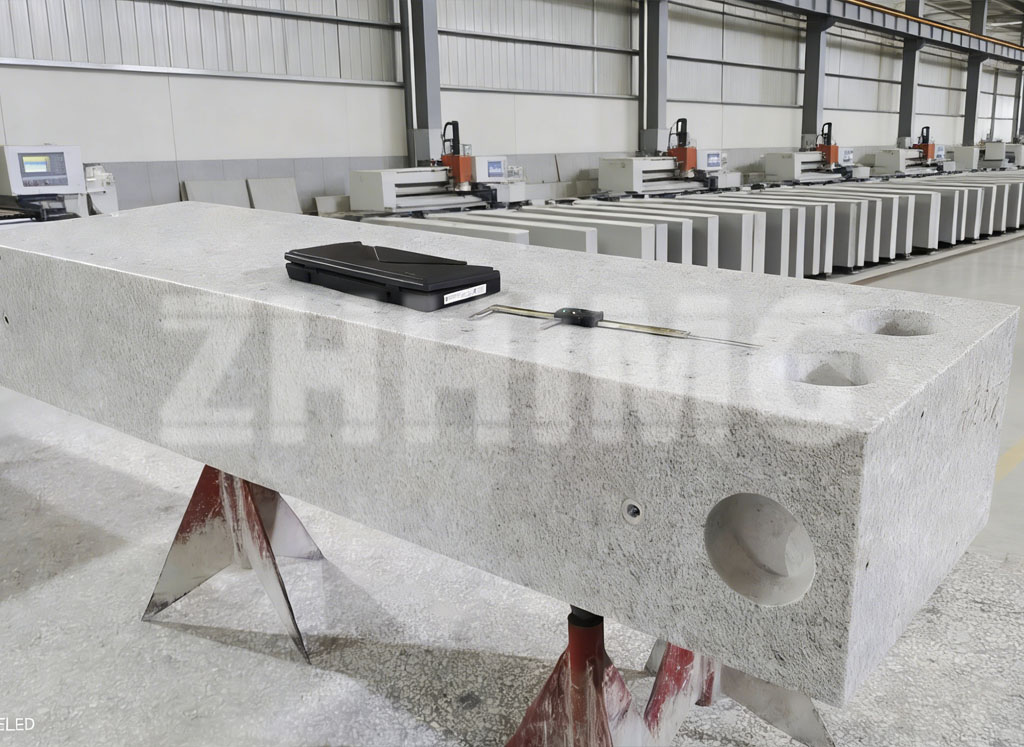
At ZHHIMG®, granite bases are manufactured in a 10,000 m² temperature- and humidity-controlled workshop, with anti-vibration trenches, silent cranes, and master technicians who bring decades of hand-lapping experience to every component. Our production capacity allows us to process granite bases up to 20 meters in length and 100 tons in weight, making us one of the highest-capacity precision granite manufacturers in the world.
How to Specify a Granite Base for Your Equipment
When requesting a quote for a granite base or granite assembly, provide the following information:
- Overall dimensions — Length, width, and thickness.
- Required flatness and parallelism — Based on your equipment’s accuracy needs.
- Mounting features — Threaded inserts, T-slots, dowel holes, or custom fixtures.
- Operating environment — Temperature range, humidity, and vibration conditions.
- Applicable standards — DIN 876, JIS, ASME, GB, or customer-specific requirements.
- Calibration requirements — Whether a traceable inspection report is needed.
Providing these details upfront helps ensure the finished base meets your application requirements without costly rework.
The Bottom Line
A granite base is only as good as the material, manufacturing process, and calibration behind it. For semiconductor equipment, metrology systems, laser platforms, and precision automation, choosing a supplier with proven expertise in high-density granite processing is essential.
Looking for custom granite bases, granite assemblies, or granite air bearings for your precision equipment? Explore ZHHIMG® solutions at <http://www.zhhimg.com>.
Post time: Nov-12-2026