
When your coordinate measuring machine (CMM), optical comparator, or high-precision assembly process relies on a granite surface plate, you cannot afford to guess about accuracy. A surface plate serves as the absolute reference plane for your entire measurement system.
But how do you choose the right one? This guide breaks down the essential factors: flatness grades, international standards, and long-term stability.
Understanding Flatness Grades
Flatness is the primary metric for evaluating a granite surface plate. It refers to the maximum deviation between the highest and lowest points on the plate’s surface. The tighter the tolerance, the higher the accuracy.
For ultra-precision applications, flatness is often measured in micrometers (µm) or even nanometers over the entire surface area. At ZHHIMG®, our high-end metrology-grade surface plates achieve nanometer-level flatness, ensuring they meet the strictest requirements of semiconductor and precision machining industries.
Key International Standards to Look For
Different industries and regions use different standards to classify granite surface plates. A reliable manufacturer will adhere to, and provide calibration certificates for, the major international standards:
- DIN 876 (Germany): The most widely recognized global standard, classifying plates into grades 00, 0, 1, and 2.
- JIS B 7513 (Japan): A rigorous standard often used in high-precision manufacturing and optics.
- ASME B89.3.7 (USA): The primary standard for American manufacturers and metrology labs.
- GB (China): The national standard for precision granite measuring instruments.
Ensure your supplier can provide a traceable calibration certificate that matches the standard your facility requires.
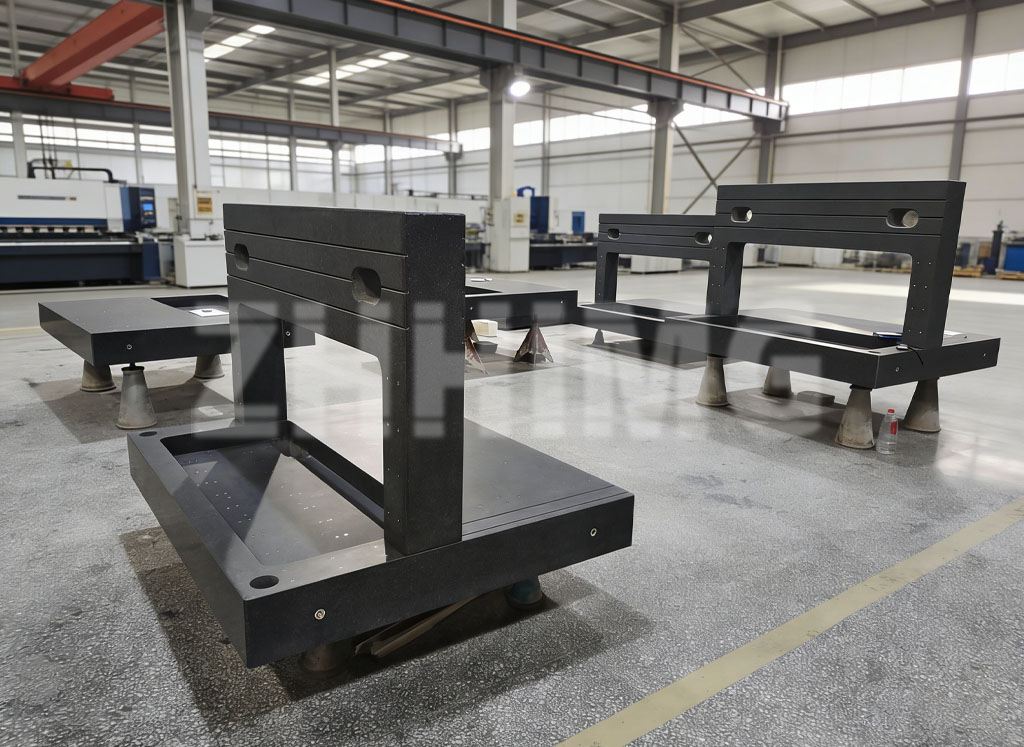
Why High-Density Granite is Non-Negotiable
Not all black granite is created equal. Standard construction-grade granite won’t cut it in a metrology lab. You need high-density, ultra-precision black granite.
Key physical properties to demand:
- Density: High-density granite (approx. 3,100 kg/m³) provides superior structural rigidity and resists bending under load.
- Thermal Stability: A low coefficient of thermal expansion means your surface plate will maintain its flatness even with slight temperature fluctuations in the workshop.
- Non-Porous Structure: Precision granite must have near-zero water absorption to prevent rust on metal parts resting on it and to avoid dimensional changes due to humidity.
How to Maintain and Verify Accuracy
Even the best granite surface plate can lose accuracy if it is not properly maintained or calibrated.
- Environment Matters: Always use your surface plate in a controlled environment. Temperature swings, direct sunlight, or drafts can cause warping.
- Regular Calibration: Depending on usage frequency, surface plates should be recalibrated annually or bi-annually.
- Proper Support: Always use three support points to hold the plate. Four points can introduce stress and distort the flatness.
ZHHIMG®: Precision You Can Measure
At ZHHIMG®, we don’t just manufacture granite components; we engineer precision. Our granite surface plates are crafted from premium-grade black granite and finished by master technicians with over 30 years of hand-lapping experience.
We manufacture in a 10,000 m² temperature and humidity controlled workshop to ensure our products remain stable from the factory floor to your metrology lab. Whether you need a standard Grade 00 plate or a custom-sized base for specialized equipment, ZHHIMG® delivers nanometer-level accuracy you can trust.
Post time: Nov-12-2026