
The Multi-Material Evolution of High-Velocity Multi-Axis Stages
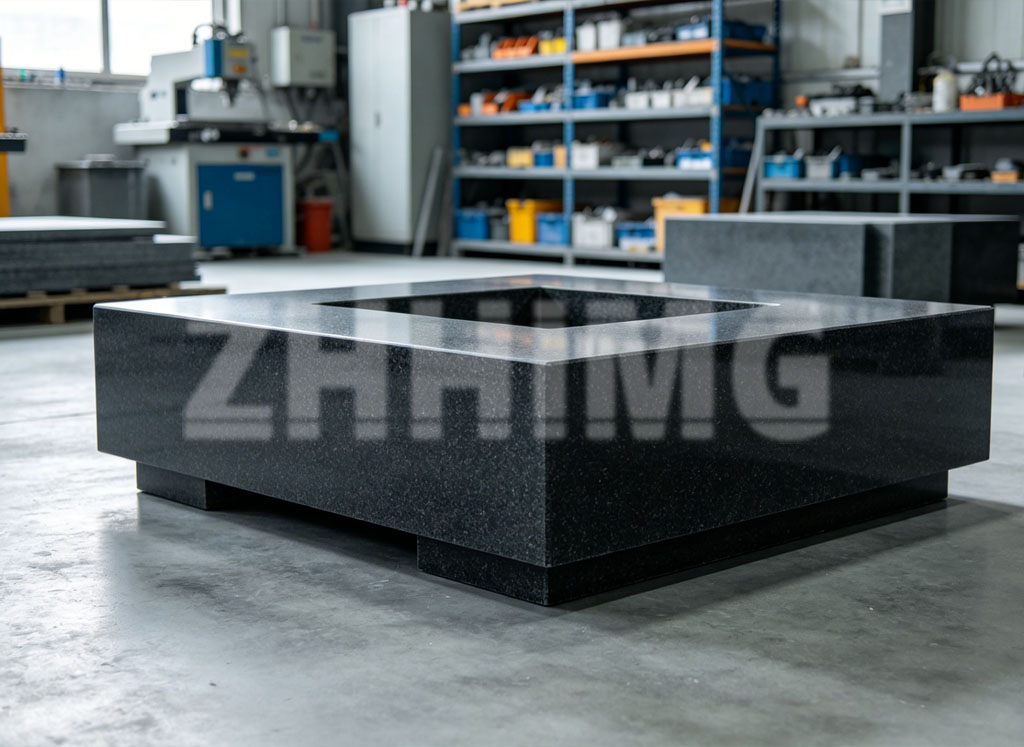
For decades, high-density black granite served as the default standard for precision machine design. It remains the ideal choice for heavy, rigid, statically stable bases for systems like coordinate measuring machines (CMMs) and large-scale optical inspection tools.
However, as advanced industries like lithography packaging, perovskite solar cell coating, and high-speed pick-and-place automation push for higher accelerations and faster settling times, mechanical engineers face a dilemma. A massive granite beam provides excellent stability, but its high weight limits acceleration speeds and demands oversized linear motors, which inject excess thermal energy into the machine chassis.
Modern precision engineering requires a multi-material approach. Manufacturers must select and integrate diverse materials—such as Precision Granite, Advanced Ceramics, Mineral Castings, and Carbon Fiber—based on the specific dynamic requirements of each axis.
| Material Type | Primary Strength | Ideal Machine Application | Dynamic Status |
| High-Density Granite | Mass, Ultimate Flatness | Base Beds, Master Surface Plates | Static Foundation |
| Technical Ceramics (Al2O3) | Ultra-High Hardness, Light | Metrology Guides, Vacuum Chucks | Low-Mass Positioning |
| Carbon Fiber Composite | Extreme Rigidity-to-Weight Ratio | Dynamic Cross-Beams and Bridges | High-Velocity Motion |
| Mineral Casting / UHPC | High Damping, Geometric Flexibility | Structural Enclosures, Complex Beds | Vibration Absorption |
1. Precision Granite: The Unyielding Foundation
For static machine beds, massive multi-ton bases, and reference platforms, high-density black granite remains irreplaceable. Its high density (~3100 kg/m³) provides the necessary mass to counter the kinetic recoil of moving gantries, ensuring the machine’s overall center of gravity remains anchored.
2. Technical Ceramics: Light, Hard, and Inert
When an axis must move quickly but cannot sacrifice rigidity, alumina ($Al_2O_3$) or silicon carbide ($SiC$) precision ceramics offer an excellent alternative. Ceramic components feature a high elastic modulus while weighing significantly less than granite. This allows for rapid acceleration profiles in semiconductor handling and wafer inspection tools without bending or twisting under inertia.
3. Carbon Fiber Precision Beams: Defeating Inertia
In ultra-fast gantry systems—such as large-area laser cutting or high-speed pick-and-place tools—the bridge axis must travel at extreme velocities. Carbon Fiber Precision Beams deliver an optimal strength-to-weight ratio. By substituting a heavy metal or stone cross-beam with a precision-engineered carbon fiber structure, engineers can dramatically reduce moving mass, allowing the machine to accelerate faster while minimizing wear on linear motors and guide rails.
4. Mineral Castings and UHPC: Complex Geometries with High Damping
For complex structural enclosures and beds that require integrated fluid channels, internal wiring conduits, or organic shapes, traditional stone machining becomes cost-prohibitive. Mineral Casting and Ultra-High-Performance Concrete (UHPC) allow for precise casting of complex geometries while providing dampening properties that absorb high-frequency motor vibrations.
Comprehensive Engineering via a Unified Supply Chain
Operating in next-generation precision manufacturing requires moving past single-material limitations. True innovation lies in selecting the exact material needed for each unique mechanical role.
As the only global manufacturer simultaneously certified under ISO 9001, ISO 14001, and ISO 45001 that produces advanced structural components across all four material families—Granite, Ceramics, Mineral Castings, and Carbon Fiber Composites—ZHONGHUI Group (ZHHIMG®) provides custom, multi-material solutions tailored for the world’s most demanding high-tech applications.
Post time: Jul-09-2026