
The Limit of Automation in Sub-Micron Machining
We live in an era dominated by advanced automation. High-end, multi-axis CNC machining centers and massive surface grinders can process giant workpieces with incredible speed and repeatability. Industrial facilities worldwide rely heavily on these technologies—including our own operations, which leverage multi-million dollar, ultra-large Nante precision grinders capable of processing metal and non-metal platforms up to 6000mm in length.
Yet, an open secret persists within the highest echelons of material science and metrology: When the tolerance requirement enters the sub-micron and nanometer domain, the world’s most advanced machinery hits a physical wall.
To bridge the gap between machine-ground flatness and true nanometer-level precision (such as Grade 000 surface plates required by semiconductor fabs), human intervention becomes necessary. This ultimate level of accuracy is achieved through the ancient, highly disciplined craft of Hand Lapping.
The Physics of Grinding vs. Hand Lapping
Why do ultra-expensive grinding machines max out before reaching absolute perfection? The answer lies in thermodynamics and mechanical stress.
When a high-speed grinding wheel contacts a material like ZHHIMG® Black Granite, it generates concentrated friction and localized heat. Even under heavy flows of coolant, micro-thermal gradients propagate through the stone. When the piece cools down after machining, it undergoes minuscule, uneven relaxation and contraction. Furthermore, the immense mechanical forces of a grinding spindle introduce tiny, cyclic residual stresses into the crystalline structure of the granite.
| Metric | Mechanical Grinding | Expert Hand Lapping |
| Thermal Stress Generation | Moderate to High (Friction-Induced) | Zero (Ambient Temperature Processing) |
| Micro-Vibration Influence | Present via Spindle and Axis Bearings | Non-Existent (Pure Manual Execution) |
| Accuracy Threshold | Limited to Micron Scale (1-3 µm) | Nanometer Level (Sub-Micron Perfect) |
Hand lapping completely bypasses these drawbacks. Conducted inside tightly regulated, constant-temperature cleanrooms, technicians apply fine abrasive compounds (such as diamond or silicon carbide powders mixed with oil or water) and manually execute calculated, non-repetitive figure-eight sweeping motions using specialized lapping blocks. Because the process is manual and low-velocity, it generates zero measurable heat and introduces no structural stress, leaving the stone’s crystal matrix in a perfectly relaxed state.
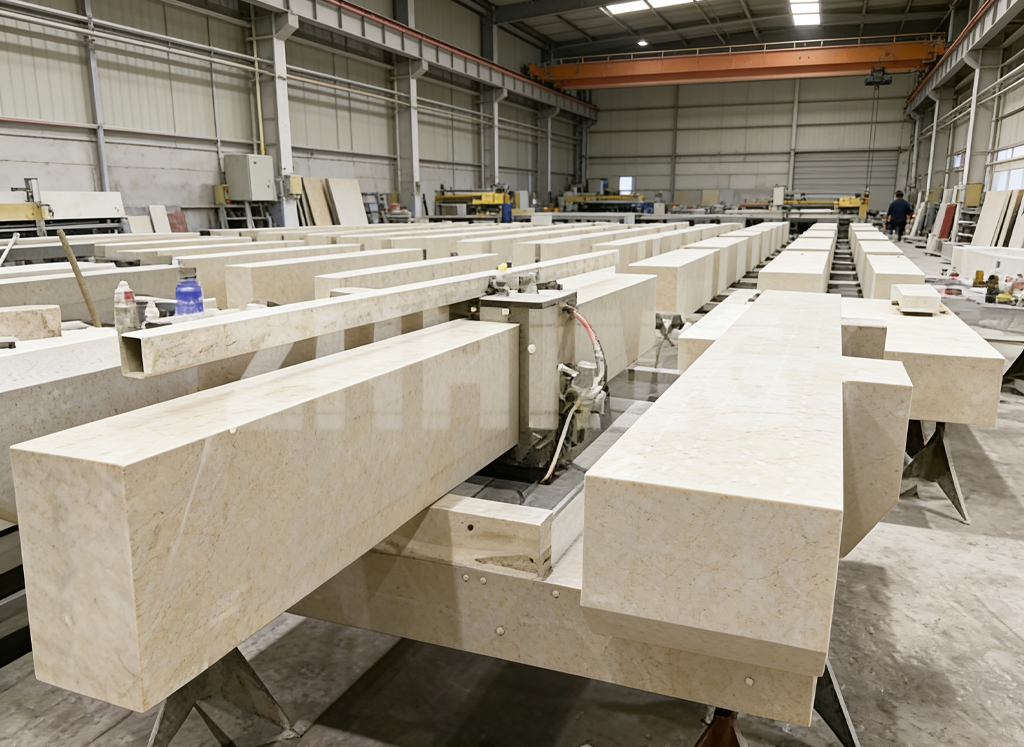
“The Walking Electronic Levels”: The Art of Human Touch
At ZHONGHUI Group, our greatest competitive asset is not just our machinery, but our master craftspeople. Many of our senior technicians possess more than 30 years of continuous, hands-on manual lapping experience.
Through decades of repetition, these specialists have developed tactile sensitivity that mirrors electronic instrumentation. In the industry, clients affectionately refer to them as “walking electronic levels.”
When refining a granite air bearing beam or a reference straight edge to a 1-micron standard (1 µm), these master lappers can feel a deviation of a single micrometer merely by sliding their hands across the pre-wiped surface. They know exactly how much abrasive pressure to apply, and precisely where to apply it, to remove just a few nanometers of material from localized high spots.
Meeting Rigid International Quality Frameworks
This blend of human skill and material science allows us to consistently meet and exceed the world’s most demanding metrology standards:
-
DIN 876 (Germany): Ensuring absolute flatness classifications for precision laboratory operations.
-
GGGP-463C-78 (United States): The federal benchmark for military and defense aerospace calibration plates.
-
JIS (Japan) & GB (China): Satisfying high-tech manufacturing frameworks globally.
As our corporate quality policy states: “The precision business can’t be too demanding.” While automation builds the heavy foundations of modern industry, it is the human touch that perfects them to the nanometer.
Post time: Jul-09-2026