
The Hidden Enemy of Nanometer Yields: Thermal and Vibrational Instability
In the semiconductor back-end and front-end manufacturing sectors, the margin for error has shrunk past the micron scale and firmly entered the nanometer domain. Whether dealing with high-speed pick-and-place flip-chip bonders, PCB drilling machines, automated optical inspection (AOI) systems, or next-generation perovskite coating machines, machine builders face a shared enemy: micro-vibrations and thermal drift.
Traditional structural metals, such as cast iron and structural steel, possess high mechanical strength but fail critically under ultra-precision parameters. Metals are thermal conductors; they expand and contract rapidly with minor cleanroom temperature fluctuations. Furthermore, metals lack sufficient internal damping properties, meaning they propagate structural resonance from linear motors and nearby factory traffic rather than absorbing it.
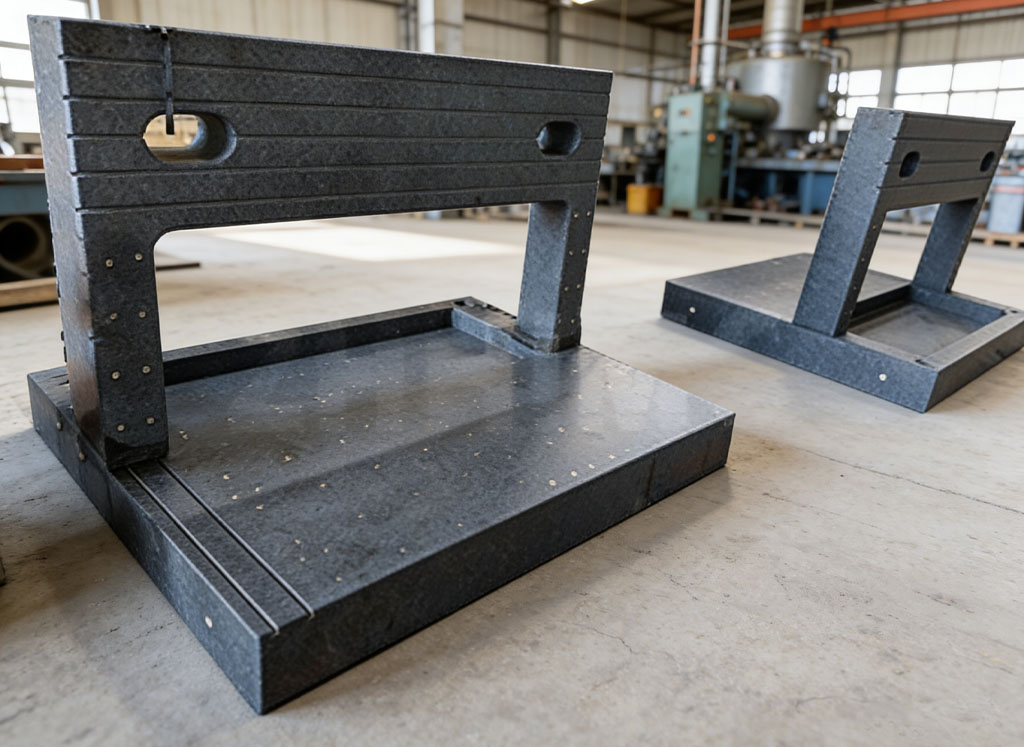
To bypass these physical limitations, the world’s leading semiconductor and metrology OEMs have shifted entirely to a natural, high-performance alternative: premium black granite.
The Physics Behind ZHHIMG® Black Granite
Not all granite is created equal. Commercial or architectural granite varies wildly in porosity, quartz distribution, and mineral density. For industrial-grade metrology and lithography bases, engineered precision stone like ZHHIMG® Black Granite is mandatory.
| Property | Industrial Metrology Value |
| Material Density | ~3100 kg/m³ |
| Thermal Conductivity | Extremely Low (Natural Insulator) |
| Coefficient of Thermal Expansion | Minimal (High Dimensional Stability) |
| Vibration Damping Ratio | Significantly higher than Cast Iron & Steel |
With a dense mineral structure yielding a density of approximately 3100 kg/m³, this specific material outperforms standard Western and European black granites. Its massive physical density translates directly into inertia, providing a rigid, unyielding foundation for multi-axis XY linear motor stages traveling at high velocities and accelerations.
Eliminating Resonance: High Internal Damping
When a linear drive accelerates, reverses, or stops on a machine bed, it injects kinetic energy back into the chassis. In a steel frame, this energy rings out as continuous micro-vibrations, causing the optical sensor or laser head to settle slowly—a massive bottleneck for throughput.
Black granite acts as a natural shock absorber. Its complex, crystalline composite matrix dampens high-frequency harmonic vibrations exponentially faster than cast iron. By suppressing structural resonance, semiconductor inspection tools can achieve near-instantaneous settling times, boosting overall equipment efficiency (OEE) and protecting fragile silicon wafers from micro-fractures during positioning.
Absolute Thermal Inertia in Sub-Micron Environments
Cleanrooms are engineered to maintain tight temperature bands, but localized heat zones—such as from power supplies, servo motors, or laser modules—are inevitable.
Because ZHHIMG® Black Granite exhibits an incredibly low coefficient of thermal expansion, it remains dimensionally inert when exposed to localized thermal gradients. Where a metal beam would warp or bow by several microns (throwing off the calibration of a Renishaw laser interferometer or an industrial CT system), a granite base maintains its absolute geometric flatness.
A Validated Global Standard for Tech Leaders
The adoption of precision granite bases is no longer optional; it is the industry benchmark. Global technology giants and semiconductor automation firms, including Samsung, Apple, and Akribis Systems, explicitly mandate granite foundations for their core alignment and inspection sub-assemblies.
As structural demands grow increasingly strict, the partnership between material science and mechanical engineering must deepen. Utilizing optimized high-density black granite ensures that as chips become smaller, the machines that build them remain perfectly stationary.
Post time: Jul-09-2026