
You’ve invested in a state-of-the-art coordinate measuring machine. The software is calibrated. The probes are certified. And yet, your measurements drift. Not by much—just a micron here, half a micron there. But in the world of ultra-precision metrology, that drift is the difference between pass and fail, between quality and rework, between profit and scrap.
What Is Thermal Drift, Really?
Thermal drift occurs when temperature variations cause the structural components of a measurement system to expand or contract unevenly. When a CMM’s components—the frame, scales, guides, or base—expand unevenly, they introduce geometric distortions that lead to measurement errors。
The problem is insidious because it’s invisible. You can’t see the 9°C vertical temperature gradient across a granite lintel, but it can produce a linear change of apparent length at a rate averaging about 1 μm per degree Celsius。In nanometer-level metrology, that’s catastrophic.
Even the mandated narrow temperature range of a metrology lab—typically 20°C ± 0.5°C—can induce enough thermal strain in metal structures to cause significant measurement drift. Steel has a CTE roughly twice that of granite. Aluminum has a CTE roughly three times higher. When the room temperature cycles—as it does in any real-world facility—metal components expand and contract at different rates than the granite base, creating measurement uncertainty that’s baked into every reading.
Why Granite Is the Thermal Shield
The solution isn’t more aggressive temperature compensation algorithms. It’s a foundation that doesn’t move in the first place.
Granite’s exceptionally low CTE minimizes dimensional change, maintaining the critical geometric relationship between the CMM’s axes and the measured part. Our ZHHIMG® black granite, with its density of ≈3100 kg/m³, offers thermal stability that exceeds most European and American black granites. The massive thermal mass of a granite base acts as a giant passive heat sink, dampening temperature fluctuations and maintaining an isothermal environment for the entire measuring volume.
But the material alone isn’t enough. The environment matters just as much.
Engineering a Thermally Stable Environment
At ZHHIMG®, we’ve taken thermal stability to an industrial extreme. Our 10,000-square-meter constant temperature and humidity workshop is built on a 1000mm-thick ultra-hard concrete foundation. The workshop is surrounded by anti-vibration trenches measuring 500mm in width and 2000mm in depth. Inside, specialized silent cranes operate to maintain a completely vibration-free and thermally stable environment.
But we go further. We maintain a dedicated constant-temperature, constant-humidity cleanroom that simulates semiconductor equipment manufacturing environments—specifically designed for granite component assembly. This isn’t just about keeping the temperature at 20°C. It’s about eliminating thermal gradients across large structural components during the most critical phase of production: final assembly and inspection.
The Measurement Chain
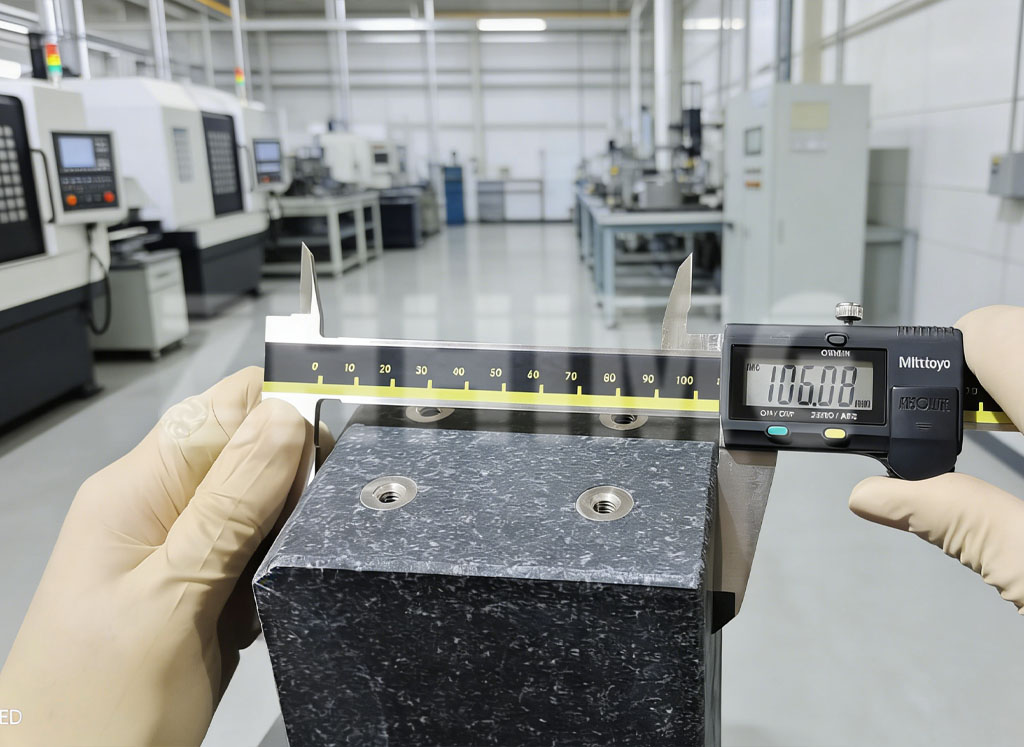
Of course, you can’t control what you can’t measure. That’s why our metrology lab is equipped with the world’s most advanced measurement instruments: German Mahr dial gauges (0.5 μm resolution), Mitutoyo micrometers and digital calipers, Swiss WYLER electronic levels, and British Renishaw laser interferometers. Every instrument carries calibration certificates from the Jinan Institute of Metrology and the Shandong Institute of Metrology—and every product calibration can be traced back to the National Institute of Metrology of China.
The Human Element
Here’s something the textbooks don’t tell you: even the best equipment and the most stable environment can’t replace human judgment. Our master grinders, each with over 30 years of hand-lapping experience, can determine exactly how many microns of material they’re removing with a single stroke. Our customers call them “walking electronic levels”. They don’t just follow a process; they feel the material, sensing resistance changes that indicate microscopic variations in flatness.
This tactile feedback loop—combining world-class infrastructure with irreplaceable human intuition—ensures that every ZHHIMG® granite component, from surface plates to air bearings, meets the most demanding global standards.
Practical Advice for Buyers
If a supplier quotes “granite” without specifying whether it’s quarried stone or mineral casting, ask directly—the price difference, the achievable geometry, and the long-term stability profile are different enough that the distinction should be part of any technical spec sheet. For high-precision metrology work in particular, request the actual density, CTE, and flatness tolerance achieved—not just the material name.
Because in the world of nanometer-level measurement, thermal drift isn’t a problem you solve with software compensation. It’s a problem you prevent with the right material, the right environment, and the right people.
Post time: Jul-08-2026