
The Industrial Sourcing Trap: Lower Costs vs. Lifespan Failure
In industrial procurement, staying within budget is critical. However, when sourcing machine beds, air bearing guides, or surface plates for metrology applications, substituting specified materials for cheaper alternatives is a catastrophic compounding mistake.
A growing and problematic trend in the global supply chain involves small-scale suppliers offering ultra-low bids by substituting genuine, high-density industrial Black Granite with commercial Marble. To an untrained eye or a remote purchasing department looking at a low-resolution digital catalog, both materials appear to be dark, heavy stone. In practice, they behave like entirely different elements under scientific conditions.
Chemical and Structural Realities: Why Marble Fails
To understand why marble is entirely unsuited for precision engineering, one must look at its geological taxonomy. Marble is a metamorphic rock formed from altered limestone (predominantly calcium carbonate). It is relatively soft, highly porous, and structurally vulnerable to environmental changes.
Conversely, Industrial Black Granite (ZHHIMG® Grade) is an igneous rock formed from cooling magma, consisting of dense plagioclase, pyroxene, and minor quartz. It possesses a dense mineral structure with a density of roughly 3100 kg/m³.
| Characteristic | True Black Granite (~3100kg/m³) | Commercial Marble (Cheap Alternative) |
| Mohs Hardness Scale | 6 to 7 (Extremely Scratch-Resistant) | 3 to 4 (Soft, Easily Marred) |
| Moisture Absorption | Negligible / Hydrophobic properties | High Porosity (Prone to Swelling) |
| Chemical Resistance | Inert to acids and industrial solvents | Readily etched by mild chemical exposure |
| Dimensional Stability | Permanent over decades of operational life | Warps under humidity and internal stress |
The Cost of 5 Microns: How Warp Destroys CMM Calibration
Consider a coordinate measuring machine (CMM) or an optical coordinate scanner deployed in an automotive or aerospace QA laboratory. If the base of that machine is crafted from cheap marble, it remains highly sensitive to ambient humidity and atmospheric moisture.
As marble absorbs moisture from the air, it undergoes subtle, non-uniform volumetric swelling. A deviation of just 5 micrometers (5 µm) across a surface plate—invisible to the naked human eye—will completely invalidate the volumetric accuracy of a CMM. When a multi-million dollar semiconductor run or an aerospace turbine blade batch fails final quality gates because the factory’s reference base warped under atmospheric shifts, the “savings” from choosing a cheap supplier vanish instantly.
Furthermore, because marble is physically soft, it scratches easily when heavy steel parts or fixtures are placed upon it. A scratch on a precision surface creates raised burrs, which lift metrology tools or components slightly off the true plane, generating false-positive errors during manual inspection.
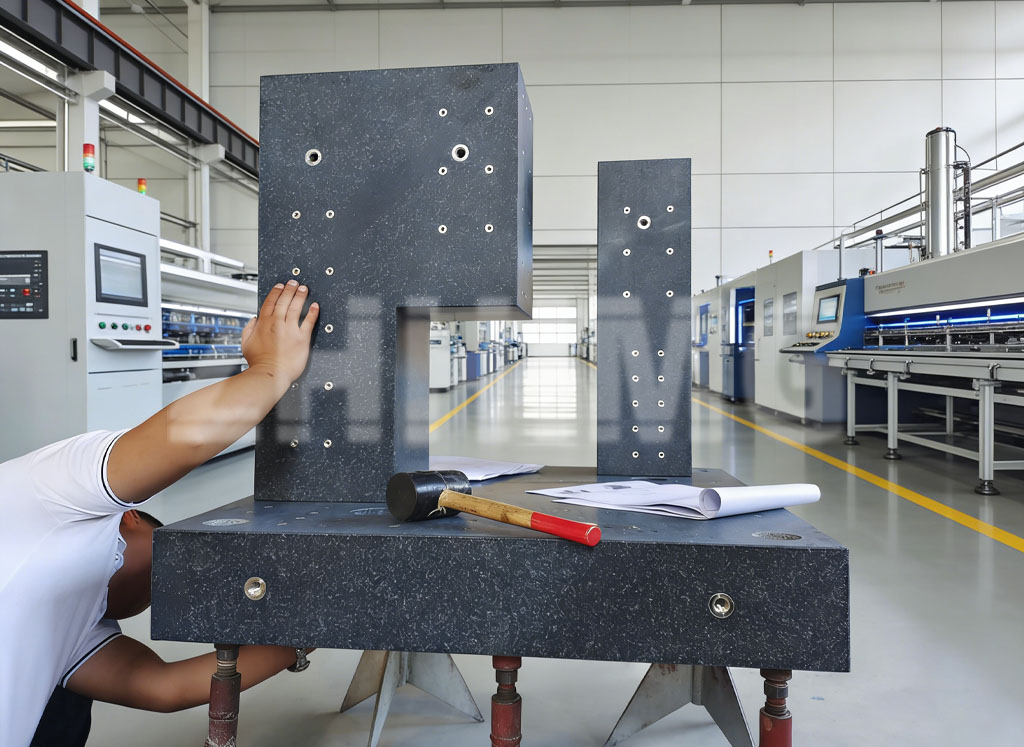
Combating Deceptive Practices in Industrial Sourcing
At ZHONGHUI Group (ZHHIMG®), our global customer commitment is foundational: No cheating, No concealment, No misleading. We actively discourage and condemn the practice of misrepresenting soft marble or low-grade gabbro as high-precision black granite.
Every precision surface plate, square ruler, and custom structural component leaving a certified facility must be verified by ultra-precise instrumentation—such as Swiss WYLER electronic levels and German Mahr indicators (0.5 µm). This ensures that the material meets strict international guidelines, such as the German DIN 876 standard or the American GGGP-463C-78 specification.
Procurement Checklist for Metrology Assets
When reviewing quotes for your next precision base, require your vendor to supply:
-
Certified Density and Material Data Sheets: Ensure the raw material shows a verified density of $\ge$ 3000 kg/m³.
-
Traceable Calibration Certificates: The verification tools used must be traceable to recognized National Metrology Institutes.
-
Rigid Compliance Paperwork: Verify that the production facility simultaneously holds independent ISO 9001 (Quality), ISO 14001 (Environmental), and ISO 45001 (Safety) credentials.
Investing in high-density black granite isn’t just about purchasing raw stone; it is about buying long-term dimensional insurance for your factory’s precision.
Post time: Jul-09-2026