
Within cleanrooms of semiconductor production lines, numerous subtle micro‑vibrations are omnipresent. Disturbances stem from vacuum pumps, fans, startup‑shutdown of peripheral equipment, material transfer mechanisms and even floor excitation caused by personnel movement. For semiconductor processes such as lithography‑related inspection, wafer surface scanning, AOI optical inspection and perovskite thin‑film coating, nanometer‑scale jitter can trigger optical path offset, alignment deviation and imaging ghosting, directly reducing wafer yield. Many equipment manufacturers deploy air‑spring vibration isolators to block vibration transmitted from the ground. Nevertheless, isolation units can only suppress externally incoming vibration. Reaction‑force vibration generated by high‑speed start‑stop of linear motors and reciprocating acceleration of moving modules inside equipment still acts on the main machine frame. Under such circumstances, the inherent damping capacity of the gantry frame becomes critical to restrain internal vibration propagation. Thanks to its native vibration‑absorbing properties, granite gantry structures match the special operating conditions of semiconductor equipment.
Even fitted with external vibration isolators, metal‑made gantries have inherent limitations. Steel and cast iron deliver low damping coefficients. Once vibration enters metal frames, it decays slowly and tends to produce sustained residual oscillation and ringing effect. When linear motors accelerate and decelerate rapidly, moving modules generate impact reaction forces, and metal gantries keep oscillating, requiring lengthy settling time to regain stability. In high‑speed semiconductor inspection scenarios, equipment continuously scans wafers. Long waiting periods for vibration dissipation drag down overall throughput. If sampling is performed before vibration fully fades, distorted measurement data will occur. Some manufacturers increase metal wall thickness to enhance rigidity, yet this cannot fundamentally improve damping performance. It merely cuts vibration amplitude rather than accelerating vibration‑energy dissipation.
High‑density granite gantries rapidly dissipate vibration energy through internal friction among mineral crystal interfaces, instead of merely resisting vibration impact by rigidity. When reaction‑force vibration originating from internal motion mechanisms propagates to gantry beams and columns, vibrational energy gets dissipated at micro‑crystal boundaries of stone. Vibration decays far faster than in metallic counterparts, effectively shortening system settling time. Even if minor vibration penetrates isolation systems and enters equipment, granite gantries further reduce vibration amplitude and prevent vibration from propagating along beams to key precision components including optical lenses, interferometers and wafer stages. For semiconductor inspection equipment, motion completion is quickly followed by valid sampling. Nano‑scale inspection accuracy is guaranteed while boosting wafer throughput per unit time.
Beyond material‑intrinsic damping characteristics, monolithically formed granite gantries further amplify vibration‑reduction performance. For large‑span semiconductor‑equipment gantries assembled from multiple metal segments, splicing joints serve as vibration reflection points. Vibrations bounce and superimpose between separate segments, easily inducing local resonance. ZHHIMG fabricates large‑size monolithic granite gantries, eliminating vibration reflection issues brought by spliced interfaces and forming continuous, complete paths for vibrational‑energy dissipation. Meanwhile, the non‑magnetic property of high‑density granite fits clean‑room environments for semiconductors. It generates no magnetic interference for electron beams and various sensors, avoiding extra signal noise and creating synergistic benefits alongside vibration‑damping performance. 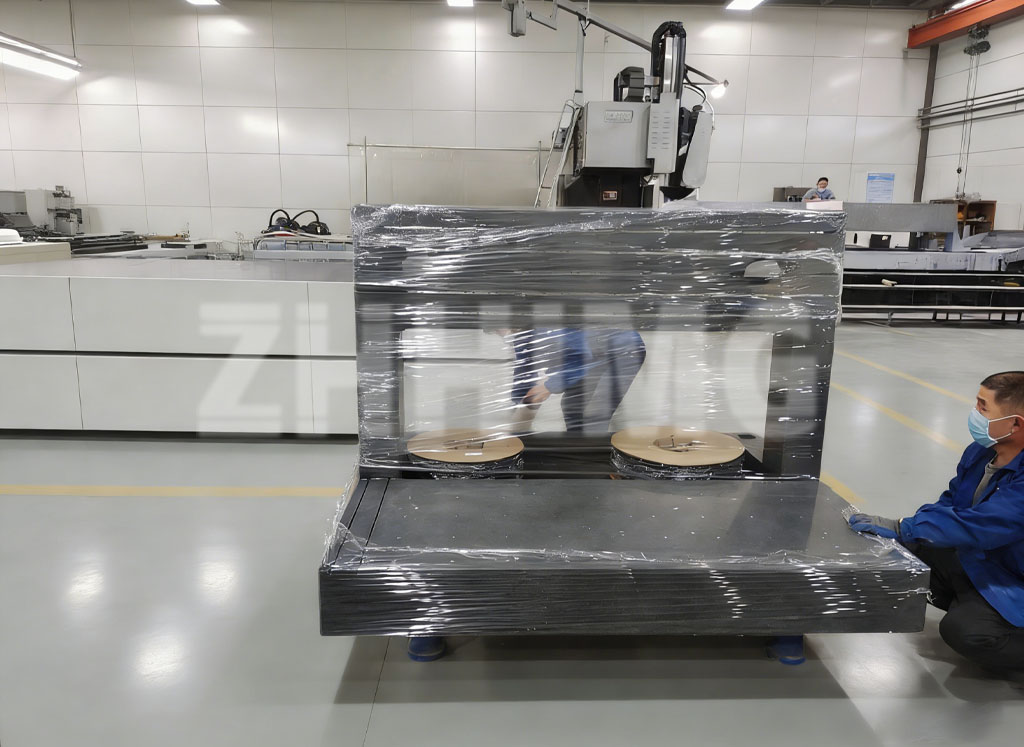
It should be noted that vibration‑suppression capacity heavily depends on raw‑material quality. Loosely‑structured ordinary marble delivers far inferior damping performance compared with high‑density black granite. Some low‑cost suppliers pass off marble as granite, resulting in poor vibration suppression under semiconductor operating conditions, along with persistent imaging jitter and alignment errors. ZHHIMG selects premium black‑granite blanks with a density of approximately 3100 kg/m³. Multi‑stage aging relieves machining‑induced stress. Grinding is completed inside dedicated constant‑temperature anti‑vibration workshops. Full sets of traceable metrological instruments are adopted to verify dynamic performance of finished parts. Granite gantries cooperate with external air‑spring isolators: one set attenuates ground‑borne vibration while the other dissipates internal vibration generated by equipment itself, forming dual‑sided vibration‑reduction solutions.
In advanced semiconductor packaging, wafer inspection, optical metrology and other scenarios, granite gantries function not merely as mechanical skeletons supporting guide rails, linear encoders and moving modules, but also as built‑in damping systems. They confine micro‑vibration within process‑allowable ranges, reduce various process‑related defects triggered by vibration, and help semiconductor equipment steadily achieve nanometer‑level process specifications.
Post time: Sep-08-2026