
Granite machine bases provide superior thermal stability and vibration damping for precision equipment, making them the preferred structural material for semiconductor fabrication, coordinate measuring machines, and ultra-precision laser systems.
When engineers design high-precision equipment — whether it is a coordinate measuring machine (CMM), a semiconductor lithography stage, a precision laser cutting system, or a PCB drilling machine — the material choice for the machine base is one of the most consequential decisions in the entire design. The base must dampen vibrations from the surrounding environment, resist thermal deformation, and maintain its geometric integrity under dynamic loads. For the most demanding applications, granite machine bases have become the standard structural material, replacing cast iron and steel in facilities where micron and sub-micron precision is the baseline requirement.
The Physics Behind Granite Machine Bases
The appeal of granite as a structural material for precision equipment lies in its combination of favorable physical properties. The critical parameters for machine base applications are thermal stability, damping capacity, and stiffness-to-weight ratio.
Thermal stability is perhaps granite’s most significant advantage. The coefficient of thermal expansion for high-density black granite is approximately 0.000005 per degree Celsius (5 × 10⁻⁶/°C), which means a one-meter granite beam will change length by only about 5 micrometers per degree Celsius. For equipment operating in environments with typical temperature variations of 2-5°C over a workday, this translates to positional errors that are easily managed within the machine’s compensation algorithms.
Damping capacity is another property where granite excels. Granite naturally dissipates vibrational energy more effectively than cast steel or aluminum, which means machines mounted on granite bases are less susceptible to externally induced vibrations from floor traffic, HVAC systems, or nearby machinery. This is particularly important for equipment performing measurements or processes that require extended integration times, such as optical inspection systems or scanning probe microscopy.
Stiffness-to-weight ratio is adequate for granite, though it is not the material’s strongest characteristic. However, granite’s high density (approximately 3,100 kg/m³ for quality black granite) means the mass of a granite base provides excellent inertia against dynamic disturbances.
Applications Across Precision Industries
The range of equipment that uses granite machine bases and structural components is broad and growing. The following applications represent the most significant market segments:
Semiconductor fabrication equipment: Wafer handling stages, lithography alignment systems, and inspection tools require sub-micron positioning accuracy. Granite’s thermal stability ensures that critical alignments do not drift during processing cycles.
Coordinate measuring machines (CMM): CMMs measure manufactured parts to tolerances often measured in micrometers. Any flexure or thermal movement in the machine structure directly translates to measurement error. Granite bridges, columns, and bases are standard in modern CMM design.
PCB drilling and routing machines: The high-speed spindles used in printed circuit board manufacturing generate significant vibration. Granite base structures damp these vibrations, protecting hole positional accuracy.
Precision laser systems: Femtosecond and picosecond lasers are used for micro-machining and micro-machining applications where positioning accuracy at the micron and sub-micron level is critical. Air bearing linear guides mounted on granite provide the straightness and smoothness required.
Linear motor stages and XY tables: Many high-speed positioning systems use air bearing linear guides. The guide surfaces for these systems are often granite because of granite’s ability to maintain flatness over long traverses and its compatibility with air film lubrication.
X-ray and CT inspection equipment: Industrial CT scanners and X-ray inspection systems require vibration-free platforms to produce clear cross-sectional images. Granite bases provide the stability necessary for sub-micron CT resolution.
Air Bearing Granite: Enabling Frictionless Motion
Air bearings represent one of the most demanding applications for granite structural components. In an aerostatic or aerodynamic bearing, a thin film of compressed air separates the moving carriage from the stationary guide surface, creating frictionless motion with virtually no wear over the bearing’s lifetime.
For air bearing applications, the granite guide surface must meet extremely stringent requirements:
- Flatness measured in fractions of a micrometer over the full travel length
- Surface roughness typically below Ra 0.2 μm to ensure uniform air film thickness
- Straightness maintained consistently along the entire guide length
- Hardness and wear resistance to prevent any surface degradation that could compromise the air film
Achieving these specifications requires precision grinding with specialized equipment — typically CNC-controlled surface grinders with Diamond grinding wheel or CBN grinding wheels. The measuring equipment used to verify these tolerances must be at least an order of magnitude more precise than the tolerances themselves, typically involving laser interferometers or electronic levels with sub-micron resolution.
Manufacturing Capabilities: What Scale Means for Buyers
The size of granite structural components can vary dramatically depending on the application. Small granite ways and guide surfaces may be only a few hundred millimeters long, while large machine bases for equipment such as large-format CMMs or floor-standing laser systems can exceed 3 meters in length, with some specialized applications requiring components up to 6 meters or longer.
Buyers should evaluate a supplier’s manufacturing capability against their specific size requirements. Key questions include:
- What is the maximum length the supplier can grind to flatness tolerances below 1 μm/m?
- Does the supplier have the lifting and handling equipment for the required component weight?
- Can the supplier produce custom profiles, T-slots, or mounting features as part of the granite structure?
For very large components, the supplier’s measurement capability becomes as important as its grinding capability. A manufacturer that grinds a 5-meter granite beam but cannot measure its flatness to the required tolerance cannot reliably produce a quality part.
Quality Standards and Traceability
Like surface plates, granite structural components should be manufactured and certified to recognized standards. Relevant standards include:
- DIN 876 — Flatness tolerances for granite measuring and machine surfaces
- ISO 8512 — Granite surface plates for inspection and marking
- ASTM GGG-P-463C — Government specification for granite surface plates (also referenced for machine bases)
- JIS B 7513 — Japanese standard for granite surface plates
Beyond flatness, buyers should specify requirements for surface roughness, squareness of perpendicular features, and parallelism of guide surfaces. All measurements should be traceable to national metrology standards, typically through the supplier’s calibration certificates issued by an accredited calibration laboratory.
Why Black Granite Matters for Structural Applications
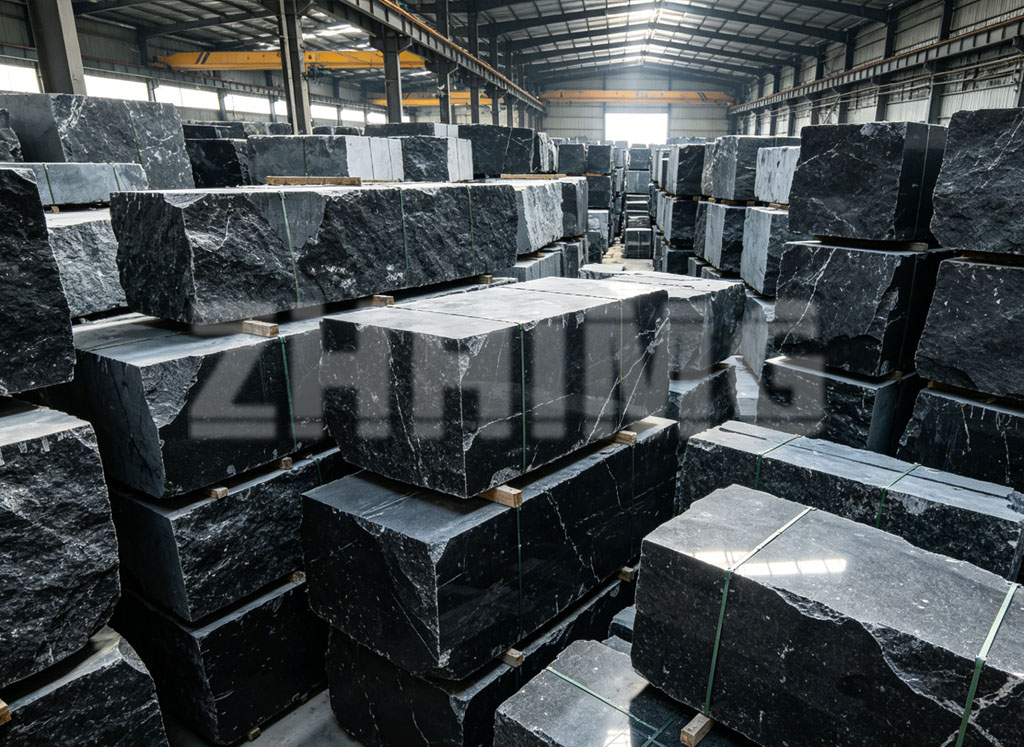
The color of granite is not merely an aesthetic consideration. Black granite — specifically certain geological formations with high feldspar and quartz content — offers superior physical properties for precision applications. Black granite typically has higher density, finer grain structure, and more consistent mineral distribution compared to lighter-colored varieties.
The higher density of quality black granite (approximately 3,100 kg/m³) translates directly to better damping performance. The finer grain structure allows for smoother ground surfaces, which is critical for air bearing applications. And the consistent mineral distribution ensures that the material’s thermal expansion behavior is uniform in all directions.
Buyers should be cautious of suppliers offering granite structural components at significantly below-market prices. The likely explanation is substitution of lower-quality granite, including materials that would more accurately be classified as marble or low-density granite. The cost savings are illusory if the machine base does not maintain its geometry over the equipment’s operating lifetime.
Frequently Asked Questions
What is the maximum size for granite machine bases?
Some manufacturers can produce granite structural components up to 20 meters in length, with widths up to 4 meters and thicknesses up to 1 meter. For most industrial equipment applications, sizes in the 1-6 meter range are most common.
How does granite compare to cast iron for machine tool bases?
Granite offers better thermal stability and damping, while cast iron offers higher stiffness-to-weight ratio and easier casting into complex shapes. For measurement and inspection equipment where thermal stability is paramount, granite is generally preferred. For machine tools with high dynamic loads, cast iron or mineral casting may be more appropriate.
What flatness tolerances can be achieved on large granite machine bases?
For components up to 3 meters, flatness tolerances of 1 μm/m or better are routinely achievable. Larger components require more specialized equipment and measurement systems, but tolerances of 2-5 μm/m over several meters are achievable with qualified suppliers.
How are granite machine bases mounted and leveled?
Granite bases typically incorporate threaded inserts or precision-machined mounting features for attachment tosupporting structures. Leveling is achieved using precision leveling screws or vibration-isolation pads at specified support points. The manufacturer’s mounting recommendations should be followed to prevent induced stress in the granite.
What causes granite structural components to lose flatness over time?
The most common causes are physical damage from impacts or improper handling, stress induced by improper mounting, and thermal cycling over very long periods. With proper installation and handling, quality granite components maintain their geometry for decades.
Post time: Jun-08-2026