
Every precision machine — a CMM, a wafer prober, a laser interferometer stage — starts with something most engineers never think twice about: the base. Yet the base is where accuracy either survives or quietly erodes. Vibration, thermal drift, and long-term deformation all trace back to the material sitting under the moving parts. Choosing between granite, mineral casting, and ceramic is not a stylistic decision. It’s a mechanical one, and it deserves more scrutiny than it usually gets.
Why the base material matters more than it looks
A frame can be beautifully machined and still fail to hold micron-level tolerance if the base breathes with the room temperature, or if it carries residual stress from casting. Metrology labs learn this the hard way: a surface plate that looked flat on delivery can drift 2-3 microns after a seasonal temperature swing. The base isn’t passive structure. It’s part of the measurement chain.
Granite: the metrology industry’s default
Natural granite has been the reference material for surface plates and machine beds for decades, and for good reason. It’s dimensionally stable, has low thermal expansion, and — critically — doesn’t creep the way cast metals do over years of service. Black granite in particular, quarried and finished to metrology grade, typically runs a density around 3,100 kg/m³, denser and more homogeneous than the marble sometimes substituted by lower-cost suppliers. That substitution is worth watching for; marble and granite are not interchangeable, whatever a quote sheet claims.
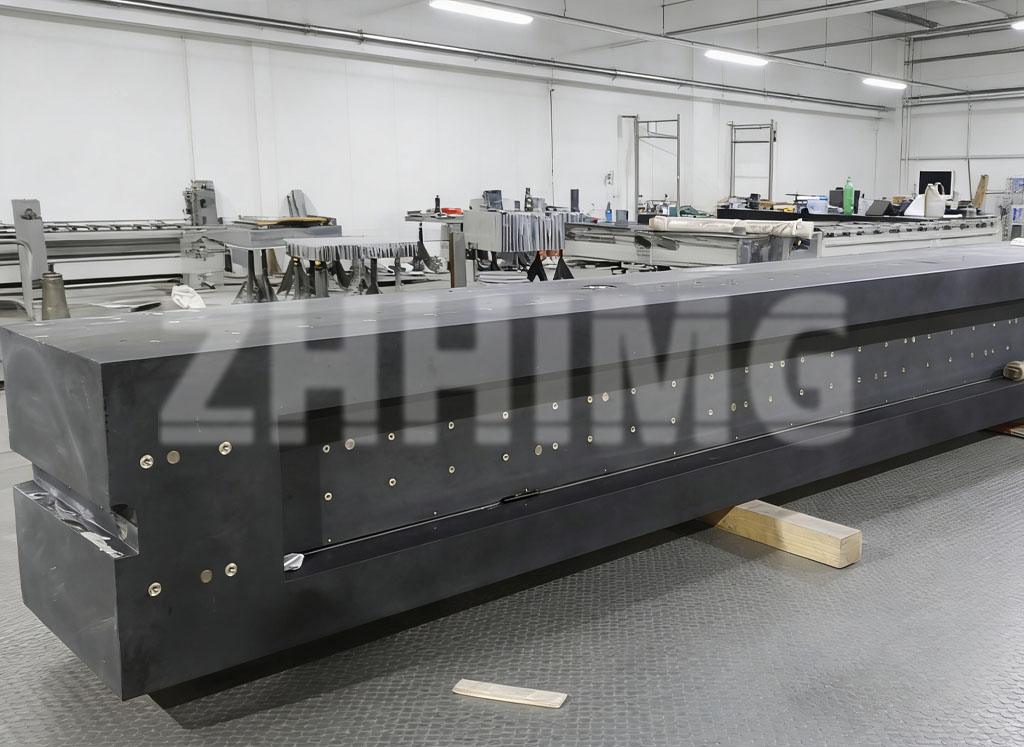
Granite’s damping characteristics are also genuinely useful — it absorbs vibration better than steel, which matters on shop floors near stamping presses or forklift traffic. The tradeoff is machinability: complex internal channels or cast-in mounting features are harder to achieve than with mineral casting, and very large monolithic pieces (some CMM bridges or beam structures now exceed 6-8 meters) require serious grinding capacity and long-span quality control.
In practice, most surface plates, CMM bases, granite v-blocks, parallels, and air-bearing platforms are granite for a reason: it’s the most field-proven option for anything requiring long-term dimensional integrity under normal factory conditions.
Mineral casting: geometry flexibility, good damping
Mineral casting (epoxy granite) is essentially crushed granite or quartz aggregate bound in a polymer resin, cast into a mold. Its appeal is design freedom — you can cast in ribs, cavities, mounting bosses, and cooling channels that would be prohibitively expensive to machine from solid stone. Damping is excellent, often better than natural granite, which is why it shows up frequently in machine tool beds and grinding machine frames.
The compromise is thermal and long-term stability. Resin systems are more sensitive to temperature and humidity than natural stone, and while modern formulations have improved significantly, they still don’t match granite for applications demanding sub-micron stability over years. For general industrial machine frames, mineral casting is a solid, cost-effective choice. For metrology-grade reference surfaces, it’s less common.
Ceramic: the high end, for good reason
Precision ceramic — typically alumina or silicon carbide based — sits at the top of the performance curve for thermal stability and stiffness-to-weight ratio. It has one of the lowest thermal expansion coefficients among the three, which matters enormously in semiconductor lithography, wafer inspection, and optical measurement systems where even a fraction of a degree can shift a reading. Ceramic components are also non-magnetic and highly wear-resistant, useful for air-bearing surfaces and precision guideways.
The catch is cost and size limitation. Sintering large ceramic components is expensive and technically demanding, and very large monolithic ceramic bases simply aren’t practical yet. Ceramic tends to appear as a component-level solution — bearing surfaces, small stages, measuring elements — rather than as a full machine bed.
Making the actual decision
In our own shop, the material choice usually comes down to three questions before anything else: What’s the operating temperature range? What’s the required long-term flatness tolerance? And what’s the physical size envelope? A CMM bridge or a semiconductor XY table generally points to granite. A machine tool frame with complex internal geometry often points to mineral casting. A small, ultra-critical measuring element in a temperature-sensitive optical path often points to ceramic, sometimes paired with a granite base for the surrounding structure.
We’ve ground granite platforms up to 6 meters in temperature- and humidity-controlled shop floors, and the recurring lesson is that material selection errors are expensive to discover after installation — usually months later, when a plate that measured flat in the factory no longer does on the customer’s floor. Whichever material a project calls for, it’s worth requesting calibration traceability documentation and asking directly how the manufacturer verified flatness and stability under real operating conditions, not just at time of shipment. That single question tends to separate serious suppliers from the rest.
A practical checklist before specifying
- Confirm the operating environment’s temperature and humidity range, not just the spec sheet’s “room temperature”
- Ask for actual flatness tolerance data, not just density or hardness numbers
- Check whether the surface plate or base is genuine granite or a lower-density substitute
- For large monolithic structures, ask about the manufacturer’s maximum single-piece processing capability
- Request calibration certificates traceable to a national metrology institute, not an internal lab report
Material selection for precision bases isn’t glamorous work, but it’s the part of the design that quietly determines whether a measurement system holds its accuracy for ten years or two. Granite, mineral casting, and ceramic each solve a slightly different problem — the job is matching the material to the actual operating conditions, not the marketing sheet.
Post time: Aug-20-2026