
A quality control engineer walks into a production facility, reaches for a newly delivered granite surface plate, and begins setting up a measurement station. Within weeks, subtle deviations appear in inspection readings. Parts that previously passed quality checks now fall outside tolerance. The root cause: a surface plate that appeared acceptable upon delivery had internal stress fractures invisible to the naked eye, slowly deforming under operational loads.
This scenario plays out more often than procurement teams realize. The global market for precision granite components includes hundreds of manufacturers ranging from family-run workshops to industrial-scale operations. Distinguishing between a legitimate granite surface plate manufacturer with rigorous quality protocols and a broker selling reground rejects requires systematic evaluation. The stakes extend beyond the purchase price—a single compromised measurement surface can corrupt thousands of parts, trigger costly rework cycles, and damage client relationships built on documented quality compliance.
This guide presents a structured framework for evaluating granite plate suppliers, covering material science fundamentals, production capabilities, certification requirements, and long-term partnership considerations.
Raw Material Quality: Where Precision Begins
The performance envelope of any granite surface plate traces back to the physical properties of its source material. Natural granite formed over millions of years under geological pressure exhibits crystalline structures that differ substantially between quarries and even between extraction zones within the same deposit.
Reputable granite plate suppliers typically source from well-documented mineral regions. The Jinan Black and Taishan Black varieties from Shandong Province, China, have established track records in precision metrology applications due to their consistent grain structure and low thermal expansion coefficients. The linear expansion coefficient for quality granite measures approximately 4.6×10⁻⁶/°C—roughly one-third that of cast iron—which translates directly to dimensional stability when ambient temperatures fluctuate during production shifts or seasonal changes.
Critical material specifications that procurement teams should verify include density exceeding 3 g/cm³, water absorption rates below 0.1%, and compressive strength of at least 120 MPa. These figures matter because porous or structurally inconsistent stone will absorb moisture unevenly, creating differential expansion that compromises flatness over time. Manufacturers should provide test documentation from recognized standards bodies—ASTM C97 in the United States, GB/T 9966 in China—confirming that incoming material batches meet declared specifications.
For applications in semiconductor fabrication, aerospace assembly, or medical device manufacturing, radiation safety becomes relevant. The European standard EN 1469 establishes limits for radionuclide content, requiring radium-226 levels below 100 Bq/kg. A professional granite surface plate factory will maintain documentation proving compliance with applicable regional safety regulations, not just performance specifications.
Manufacturing Processes: From Rough Block to Micron-Level Accuracy
Transforming raw stone into a precision reference surface demands controlled conditions and specialized techniques accumulated over decades. Understanding the production environment helps procurement specialists assess whether a manufacturer operates at the level their applications require.
Temperature stability during machining ranks among the most critical yet frequently overlooked factors. When granite undergoes grinding, heat generation at the contact interface causes temporary surface deformation. A controlled workshop maintaining temperature fluctuation within ±1°C prevents these thermal artifacts from being “frozen” into the finished surface. Manufacturers operating in uncontrolled warehouse environments may produce plates that appear flat during final inspection but exhibit gradual relaxation as internal temperature gradients equalize during shipping or installation.
Surface flatness tolerances follow standardized grading systems. The ISO 8512-2 international standard defines four grades, while national standards like ASME B89.3.7 (United States), DIN 876 (Germany), and GB/T 20428 (China) specify comparable accuracy levels:
| Grade | Flatness Tolerance | Typical Application |
|---|---|---|
| 000 / AA | ≤1.5 μm/m | Calibration laboratories, optical instrument certification |
| 00 / A | ≤3.0 μm/m | Coordinate measuring machines, precision part inspection |
| 0 | ≤6.0 μm/m | Industrial inspection, machine tool alignment |
| 1 / B | ≤12.0 μm/m | General workshop use, tool setup stations |
Surface roughness specifications typically require Ra values between 0.32 μm and 0.63 μm for work surfaces, with premium applications demanding finishes below Ra 0.025 μm. Achieving these finishes requires progressive grinding through multiple grit levels followed by hand-lapping with experienced technicians—a process that automated CNC systems cannot fully replicate for the highest precision grades.
Stress management during manufacturing deserves particular scrutiny. After initial cutting and rough shaping, quality-conscious manufacturers subject blanks to aging treatments lasting 48-72 hours, allowing internal crystalline stresses to equalize before precision grinding begins. Skipping or abbreviating this step risks dimensional instability in the finished product.
Customization capabilities distinguish serious manufacturers from commodity brokers. The ability to produce large-format plates exceeding 2000×1000 mm, machine precision pockets and threaded inserts, or fabricate non-rectangular geometries indicates genuine production capacity rather than simple resale operations.
Certification Framework: Separating Substance from Documentation
Certifications provide a baseline for supplier credibility, though procurement teams should understand what each standard actually verifies versus what buyers sometimes assume it guarantees.
Management system certifications like ISO 9001 (Quality), ISO 14001 (Environmental), and ISO 45001 (Occupational Health and Safety) indicate that a manufacturer maintains documented processes and conducts internal audits. These credentials matter, but they do not directly confirm that specific product accuracy specifications are met—only that the organization follows its own procedures.
Product-specific standards carry more direct relevance to measurement capability verification. ISO 8512-2, DIN 876, and ASME B89.3.7 define the test methods and tolerance values manufacturers claim compliance with. Procurement specifications should require that the granite surface plate factory provides current certificates demonstrating traceability to these standards.
Calibration certificates warrant careful examination. Reports from laboratories accredited to ISO 17025 carry international recognition for measurement competence. For North American applications, calibration traceability to NIST (National Institute of Standards and Technology) reference standards provides defensible documentation during quality system audits. European customers may require calibration bodies recognized under the International Laboratory Accreditation Cooperation (ILAC) framework.
Quality Verification Protocols: Beyond Paperwork
Effective quality assurance extends beyond collecting certificates. Procurement teams should understand what inspection methods manufacturers employ during production and how accuracy is verified before shipment.
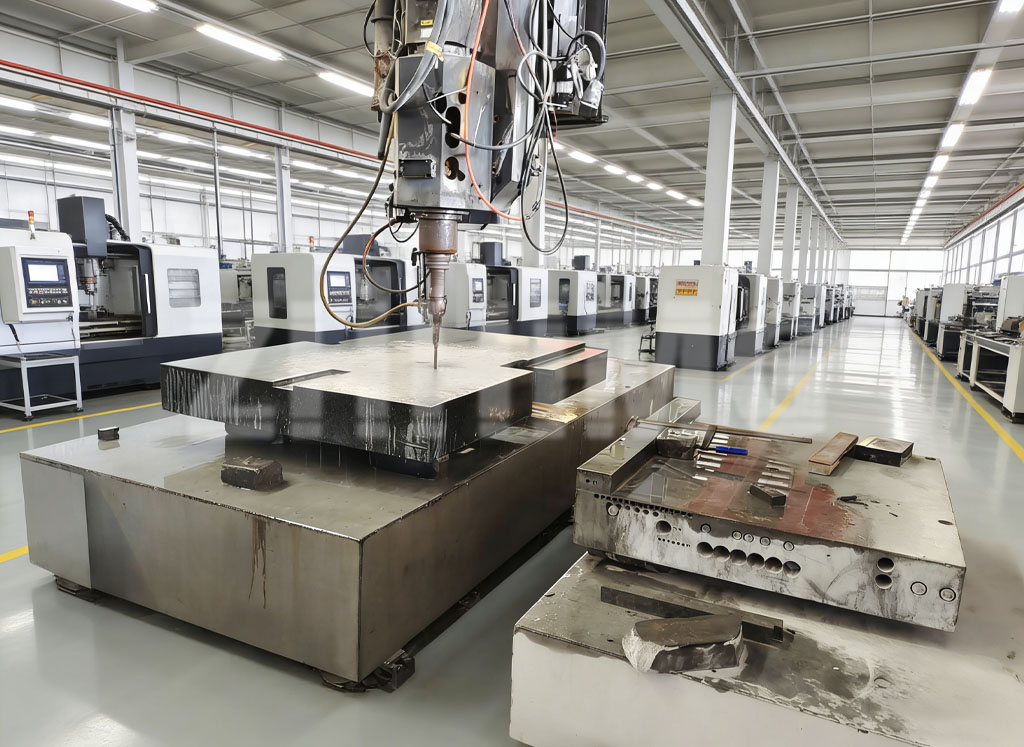
Flatness measurement typically employs one of several established techniques. The Moody method (also called Union-Jack pattern) measures elevation data along eight defined traverse lines across the plate surface, combining results into a three-dimensional flatness map. Electronic level systems with bridge plates offer efficient large-area coverage, while laser interferometry provides the highest precision for laboratory-grade verification. Each method has appropriate applications—the key is that measurement actually occurs using calibrated instrumentation, not simply that certificates exist.
Surface plate suppliers serious about quality control maintain metrology equipment including laser interferometers, precision electronic levels, and temperature-compensated measurement environments. They should welcome reasonable requests to witness verification procedures or review calibration records for the specific equipment used on ordered products.
Third-party verification by independent metrology laboratories provides additional assurance. Institutions with national accreditation can perform duplicate measurements to confirm manufacturer-reported accuracy. While this adds cost and turnaround time, it provides conclusive evidence for high-value purchases or applications with stringent compliance requirements.
Traceability systems allow any finished plate to be linked back to the specific material batch, production date, and inspection records from its manufacture. This capability proves essential when investigating field issues or demonstrating quality history during customer audits.
After-Sales Support: The Long-Term Partnership Dimension
Measurement reference surfaces require periodic recalibration and occasional restoration throughout their operational lifespan. The support infrastructure a manufacturer provides significantly impacts total cost of ownership and ongoing measurement confidence.
Warranty coverage should explicitly address material defects and workmanship failures, with minimum terms of one year for standard products. Extended warranty options signal manufacturer confidence in product durability.
Recalibration services—whether provided directly or through established metrology partners—should be available on a scheduled basis matching application requirements. High-precision laboratory applications often require annual verification, while production floor environments might tolerate longer intervals depending on usage intensity and tolerance requirements.
Technical responsiveness matters when measurement questions arise. Manufacturers capable of providing application engineering consultation, not just transactional sales, add value beyond the initial purchase. Questions about mounting configurations, environmental controls, or integration with specific measurement systems benefit from direct manufacturer expertise.
Precision restoration through professional regrinding can extend surface plate service life significantly. When surfaces develop wear patterns or minor damage, skilled technicians can restore accuracy without replacing the entire investment. Manufacturers offering this capability demonstrate commitment to long-term customer relationships rather than one-time transactions.
Building the Evaluation Framework
Armed with understanding of material science, manufacturing processes, certification systems, and support infrastructure, procurement teams can construct evaluation criteria appropriate to their specific requirements.
Factory audits provide irreplaceable insight during critical sourcing decisions. When visiting a potential granite surface plate manufacturer, attention should focus on climate-controlled machining areas, metrology equipment calibration records, and the experience levels of production personnel. Hand-grinding skill develops over decades and cannot be faked—ask about technician tenure and observe whether critical finishing operations involve experienced craftspeople.
Sample evaluation offers direct evidence of manufacturing capability. Requesting test pieces before committing to full production orders allows verification that claimed precision levels are achievable under the supplier’s actual production conditions.
Contract specifications should unambiguously define acceptance criteria, including measurement methodology, environmental conditions during testing, and procedures for resolving disputes when delivered products do not meet documented tolerances.
Cost considerations should weigh long-term value against initial purchase price. A plate requiring early replacement or generating measurement uncertainty costs far more than the price premium for demonstrated quality. Some organizations have documented monthly scrap costs exceeding six figures directly attributable to measurement reference surfaces that did not maintain declared accuracy—investments in reliable suppliers generate measurable returns.
Conclusion
Selecting among granite surface plate manufacturers requires moving beyond surface-level specifications to evaluate underlying capabilities that determine real-world performance. Material consistency, controlled manufacturing environments, rigorous verification protocols, and genuine technical support infrastructure combine to create products that maintain measurement confidence over years of service.
Procurement teams who invest time in systematic supplier evaluation protect their organizations from the compounding costs of measurement uncertainty—rejected parts, customer complaints, regulatory exposure, and the erosion of quality culture that accompanies unreliable reference standards. The framework presented here provides a foundation for those evaluations, adaptable to specific application requirements and organizational priorities.
Post time: Apr-15-2026