
Granite surface plates offer superior thermal stability and durability compared to metal alternatives, making them the preferred reference surface for precision measurement in labs and workshops worldwide.
For decades, quality control engineers have relied on granite surface plates as the foundational reference for dimensional metrology. Despite advances in materials science, these massive, precisely ground stone slabs continue to dominate inspection rooms, CMM bases, and calibration laboratories across industries ranging from aerospace to semiconductor manufacturing. The question is not whether granite is reliable — it has proven itself for generations — but rather which grade, what material properties, and what supplier can meet the increasingly stringent tolerances of modern manufacturing.
Why Granite Outperforms Metal for Precision Measurement
The physical properties of granite make it uniquely suited for use as a measurement reference surface. Unlike steel or cast iron, granite exhibits exceptional thermal stability — its coefficient of thermal expansion is remarkably low, meaning the plate’s dimensions change minimally when ambient temperature shifts. In practice, this translates to a surface that holds its flatness throughout the workday, even in environments without perfect climate control.
Granite also resists warping and deformation under load. A properly supported granite surface plate will maintain its flatness specification for decades with minimal maintenance. Many quality labs still use surface plates that are 20 or 30 years old, and the only maintenance required is periodic cleaning and recertification of the flatness grade.
Steel surface plates, by contrast, are prone to rust and require protective coatings that can introduce measurement errors. Cast iron plates are more susceptible to thermal drift. For any application where sub-micron measurements matter, granite is simply the more predictable choice.
Understanding Surface Plate Flatness Grades
Surface plates are classified by flatness tolerance, typically following standards such as ASTM GGG-P-463C, DIN 876, or ISO 8512. The most common grades are:
- · Grade 00: Flatness deviation ≤0.5 μm/m — used for the most demanding calibration laboratories and reference applications
- · Grade 0: Flatness deviation ≤1 μm/m — suitable for general inspection and CMM bases
- · Grade 1: Flatness deviation ≤2 μm/m — appropriate for workshop-level inspection and toolmaking
For most industrial quality control applications, Grade 0 provides the best balance between cost and performance. Grade 00 plates are typically reserved for national metrology institutes and primary calibration laboratories where traceability to national standards is required.
When selecting a surface plate, buyers should verify the applicable standard for their industry. Aerospace and defense contracts often require ASTM standards, while European manufacturers may specify DIN 876. A competent supplier should be able to manufacture and certify to any of these standards.
Material Matters: Why Black Granite Is Preferred
Not all granite is created equal. Black granite — specifically certain types with high mineral density — offers superior performance characteristics for precision measurement applications. The key parameters are density and mineral composition.
High-density black granite (typically around 3,100 kg/m³) provides better flatness stability and resistance to wear compared to lighter granite varieties. Lower-quality materials, including certain marble substitutes sometimes offered by cost-cutting suppliers, will not maintain flatness over time and can introduce systematic measurement errors.
Prospective buyers should ask suppliers to provide material certification confirming the granite’s physical properties. A reputable manufacturer will readily supply this documentation. Any supplier that cannot or will not confirm the material composition should be viewed skeptically.
Size Selection: Getting the Working Area Right
Surface plates come in a wide range of dimensions, from small 300mm × 200mm lab plates to large plates exceeding 3,000mm in length. The working area should be sized to accommodate the largest workpiece or fixture that will be placed on it, while leaving sufficient margin for proper support and access.
Common size categories include:
- · Small (up to 600mm): Electronic components, precision tooling, small mechanical parts
- · Medium (600mm to 1,500mm): Gear inspection, medium-sized machined components, CMM bases
- · Large (1,500mm to 3,000mm+): Large fabricated parts, machine tool assembly, aerospace components
Some manufacturers can produce custom sizes. For applications requiring plates larger than 3,000mm, it is important to confirm that the supplier has the manufacturing capability and the specialized grinding equipment to achieve the specified flatness across the full working surface.
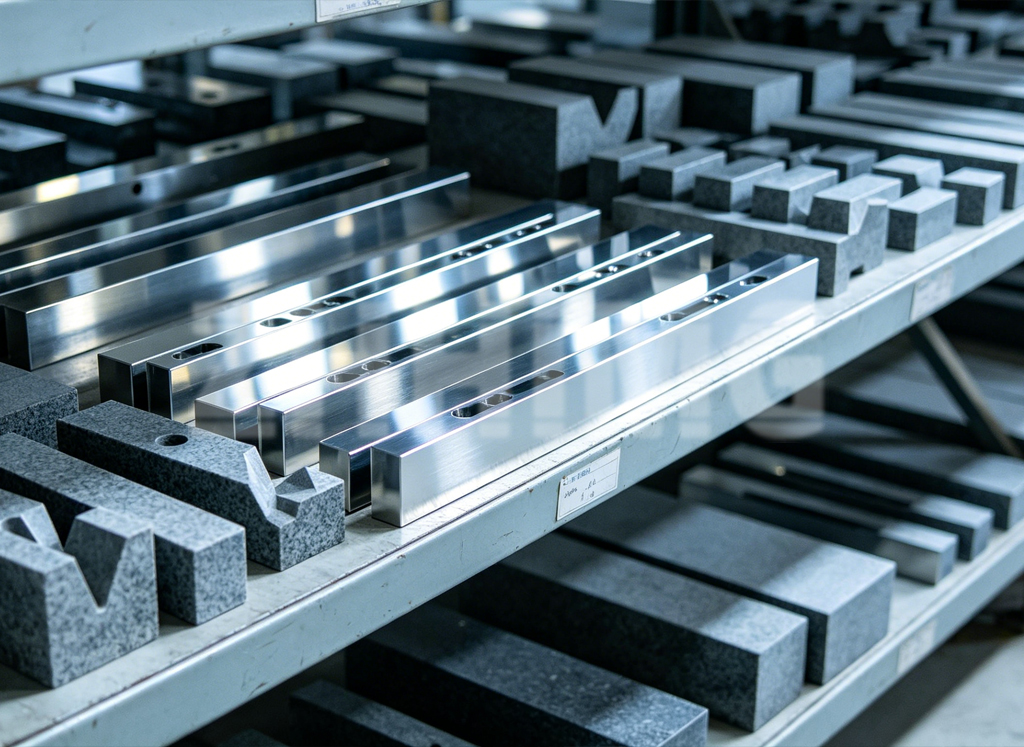
Accessory Considerations: Stands, Strips, and Pedestals
A surface plate is only as stable as its support system. Pneumatic or solid stands with adjustable feet allow the plate to be leveled precisely and can incorporate vibration-dampening features for use in factory environments. Plate stands should be positioned at the recommended locations specified by the plate manufacturer to prevent distortion of the working surface.
Granite strips and right-angle plates are common accessories used alongside surface plates for establishing reference planes on three-dimensional workpieces. Parallel granite sets are used for checking roundness, concentricity, and parallelism of cylindrical components.
Supplier Selection: What Quality Engineers Actually Check
When evaluating surface plate suppliers, experienced quality engineers typically investigate several factors:
1. Certification standards — Confirm the supplier can provide plates certified to the specific standard required (ASTM, DIN, ISO, JIS, etc.)
2. Traceability — The flatness measurement should be traceable to national or international metrology standards
3. Material documentation — Proof of granite density and mineral composition
4. Manufacturing capability — Verify the supplier has the equipment and expertise for the size and grade required
5. Recertification services — Ongoing flatness verification, either in-house or through an accredited calibration laboratory
Facilities that have worked with surface plate suppliers for years often report that the supplier’s measuring methodology matters as much as the plate itself. A manufacturer that uses interferometry and laser measurement systems will produce more consistent results than one relying on simpler methods.
Maintenance and Recertification
Even the highest-quality surface plate requires periodic recertification to verify that its flatness has not drifted. The frequency depends on the usage intensity and the flatness grade required. In most industrial settings, annual recertification is standard practice for Grade 0 and Grade 1 plates, with more frequent checks for Grade 00 plates used in calibration labs.
Recertification involves measuring the surface at multiple points using autocollimators, electronic levels, or laser interferometers, then calculating the flatness deviation against the applicable standard. Any plate that exceeds its tolerance grade should be removed from service or reworked by a qualified grinding specialist.
Frequently Asked Questions
What is the difference between Grade 00, Grade 0, and Grade 1 surface plates?
Grade 00 has the tightest flatness tolerance (≤0.5 μm/m), Grade 0 allows ≤1 μm/m, and Grade 1 allows ≤2 μm/m. Choose Grade 00 for calibration reference, Grade 0 for general inspection, and Grade 1 for workshop use.
How long does a granite surface plate last?
With proper support and periodic recertification, a granite surface plate can remain in service for 30 years or more. The limiting factor is typically not wear but the evolution of flatness beyond tolerance over very long periods.
Can granite surface plates be resurfaced if they lose flatness?
Yes. Resurfacing (re-grinding) can restore a surface plate to its original grade tolerance, provided the plate has sufficient material remaining. Most manufacturers can provide this service.
Why do some suppliers offer surface plates at significantly lower prices?
Lower prices often indicate the use of inferior granite materials (such as marble or low-density granite), less precise manufacturing methods, or less rigorous flatness verification. The initial savings may be offset by premature recertification needs or complete replacement.
What accessories are needed with a surface plate?
A properly rated stand with leveling feet is essential. Optional accessories include granite strips, right-angle plates, parallel sets, and spirit levels. Temperature and humidity monitoring is recommended for high-precision applications.
Post time: Jun-08-2026