
Choosing the right material for a precision machine base is a critical engineering decision. The base supports the machine’s major components, establishes reference geometry, and influences how the equipment responds to temperature changes, mechanical loads, and vibration.
For decades, cast iron has been a traditional choice for machine tools because of its rigidity, load-bearing capability, and established manufacturing processes. However, as requirements for dimensional accuracy and measurement repeatability become more demanding, precision granite has become an attractive alternative for many specialized applications.
So, when comparing granite vs. cast iron, which material is better for a precision machine base?
The answer depends on the machine’s operating conditions, accuracy requirements, structural design, and total cost of ownership. Granite offers advantages in thermal stability, corrosion resistance, and precision reference surfaces, while cast iron offers high stiffness, strength, and extensive design flexibility.
This comprehensive guide compares granite machine bases and cast iron machine bases to help equipment manufacturers, design engineers, and procurement professionals make an informed decision.
1. What Is a Precision Granite Machine Base?
A precision granite machine base is a structural component manufactured from selected natural granite. It is commonly used as a foundation for precision equipment that requires stable geometry, accurately finished mounting surfaces, and reliable long-term performance.
Unlike ordinary construction stone, precision granite is selected and processed according to engineering requirements. Manufacturing typically involves cutting, grinding, drilling, and precision lapping to achieve the specified dimensions and geometric tolerances.
Common applications include:
- Coordinate measuring machines (CMMs).
- Optical inspection and measurement systems.
- Semiconductor metrology equipment.
- Laser processing and precision positioning systems.
- Air-bearing stages and specialized automation equipment.
- Precision surface plates and machine reference structures.
Key Advantages of Granite
Low thermal expansion: Suitable granite grades generally have a lower coefficient of thermal expansion than cast iron, helping reduce dimensional changes caused by temperature fluctuations.
Dimensional stability: Properly selected and manufactured granite can provide stable reference geometry for precision measurement and positioning applications.
Vibration damping: Granite has useful inherent damping characteristics. Combined with appropriate structural design and support conditions, it can help control vibration in sensitive equipment.
Corrosion resistance: Natural granite does not rust like unprotected cast iron, reducing the need for protective coatings and routine rust prevention.
Precision finishing: Granite can be ground and lapped to produce highly accurate reference surfaces for mounting guideways, optical components, and measurement systems.
These characteristics make granite particularly attractive when geometric accuracy and stability are more important than maximizing structural stiffness per unit volume.
2. What Is a Cast Iron Machine Base?
Cast iron machine bases are manufactured by pouring molten iron into a mold and allowing it to solidify. After cooling and any required stress-relief treatment, the casting is machined to achieve the dimensions and interfaces required by the equipment design.
Gray cast iron is widely used in traditional machine tools because its graphite-containing microstructure provides useful damping characteristics compared with many other metallic structures. It also offers high stiffness, compressive strength, and substantial load-bearing capability.
Typical applications include:
- CNC machining centers.
- Milling and turning machines.
- Heavy-duty industrial machine tools.
- Large structural machine frames.
- Equipment subjected to substantial mechanical loads.
- General-purpose manufacturing systems.
Key Advantages of Cast Iron
High elastic modulus: Cast iron generally has a higher Young’s modulus than natural granite, allowing it to provide substantial stiffness for a given geometry under comparable loading conditions.
High load-bearing capability: Appropriate cast iron grades can withstand significant compressive loads and demanding mechanical operating conditions.
Flexible casting geometry: Sand casting and other foundry processes can produce complex structural forms, ribs, cavities, and integrated mounting features.
Established manufacturing infrastructure: Cast iron is supported by mature foundry, machining, and machine-tool manufacturing industries.
Repair and modification options: Depending on the design and condition, cast iron components can be machined, resurfaced, or repaired using appropriate industrial processes.
However, cast iron is susceptible to corrosion when exposed to moisture and corrosive environments without adequate protection. Its thermal expansion and potential residual-stress behavior must also be considered in precision applications.
3. Granite vs. Cast Iron: Side-by-Side Comparison
The following table summarizes the main engineering differences between natural precision granite and cast iron.
| Property | Precision granite | Cast iron |
|---|---|---|
| Density | Typically around 2,600–3,100 kg/m³, depending on grade | Typically around 7,000–7,300 kg/m³ |
| Coefficient of thermal expansion | Often approximately 5–8 × 10⁻⁶/K for suitable grades | Commonly approximately 10–12 × 10⁻⁶/K, depending on grade |
| Elastic modulus | Grade-dependent; commonly lower than cast iron | Generally higher than granite |
| Vibration damping | Useful inherent damping; system-dependent | Useful damping, particularly in gray cast iron |
| Thermal conductivity | Generally low | Generally much higher |
| Corrosion resistance | Does not rust | Requires appropriate corrosion protection |
| Precision reference surfaces | Can be ground and lapped to high accuracy | Can be precision-machined and ground |
| Complex internal geometry | Limited by solid-stone machining | Well suited to complex cast geometries |
| Material behavior | Natural stone with grade-dependent characteristics | Metallic material with grade- and process-dependent characteristics |
| Typical strengths | Metrology, optical systems, precision reference structures | Heavy-duty machine tools, loaded structures, general machining |
| Maintenance | Generally low, with appropriate handling and cleaning | May require coating maintenance and rust prevention |
The values above are indicative engineering ranges, not guaranteed specifications. Actual properties depend on the granite grade, cast iron grade, manufacturing process, component geometry, and operating conditions.
The most important distinction is not that one material is universally superior. Granite and cast iron offer different combinations of thermal behavior, mechanical stiffness, damping, and manufacturing flexibility.
4. Thermal Expansion: Why Granite Can Be Better for Precision
Thermal expansion is one of the most important considerations when designing precision equipment.
When a machine base changes temperature, its dimensions change. If the base supports linear guides, encoder scales, optical components, or measurement heads, these dimensional changes can affect alignment and positioning accuracy.
For suitable precision granite, the coefficient of thermal expansion is commonly around 5–8 × 10⁻⁶/K. Gray cast iron is often around 10–12 × 10⁻⁶/K.
Consider a simplified example involving a one-meter-long component experiencing a uniform temperature increase of 1°C.
Using representative coefficients:
- Granite at 6 × 10⁻⁶/K expands by approximately 6 µm.
- Cast iron at 11 × 10⁻⁶/K expands by approximately 11 µm.
Under these assumptions, granite expands less than cast iron for the same length and temperature change.
This difference can matter in coordinate measuring machines, optical inspection systems, semiconductor metrology equipment, and precision positioning platforms.
However, the example represents uniform expansion only. Actual machine behavior also depends on temperature gradients, mounting constraints, heat sources, and differences in expansion between connected components.
What About Cast Iron?
Cast iron remains a practical choice for many machine tools. Its thermal behavior can be managed through structural design, temperature control, appropriate material conditioning, and machine compensation.
For applications with demanding thermal stability requirements, however, granite’s relatively low coefficient of thermal expansion can provide a useful design advantage.
Engineering takeaway: If dimensional changes caused by temperature variation are a major contributor to your machine’s error budget, precision granite deserves serious consideration.
5. Vibration Damping: Which Material Performs Better?
Vibration can affect surface finish, measurement repeatability, positioning accuracy, and machining stability. The machine base plays an important role in determining how vibration travels through the structure.
Both granite and cast iron are used in precision machinery partly because of their damping characteristics.
Vibration Behavior of Granite
Granite combines substantial mass with inherent material damping. It can provide a stable structural platform for optical systems, metrology equipment, and precision motion assemblies.
Its relatively low thermal conductivity can also influence how localized heat spreads through the structure, although thermal conductivity and vibration damping are separate properties.
Vibration Behavior of Cast Iron
Gray cast iron is widely used in machine tools because its microstructure provides useful damping compared with many other structural metals.
It also offers high stiffness, which can help limit deformation under load. In heavy machining applications, this combination of stiffness, mass, and damping can be highly effective.
Which Is Better?
There is no universal answer based on material name alone.
Vibration performance depends on material composition, structural geometry, natural frequencies, support stiffness, excitation forces, and damping at the assembled-system level.
For example, a well-designed cast iron machine base may perform better than a poorly supported granite structure. Likewise, a precision granite base may be advantageous where the machine requires stable measurement references and controlled vibration.
For demanding applications, engineers should consider modal analysis, finite element analysis (FEA), and physical vibration testing rather than relying on a generic material ranking.
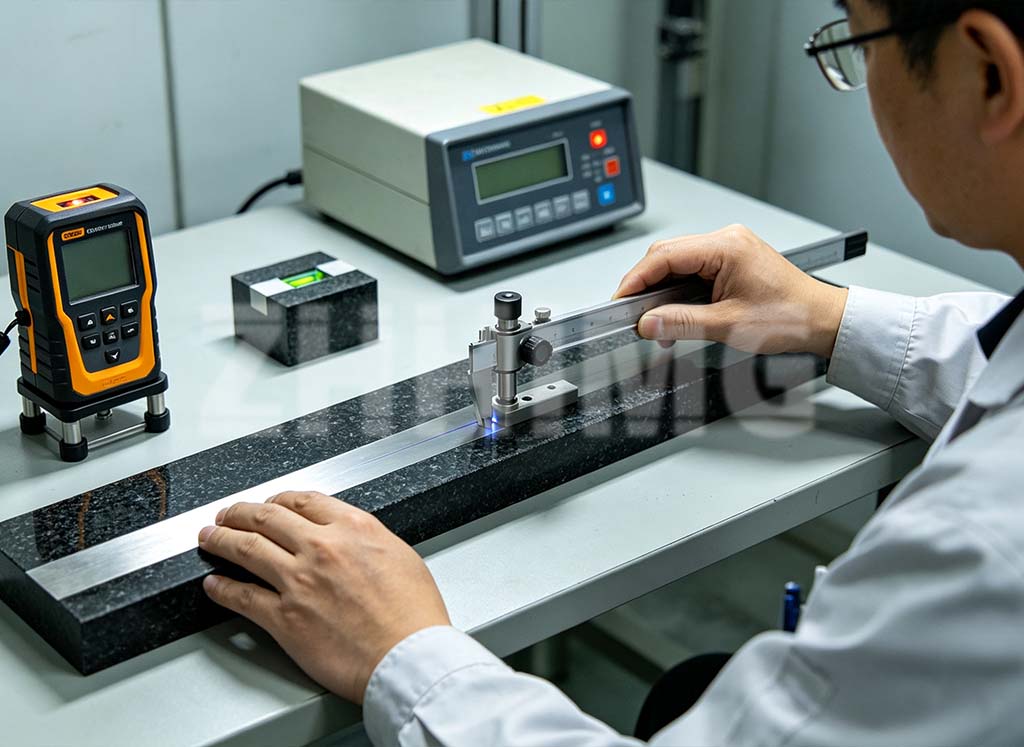
6. Structural Rigidity and Load-Bearing Performance
Structural rigidity determines how much a machine base deforms under applied loads. Excessive deformation can affect guideway alignment, positioning accuracy, and the relationship between moving components.
Cast iron generally has a higher Young’s modulus than natural granite. This means that, under comparable geometry and loading conditions, cast iron often provides greater elastic stiffness.
It is also available in grades with high compressive strength, making it suitable for heavy-duty machine tools and structures exposed to substantial cutting forces.
Granite has a lower elastic modulus and is a brittle material. Its performance therefore depends strongly on component dimensions, support locations, load distribution, and the avoidance of local stress concentrations.
However, a material’s elastic modulus does not determine the complete performance of a machine base.
Designers must also consider:
- Overall geometry and cross-sectional dimensions.
- Unsupported spans and support conditions.
- Static and dynamic loading.
- Mounting interfaces and bolt preload.
- Local deformation at guideway and bearing surfaces.
- Natural frequencies and structural resonance.
- Transportation and installation loads.
A carefully engineered granite structure can meet demanding precision requirements, while a well-designed cast iron structure can provide the stiffness required for heavy cutting.
The correct choice should be based on the complete mechanical design, not a single material property.
7. Manufacturing Differences: Machined Granite vs. Cast Iron
Manufacturing processes influence design flexibility, lead time, dimensional accuracy, and total project cost.
Manufacturing a Precision Granite Base
Granite machine bases are produced from selected stone blocks. The manufacturing process generally includes cutting, grinding, drilling, precision finishing, and dimensional inspection.
Advantages include the ability to produce highly accurate reference surfaces and the absence of a metal casting process.
However, granite is limited by its brittle behavior and the geometry that can be machined from a solid block. Complex enclosed cavities and intricate internal channels may be difficult or uneconomical to produce.
Critical mounting features must also be carefully designed to avoid concentrated loads and damage during installation.
Manufacturing a Cast Iron Base
Cast iron can be molded into complex shapes, including ribs, cavities, and integrated structural features. This can reduce the number of separate components and simplify some machine architectures.
After casting, the component may require stress relief, machining, grinding, and inspection. Foundry quality, cooling conditions, and residual-stress management can influence dimensional stability.
For high-volume production, tooling costs can be distributed across multiple parts. For prototypes or specialized low-volume equipment, the economics depend on mold complexity, machining requirements, and production planning.
Design recommendation: Select the base material early in the machine development process. The choice affects component geometry, manufacturing methods, mounting interfaces, and the accuracy achievable in the final assembly.
8. Cost and Total Cost of Ownership
Initial purchase price is only one part of the financial comparison between granite and cast iron.
A meaningful evaluation should include material selection, manufacturing, finishing, inspection, transportation, installation, maintenance, and expected service life.
When Granite May Offer Better Value
Granite can be attractive when:
- High-accuracy reference surfaces are essential.
- Thermal expansion must be minimized.
- Corrosion prevention and maintenance need to be limited.
- The component geometry suits machining from solid stone.
- Long-term dimensional stability is a major requirement.
Granite machining and lapping can be labor-intensive, especially for large components or demanding tolerances. Handling and transportation also require appropriate equipment and packaging.
When Cast Iron May Offer Better Value
Cast iron can be attractive when:
- High structural stiffness and load capacity are priorities.
- The machine requires complex integrated geometry.
- The design is suitable for established foundry processes.
- Production volumes justify tooling investment.
- The application is a conventional or heavy-duty machine tool.
Foundry tooling, stress relief, machining, coating, and inspection must all be included in the project budget.
Neither material is always cheaper. The most economical solution is the one that meets the required performance with the lowest appropriate lifecycle cost.
9. Which Material Is Right for Your Application?
Choose Precision Granite If Your Application Requires:
- Stable reference surfaces for high-accuracy measurement.
- Relatively low thermal expansion.
- Precision optical inspection or metrology.
- Corrosion-resistant structural components.
- Accurate mounting interfaces for sensitive instruments.
- Long-term geometric stability under controlled operating conditions.
Typical applications include CMMs, semiconductor metrology equipment, optical inspection platforms, laser systems, and precision positioning structures.
Choose Cast Iron If Your Application Requires:
- High stiffness and substantial load-bearing capacity.
- Complex cast geometries and integrated structural features.
- A traditional machine-tool architecture.
- Support for heavy cutting operations.
- Established casting and machining workflows.
Typical applications include CNC milling machines, turning centers, heavy-duty machine tools, and industrial manufacturing equipment.
Consider a Hybrid Structure When Necessary
Some machine designs benefit from combining materials.
For example, a precision granite reference structure may be integrated with a steel frame or other structural components to balance geometric stability, stiffness, weight, and manufacturing flexibility.
A hybrid design requires careful consideration of thermal expansion differences, interface stiffness, mounting stress, and vibration transmission. It should be selected when the combined structure offers a measurable engineering benefit.
10. How to Specify a Custom Precision Machine Base
Whether you choose granite or cast iron, a clear technical specification is essential.
Before requesting a quotation, prepare the following information:
1. Engineering drawings: Provide a 2D drawing or 3D CAD model with dimensions, mounting holes, recesses, and interface details.
2. Geometric tolerances: Specify flatness, straightness, parallelism, perpendicularity, and other requirements for functional surfaces.
3. Load conditions: Identify supported mass, dynamic forces, mounting loads, and any concentrated forces.
4. Operating environment: Describe temperature variation, vibration sources, humidity, and other relevant conditions.
5. Quantity and delivery schedule: Clarify whether the project is a prototype, a low-volume custom order, or a repeat production run.
6. Inspection requirements: Define the measurement methods, acceptance criteria, and documentation needed for delivery.
A capable supplier should evaluate the complete drawing, identify manufacturing constraints, and confirm the inspection requirements before production begins.
Conclusion: Granite or Cast Iron?
The choice between granite and cast iron depends on what the machine must achieve.
Precision granite is often the preferred option when low thermal expansion, stable reference surfaces, corrosion resistance, and precision measurement are central priorities.
Cast iron is often the preferred option when high stiffness, load-bearing capability, complex cast geometry, and conventional machine-tool manufacturing are more important.
Both materials have established roles in precision engineering. Neither is universally superior, and the final result depends on material grade, structural design, manufacturing quality, and operating conditions.
At UNPARALLELED Group, we manufacture precision granite bases, surface plates, and customized granite components for demanding industrial and precision engineering applications.
If you are developing a precision machine, upgrading an existing platform, or evaluating granite as an alternative to cast iron, our team can review your drawings and technical requirements to help determine a suitable solution.
Contact UNPARALLELED Group to discuss your custom granite machine base requirements and request a technical quotation.
Frequently Asked Questions
Is granite better than cast iron for precision machine bases?
Granite can be better for applications requiring low thermal expansion, stable reference surfaces, and corrosion resistance. Cast iron generally offers higher elastic stiffness and is well suited to heavy-duty machine structures. The right choice depends on the application’s accuracy and loading requirements.
Does granite have better vibration damping than cast iron?
Both materials provide useful vibration damping, but their performance depends on material grade, structure, support conditions, and excitation frequency. Neither material should be assumed to outperform the other in every machine configuration.
Why is granite used in CMMs?
Granite is widely used in coordinate measuring machines because suitable grades provide stable reference surfaces, relatively low thermal expansion, and useful vibration-damping characteristics. These properties help support measurement repeatability when combined with proper system design and environmental control.
Can cast iron achieve high precision?
Yes. Cast iron machine structures can be precision-machined to demanding geometric tolerances. Their thermal behavior and long-term stability must be managed according to the application’s accuracy requirements.
Is a granite machine base suitable for CNC equipment?
Yes. Granite can be suitable for selected CNC-related applications, particularly precision positioning, optical measurement, and metrology systems. For heavy cutting or highly dynamic machine tools, stiffness, structural design, and loading must be carefully evaluated before selecting the material.
What information is needed for a granite machine base quotation?
A 2D drawing or 3D CAD model, dimensions, geometric tolerances, mounting requirements, expected loads, operating conditions, quantity, and delivery schedule will help the manufacturer assess feasibility and prepare a quotation.
Post time: Oct-27-2026