
Choosing the right machine base material is a critical decision for manufacturers of precision machinery, CNC equipment, metrology systems, and industrial automation. The material affects structural rigidity, vibration damping, thermal stability, dimensional accuracy, manufacturing flexibility, and total project cost.
Two popular options for demanding applications are mineral casting and natural granite. Both offer advantages over conventional structural materials in specific operating conditions, but they serve different engineering priorities.
Mineral casting is widely valued for its excellent vibration damping and design flexibility. A precision granite machine base, on the other hand, is particularly attractive when long-term dimensional stability, precise reference surfaces, and consistent geometric accuracy are essential.
So, which material is right for your machine?
In this guide, we compare mineral casting vs. granite across their material properties, manufacturing processes, performance characteristics, costs, and applications. By understanding these differences, equipment manufacturers can make a more informed decision based on their actual engineering requirements.
1. What Is Mineral Casting?
Mineral casting, also known as polymer concrete or epoxy granite, is a composite material made by combining graded mineral aggregates with a polymer resin binder, typically epoxy resin. Depending on the formulation, the aggregates may include granite, basalt, quartz, and other mineral materials.
Unlike conventional concrete, mineral casting uses a polymer binder rather than cement as its primary binding system. The mixture is placed into a mold and cured to form a rigid structural component.
Key Characteristics of Mineral Casting
Excellent vibration damping
One of the main reasons manufacturers choose mineral casting is its ability to dissipate mechanical vibration. The composite structure converts a portion of vibrational energy into heat, helping reduce vibration transmission and improve dynamic performance.
This characteristic can be valuable in high-speed machining, precision grinding, and automated equipment where vibration affects surface finish, positioning stability, and process consistency.
Flexible structural design
Mineral casting can accommodate complex shapes, internal cavities, reinforcing ribs, and embedded metal inserts. Depending on the mold design and manufacturing process, features such as cable channels, coolant passages, and mounting interfaces can be integrated into the casting.
This design freedom can reduce the number of individual parts and simplify assembly.
Reduced dependence on extensive machining
Many features can be created directly during molding, potentially reducing machining operations compared with a design made entirely from solid material. However, precision mounting surfaces and critical interfaces may still require post-casting machining and inspection.
Thermal performance depends on formulation
Mineral casting generally has relatively low thermal conductivity compared with many metals. This can slow heat transfer through the structure and help reduce the rapid propagation of localized temperature changes.
However, low thermal conductivity does not automatically mean low thermal expansion. The coefficient of thermal expansion depends on the aggregate, resin system, mixture proportions, and curing process. Engineers should evaluate the actual material data and the thermal behavior of the complete machine assembly.
2. What Is a Precision Granite Machine Base?
A granite machine base is a structural component manufactured from natural granite selected for precision engineering applications. It may serve as the foundation for coordinate measuring machines (CMMs), optical inspection equipment, semiconductor inspection systems, laser processing equipment, and other precision machinery.
Unlike mineral casting, which is produced by combining aggregates and resin, a natural granite machine base is manufactured from a solid stone block. The block is cut, ground, drilled, and finished to meet the dimensional and geometric requirements of the application.
Key Characteristics of Granite
Long-term dimensional stability
Natural granite has undergone geological formation over long periods. Properly selected and processed granite does not have the same curing and polymer-aging behavior as a resin-bound composite.
This makes it a strong candidate for applications in which maintaining the geometry of a reference structure over time is a primary concern. Actual stability still depends on stone quality, support conditions, temperature variation, machining quality, and the design of the complete assembly.
Precision reference surfaces
Granite can be ground and lapped to achieve highly accurate flatness, straightness, and other specified geometric characteristics.
For precision measurement systems, the quality of these reference surfaces directly affects how accurately machine components can be aligned and how reliably measurements can be performed.
Useful vibration damping and high mass
Granite combines substantial mass with inherent vibration-damping characteristics. This helps provide a stable platform for sensitive equipment, although the final vibration response depends on the geometry, support system, excitation frequencies, and surrounding environment.
Corrosion resistance and low maintenance
Natural granite does not rust like unprotected steel and generally offers good resistance to many common industrial environmental conditions. It can be suitable for clean manufacturing environments and precision laboratories.
Nevertheless, granite is a brittle material. Concentrated impact, poorly designed mounting points, excessive local stress, or incorrect handling can cause damage.
3. Mineral Casting vs. Granite: A Side-by-Side Comparison
The most effective way to compare these materials is to evaluate the properties that directly influence machine performance.
| Evaluation factor | Mineral casting | Natural granite |
|---|---|---|
| Vibration damping | Typically excellent; formulation-dependent | Good inherent damping combined with high mass |
| Geometric stability | Depends on formulation, curing, design, and aging | Generally excellent when properly selected and processed |
| Thermal conductivity | Generally low | Generally low; grade-dependent |
| Thermal expansion | Depends strongly on composite formulation | Generally low for suitable precision granite |
| Structural rigidity | Depends on geometry, aggregate, binder, and reinforcement | High compressive stiffness; geometry remains important |
| Shape complexity | Excellent; complex forms can be molded | Limited by the geometry that can be cut from solid stone |
| Embedded components | Inserts and selected channels can be integrated during casting | Holes, recesses, and inserts are normally machined or installed separately |
| Precision reference surfaces | Usually require finishing of critical interfaces | Can be ground and lapped to very high precision |
| Corrosion resistance | Generally good | Generally good |
| Design flexibility | High | Moderate to limited |
| Production economics | Attractive for complex designs and suitable production volumes | Attractive for precision structures where stone finishing is justified |
| Typical applications | Dynamic machine tools, grinding equipment, integrated machine structures | CMMs, optical inspection, metrology, precision reference structures |
Important: This table describes general material tendencies, not guaranteed performance values. Actual results depend on the material grade, composite formulation, component geometry, support arrangement, machining process, and acceptance criteria.
4. Vibration Damping: When Mineral Casting Has the Advantage
Vibration can reduce machine accuracy, degrade surface finish, increase measurement variation, and shorten tool life. It is therefore a major consideration when selecting a machine base.
Mineral casting is particularly attractive when the machine generates substantial dynamic excitation. Its polymer-bound composite structure can dissipate vibrational energy effectively, making it a useful option for high-speed machining centers, grinding machines, and automated production equipment.
Research published in Precision Engineering in 2024 investigated epoxy granite as an alternative to cast iron in a machining center and reported improvements in dynamic performance under the studied conditions. These findings support the potential of epoxy granite, but they should not be interpreted as a universal performance guarantee or a direct comparison with natural granite.
Natural granite also provides useful vibration damping. Its substantial mass and structural characteristics can help stabilize precision systems, particularly when the base supports sensitive measuring or optical components.
The key distinction is the dominant engineering requirement:
- Choose mineral casting when vibration dissipation and complex structural integration are major priorities.
- Consider granite when vibration control must be combined with highly accurate reference surfaces and long-term geometric stability.
Neither material eliminates the need for appropriate machine isolation. Floor vibration, motor excitation, spindle dynamics, and structural resonance must still be considered during system design.
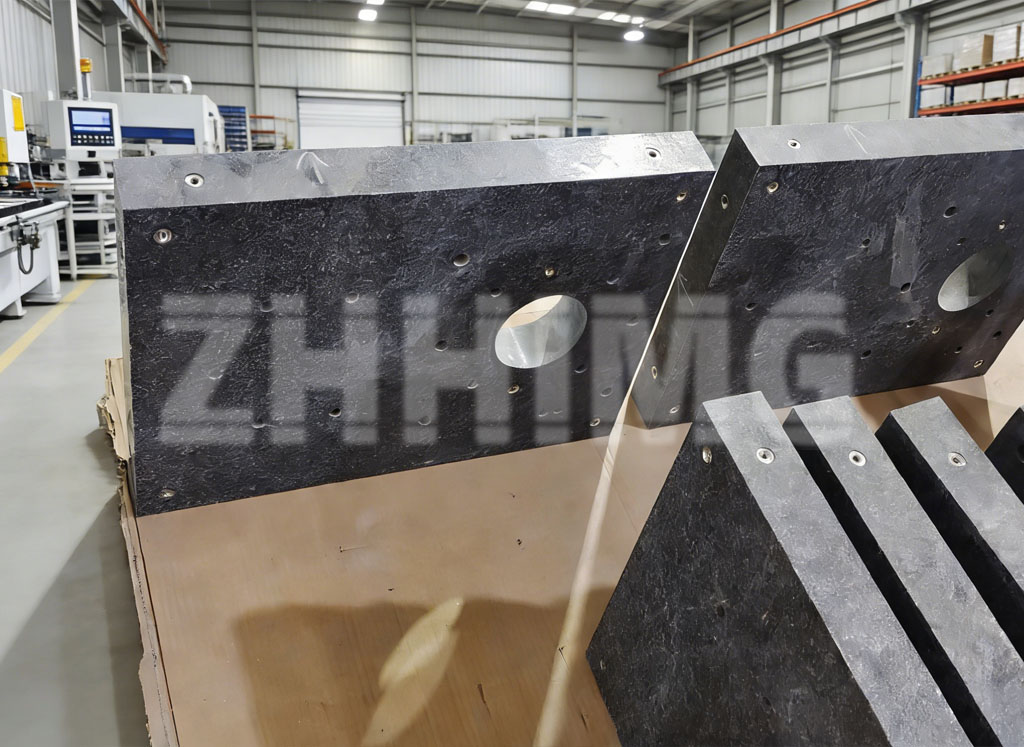
5. Thermal Stability and Dimensional Accuracy
Temperature changes can cause machine structures to expand, contract, and deform. Even small dimensional changes can affect positioning accuracy, measurement repeatability, and alignment in precision equipment.
Mineral Casting: Thermal Isolation with Formulation-Dependent Expansion
Mineral casting generally has low thermal conductivity, which can slow the transfer of heat through the structure. This may help reduce the spread of localized heat generated by motors, drives, or other machine components.
However, thermal conductivity and thermal expansion are different properties. A material can transfer heat slowly while still expanding appreciably as its temperature changes.
For this reason, engineers should evaluate the composite’s coefficient of thermal expansion, temperature distribution, curing stability, and interaction with embedded metal inserts. These factors become especially important in machines with demanding positioning tolerances or substantial temperature fluctuations.
Granite: A Strong Choice for Precision Reference Structures
Natural granite is often selected for precision applications because suitable grades combine low thermal expansion with stable geometric behavior.
Its properties make it particularly useful in coordinate measuring machines, optical measurement platforms, semiconductor inspection equipment, and other systems in which the base establishes critical geometric references.
Nevertheless, granite is not immune to thermal error. Uneven heating, changing room temperature, mounting stress, and differences in expansion between granite and attached metal components can all affect system accuracy.
Engineering recommendation: Evaluate thermal expansion at the assembly level rather than selecting a material using a single property in isolation. The relevant question is how much the machine’s functional geometry changes under its expected operating conditions.
6. Structural Rigidity and Load-Bearing Performance
A machine base must resist deformation under static loads, moving loads, clamping forces, and operating forces.
Natural granite has useful compressive strength and stiffness, making it suitable for many precision structures. Its performance depends on the stone grade, component dimensions, unsupported spans, mounting arrangement, and the location of applied loads.
Mineral casting can also support demanding structural applications, but its elastic modulus and mechanical strength depend on the formulation and manufacturing process. Designers may need to adjust wall thickness, rib geometry, internal reinforcement, or support locations to achieve the required stiffness.
For both materials, the geometry of the base is as important as the material itself.
A poorly supported granite structure may deform more than expected. Similarly, a mineral casting design with inadequate sections or poorly positioned inserts may not provide sufficient stiffness.
Before finalizing a design, consider:
- Maximum static and dynamic loads.
- Allowable deformation at critical mounting points.
- Rail, bearing, and spindle alignment requirements.
- Bolt preload and local stress concentrations.
- Natural frequencies and resonance risks.
- Transportation, lifting, and installation loads.
Finite element analysis (FEA), modal analysis, and physical validation can help establish whether a proposed structure meets the required performance targets.
7. Manufacturing Flexibility: Molded Composite or Machined Stone?
Manufacturing method is another major difference between mineral casting and granite.
Mineral Casting for Complex Geometries
Mineral casting is well suited to structures that require intricate geometry or integrated functional features. A carefully designed mold can accommodate ribs, cavities, selected fluid passages, and embedded mounting inserts.
This can simplify the overall machine architecture by consolidating several parts into a single component.
However, mold design and fabrication require upfront investment. The casting process must also control aggregate distribution, resin mixing, compaction, curing, and insert positioning. Critical surfaces generally require dimensional inspection and may require additional machining.
For repeated production, the initial mold investment may be distributed across multiple units, improving production economics.
Granite for Precision-Machined Components
Granite components are produced by machining and finishing selected natural stone blocks. This approach is particularly effective for bases, beams, plates, and other structures with clearly defined precision surfaces.
Grinding and lapping can produce highly accurate reference geometry. Holes, slots, recesses, and mounting features can be incorporated according to the engineering drawing.
The main limitation is geometric freedom. A design that requires extensive internal channels, complex enclosed cavities, or numerous integrated features may be difficult or uneconomical to manufacture from solid granite.
For this reason, material selection should take place early in the design process. Changing the base material after the machine architecture has been finalized can lead to unnecessary engineering work and additional costs.
8. Mineral Casting vs. Granite: Which Is More Cost-Effective?
There is no universal cost winner. The more useful comparison is the total cost of the finished machine base, including design, tooling, manufacturing, finishing, inspection, assembly, and long-term performance.
When Mineral Casting May Be More Economical
Mineral casting can offer cost advantages when:
- The structure has complex geometry.
- Multiple components can be consolidated into one casting.
- Integrated channels and mounting features reduce secondary operations.
- The same design will be produced repeatedly.
- Vibration damping is a major performance requirement.
The economics depend on mold complexity, production volume, material formulation, curing time, and the amount of post-casting machining required.
When Granite May Be More Economical
Granite may offer better overall value when:
- Highly accurate reference surfaces are essential.
- The component geometry is compatible with stone machining.
- Long-term dimensional stability is a key requirement.
- The project involves prototypes or relatively low production volumes.
- The cost of achieving the required geometry with alternative materials would be substantial.
Granite machining and lapping can be labor-intensive, especially for large components or tight tolerances. However, a precision granite structure can be a rational investment when the accuracy requirements justify its manufacturing process.
When requesting quotations, compare the same functional requirements and scope of supply. A meaningful comparison should include finished dimensions, tolerances, mounting features, inspection documentation, packaging, and delivery terms—not just the price per kilogram.
9. Which Machine Base Material Should You Choose?
The following application-based guide provides a practical starting point.
Choose Mineral Casting If Your Priority Is:
- High vibration damping in dynamic machine structures.
- Complex shapes with integrated mounting features.
- Molded ribs, cavities, or selected internal channels.
- Consolidation of multiple structural components.
- Repeat production where tooling costs can be amortized.
Typical applications include high-speed machining equipment, precision grinding machines, and automation systems with complex structural requirements.
Choose Granite If Your Priority Is:
- Highly accurate geometric reference surfaces.
- Long-term dimensional stability.
- Precision measurement and inspection.
- Stable mounting surfaces for linear guides, air bearings, or optical components.
- Low corrosion risk and limited routine maintenance.
Typical applications include CMM bases, optical inspection platforms, semiconductor metrology equipment, laser systems, and precision measurement structures.
Consider a Hybrid Design If You Need Both
Some machines benefit from combining materials rather than choosing only one.
For example, a precision granite component can provide the primary reference surfaces, while a mineral casting structure provides damping and accommodates complex supporting features.
A hybrid design can be worth evaluating when the machine needs both high geometric accuracy and strong vibration attenuation. Its success depends on interface stiffness, mounting methods, thermal expansion differences, and the transmission of vibration between components.
The additional interfaces also introduce engineering complexity, so a hybrid structure should be justified by measurable performance requirements rather than assumed to be superior.
10. How to Specify the Right Material for Your Machine Base
Before selecting a supplier or requesting a quotation, prepare the information needed to evaluate the application.
1. Machine type and operating principle
Identify whether the equipment performs precision measurement, optical inspection, high-speed machining, grinding, or automated handling.
2. Accuracy requirements
Specify the required flatness, straightness, parallelism, positioning accuracy, and repeatability. Clarify which tolerances apply to the base itself and which apply to the complete assembled machine.
3. Mechanical loading
Provide the overall component dimensions, supported mass, concentrated loads, moving masses, acceleration levels, and expected operating forces.
4. Thermal and vibration environment
Describe the operating temperature range, temperature variation, heat sources, floor vibration, and any isolation systems.
5. Geometry and integration requirements
Share the drawings or CAD models, including mounting holes, inserts, rails, cable routing, fluid passages, and interface locations.
6. Production quantity and delivery schedule
Indicate whether the project is a prototype, a small production run, or a repeat order. These details influence tooling decisions, process selection, and overall project cost.
A supplier with experience in both mineral casting and precision granite can assess these requirements and recommend the material that best matches the intended performance.
Conclusion: Select the Material That Matches Your Engineering Priorities
The comparison between mineral casting and granite is not simply a choice between two materials. It is a decision about how the machine base will control vibration, maintain geometry, accommodate functional features, and support the equipment throughout its service life.
Mineral casting is often the stronger candidate when vibration damping and complex molded geometry dominate. Natural granite is often the stronger candidate when precision reference surfaces and long-term geometric stability dominate.
Neither option is universally superior. The right solution depends on the required accuracy, structural loads, operating environment, manufacturing volume, and overall cost target.
At UNPARALLELED Group, we provide precision granite components and mineral casting solutions for demanding industrial applications. Our engineering team can help evaluate material options based on your drawings, technical specifications, and machine performance requirements.
Planning a new precision machine or redesigning an existing base?
Send us your drawings, component dimensions, accuracy requirements, and application details. We can help you assess whether a mineral casting machine base, a granite machine base, or a hybrid structure is the most suitable solution for your project.
Contact UNPARALLELED Group to discuss your custom machine base requirements and request a technical quotation.
Frequently Asked Questions
Is mineral casting better than granite for machine bases?
Not in every application. Mineral casting is often preferred for its vibration damping and design flexibility, while natural granite is frequently selected for precision reference surfaces and long-term geometric stability. The best choice depends on the machine’s performance requirements.
What is the difference between mineral casting and epoxy granite?
Epoxy granite is a common type of mineral casting that uses mineral aggregates bonded with epoxy resin. The exact composition and performance vary by manufacturer and formulation, so technical data should be reviewed for the specific material.
Which material provides better vibration damping?
Mineral casting generally offers excellent vibration damping and can outperform many conventional structural materials. Granite also provides useful inherent damping and substantial mass. The actual vibration response depends on the structure, excitation frequency, supports, and system configuration.
Is a granite machine base suitable for CNC machines?
Yes. Granite can be used in CNC-related equipment, particularly where precision positioning, stable reference surfaces, or optical and measurement functions are important. For applications dominated by aggressive cutting forces or complex integrated structures, mineral casting or a hybrid design may also be worth evaluating.
Can mineral casting achieve the same precision as granite?
Mineral casting can be manufactured to meet demanding dimensional requirements, particularly when critical surfaces are appropriately machined and inspected. However, the ability to achieve a specified tolerance is not the same as long-term geometric stability. The required tolerances, operating conditions, and material behavior should all be evaluated.
Is mineral casting cheaper than granite?
It depends on the design, production volume, tooling requirements, finishing operations, and acceptance criteria. Mineral casting may be cost-effective for complex or repeated designs, while granite may be attractive for precision components with simpler geometries and demanding reference-surface requirements.
Can granite and mineral casting be used together?
Yes. A hybrid structure can combine granite reference surfaces with a mineral casting support structure. Engineers must account for the interface, mounting stiffness, thermal expansion differences, and overall structural dynamics.
What information is needed for a custom machine base quotation?
Provide a 2D engineering drawing or 3D CAD model, overall dimensions, material preference if established, tolerance requirements, mounting details, expected loads, application, quantity, and target delivery date. These details help the manufacturer evaluate feasibility and prepare a more accurate quotation.
Post time: Oct-27-2026