
Why the material matters more than the grade number
A surface plate grade such as DIN 876 Grade 00, Grade 0 or Grade 1 tells you the flatness tolerance at the time of calibration. It does not fully describe how the plate behaves after months or years of use.
In precision environments, three factors often matter more:
- Coefficient of thermal expansion (CTE): how much the material changes with temperature
- Vibration damping: how quickly external vibration decays
- Long-term stability: whether flatness drifts after handling, temperature change or minor impact
Granite, cast iron and mineral casting each behave differently here.
Granite vs cast iron: key differences
| Factor | Granite surface plate | Cast iron surface plate |
|---|
| Factor | Granite surface plate | Cast iron surface plate |
|---|---|---|
| Thermal stability | Low CTE; slow, uniform temperature response | Higher CTE; more sensitive to local heat |
| Vibration damping | High natural damping; suitable for sensitive measurement | Lower damping; may transmit vibration more easily |
| Corrosion resistance | Non-metallic; does not rust | Requires oiling and protective maintenance |
| Magnetic workholding | Not magnetic | Can support magnetic chucks |
| T-slots and clamping | Possible with inserts, but not inherent | Easier for heavy mechanical clamping |
| Long-term flatness | Stable if properly supported and handled | Can change with stress relief, impact or corrosion |
| Weight handling | Heavy but brittle; edge protection is important | Heavy and tough; surface can burr |
| Typical best use | Metrology, CMM, AOI, laser, semiconductor, air-bearing assembly | Machining setup, magnetic inspection, workshop use |
Granite is not automatically better for every workshop. But for nanometer-level measurement, air-bearing motion, optical inspection and semiconductor assembly, its low thermal sensitivity and high damping are difficult to replace.
Why granite performs better in metrology and semiconductor applications
Low thermal expansion improves measurement repeatability
Precision measurement is rarely only about the instrument. The reference surface also expands and contracts with temperature.
Granite has a relatively low and stable coefficient of thermal expansion. This means that small temperature fluctuations in a controlled workshop cause less flatness change than many metallic materials.
For CMM rooms, optical inspection labs and semiconductor assembly areas, this stability reduces measurement drift and rework.
High vibration damping protects sensitive readings
Vibration from forklifts, HVAC systems, nearby presses or foot traffic can affect sub-micron measurement.
Granite naturally absorbs vibration better than many metallic surfaces. When combined with proper anti-vibration mounts and a stable foundation, granite bases help keep readings stable during long inspection cycles.
This is especially important for:
- CMM and vision measuring machines
- Laser interferometer setups
- AOI and industrial CT equipment
- Semiconductor wafer handling platforms
- Air-bearing XY tables and linear motor stages
No rust, no oil film, less maintenance
Cast iron surfaces must be protected against corrosion. If oil films are uneven, they can affect wringing, indicator contact or optical measurement.
Granite does not rust. It still requires cleaning and careful handling, but it does not depend on continuous oil protection to maintain surface integrity.
When cast iron is still the right choice
Cast iron surface plates and cast iron bases remain useful in several scenarios:
- The workpiece requires magnetic chuck mounting
- The plate must carry T-slots, threaded holes or heavy clamping
- The environment is a general machining shop rather than a metrology lab
- The budget is limited and nanometer-level stability is not required
- The surface will be used mainly for mechanical setup, not high-precision calibration
If magnetic workholding is needed but thermal stability is also important, a hybrid solution may be considered: a cast iron base with a granite working surface, or a mineral casting base with embedded metal inserts.
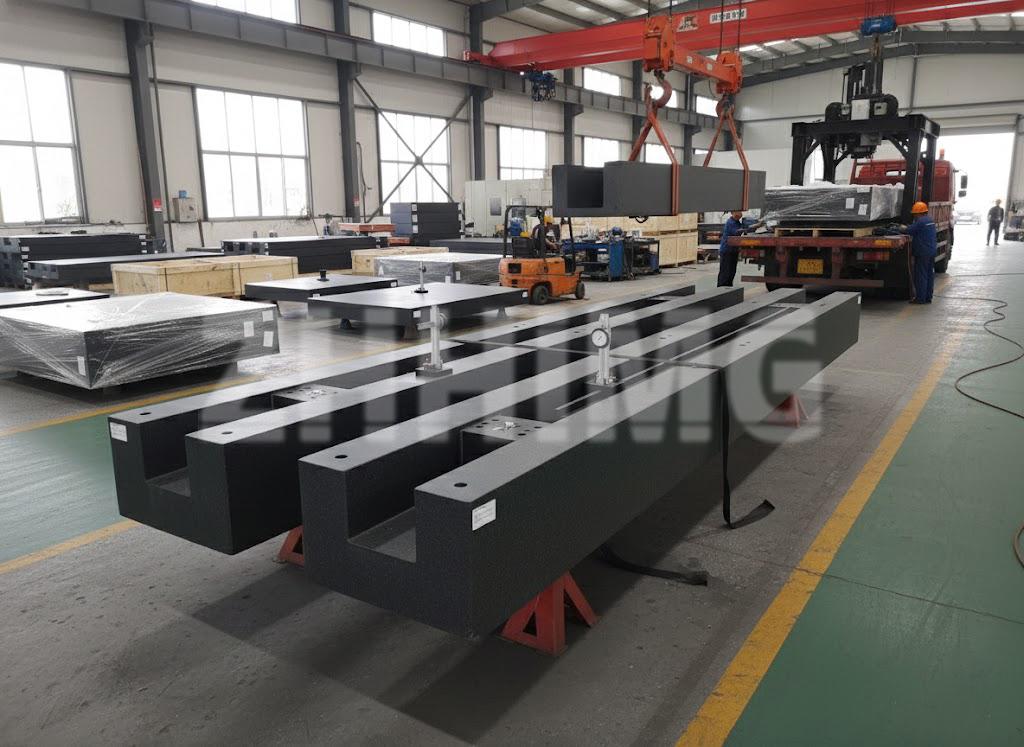
Granite, cast iron and mineral casting: which base material should you choose?
| Application | Preferred material | Reason |
|---|
| Application | Preferred material | Reason |
|---|---|---|
| CMM, vision system, laser measurement | Granite | High stability, low CTE, high damping |
| Semiconductor and air-bearing assembly | Granite | Clean, non-magnetic, dimensionally stable |
| Workshop inspection with magnetic parts | Cast iron | Magnetic workholding and mechanical strength |
| Large machine base with complex inserts | Mineral casting / granite | Design flexibility, damping and thermal stability |
| Heavy machining setup | Cast iron | Clamping, T-slots and impact resistance |
For large equipment bases, mineral casting is also a common alternative. It offers good damping and design flexibility, especially when many inserts, cable routes or mounting interfaces are required. Granite still tends to be preferred when the highest surface accuracy and long-term stability are needed.
You can read more about material selection in our guide: Granite vs Mineral Casting vs UHPC for Precision Machine Bases.
How ZHHIMG controls flatness and long-term stability
ZHHIMG® precision granite components are manufactured using high-density black granite with a density of approximately 3,100 kg/m³. This material is selected for its stability, wear resistance and suitability for precision metrology and equipment bases.
Our capability includes:
- Granite surface plates for metrology reference
- Granite squares, straight edges, V-blocks and parallels
- Granite machine bases, granite assemblies and granite air bearings
- Large-format granite components up to 20,000 mm in length
- Single-piece capacity up to 100 tons
- Resurfacing and repair services for granite plates and bases
Inspection is carried out with calibrated instruments including electronic levels, laser interferometers, dial indicators and roughness testers. Calibration traceability is maintained through recognized metrology channels.
Our facilities include large grinding equipment, temperature- and humidity-controlled assembly areas, and dedicated processes for granite component assembly used in semiconductor and precision measurement applications.
FAQ: granite vs cast iron surface plates
Is a granite surface plate more accurate than a cast iron surface plate?
Granite does not guarantee a higher grade number by itself, but it generally maintains accuracy more stably in temperature-controlled metrology environments. Cast iron can achieve good flatness, yet it is more sensitive to rust, local heating and surface damage.
Can a cast iron surface plate be used for CMM calibration?
It can be used if the required grade, stability and maintenance conditions are met. However, most CMM and optical inspection applications prefer granite because of its lower thermal sensitivity and better vibration damping.
Does granite rust?
No. Granite is a non-metallic material and does not rust. It should still be kept clean, dry and protected from impact, oil contamination and edge damage.
Which is better for semiconductor equipment bases?
Granite is usually preferred for semiconductor, AOI, laser and air-bearing applications. It provides high dimensional stability, non-magnetic properties and good vibration damping.
Can ZHHIMG supply custom granite bases with inserts?
Yes. We can manufacture custom granite machine bases, granite assemblies and granite air bearings with threaded inserts, mounting holes, datum features and handling interfaces according to customer drawings.
Post time: Nov-18-2026