
Choosing a precision machine base is not simply a matter of selecting the material with the highest strength or the largest advertised damping value. The base must work as part of a complete machine, supporting its geometry, mounting interfaces and operating requirements throughout manufacturing, assembly and use.
Natural granite, mineral casting and ultra-high-performance concrete are all used in machine-bed construction. Each offers a different route to producing a structural component, and each should be evaluated against the actual design rather than a general claim that one material is always superior.
For equipment manufacturers comparing these options, the most useful starting point is the application: what the structure must support, which surfaces require precision finishing, how the machine will operate and what evidence will demonstrate acceptance.
Understand What the Three Material Names Mean
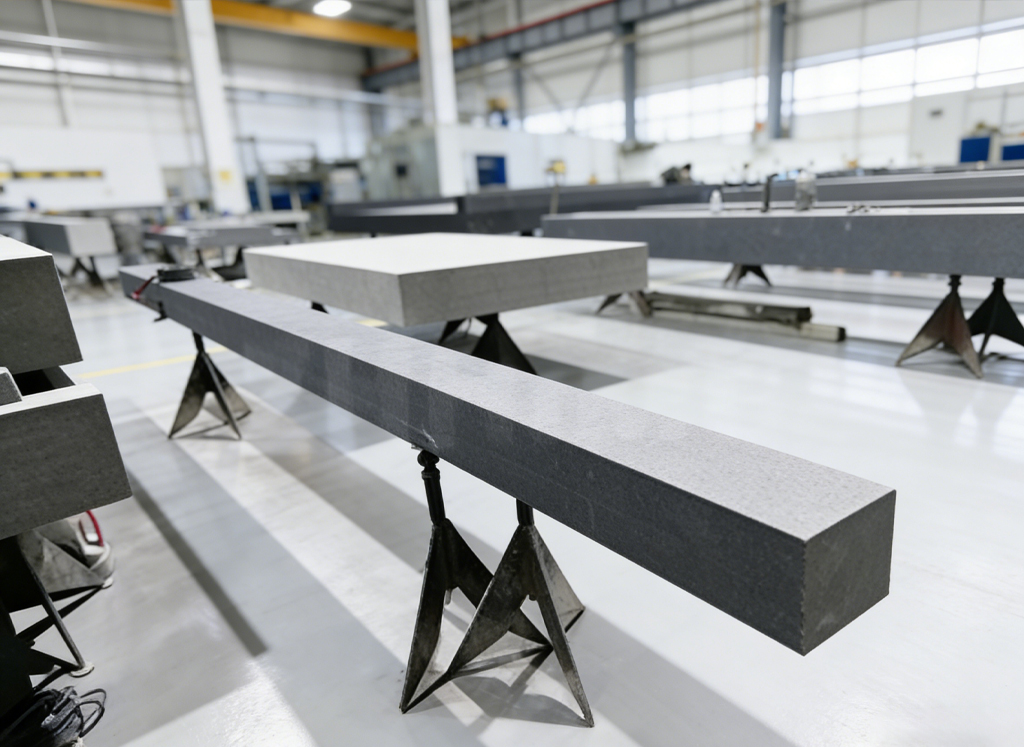
Natural granite is a quarried stone that is manufactured into the required component. A granite machine base should therefore be specified by more than its color or commercial name. The selected material, component geometry, mounting features and finished-surface requirements all belong in the technical discussion.
Mineral casting, as used in this article, means an engineered composite made from selected mineral aggregates and a polymer binder, commonly epoxy resin. It is cast into a mold rather than cut entirely from a natural stone block. Commercial descriptions may include “epoxy granite” or “polymer concrete,” but buyers should confirm the actual composition and product specification instead of assuming that every name describes an identical material.
UHPC stands for ultra-high-performance concrete. In machine-base applications, it is a cement-based engineered material, distinct from epoxy-bound mineral casting. Commercial formulations can incorporate carefully selected mineral constituents and fine fillers. A material intended for precision machine construction should not be treated as interchangeable with ordinary construction concrete.
This distinction is important when reviewing quotations. Natural granite, epoxy-bound mineral casting and cement-based UHPC are separate material systems. A proposal should identify which system is being offered and which supporting data apply to it.
Begin with the Machine Design, Not a Material Ranking
Before comparing materials, define the function of the base. A stationary foundation for an inspection instrument, a bed supporting a moving carriage and a structure carrying machining loads should not automatically use the same selection criteria.
Explain the expected forces, moving masses, travel range, installation orientation and support arrangement. Identify the surfaces that establish machine geometry and the interfaces used to attach guideways, motors, measuring systems or fixtures.
At the material-selection stage, ask how each proposal will achieve the required finished component. Will the working surfaces be directly finished? Will the design use separate mounting elements? Which features will be inspected before assembly, and which will require verification afterward?
The material and the manufacturing route should be reviewed together. Industrial machine-bed production uses approaches including grinding, replication and integrated mounting features, depending on the material system and component design.
A comparison based only on raw-material properties leaves these manufacturing and assembly questions unanswered. The objective is to select a practical route to the required machine structure, not simply a promising entry in a material data sheet.
Compare Vibration and Thermal Requirements Carefully
Vibration damping is frequently highlighted in discussions of mineral casting and UHPC. Machine-base suppliers offer these materials specifically for applications where dynamic behavior is an important design consideration. However, a published result for one proprietary formulation should not be assumed to apply to every product sold under the same broad material name.
When a quotation includes a damping comparison, ask what was tested. Was it a material specimen, an unfinished base or an assembled machine structure? What reference material and test method were used? Without that context, a statement such as “several times better damping” may not provide a useful basis for choosing your component.
The same discipline should apply to thermal claims. Request data for the actual material proposed, together with the temperature range and test conditions. Explain the machine’s operating environment and identify relevant heat sources, such as motors, process equipment or nearby services.
Do not use a single thermal-property value as a substitute for reviewing the complete design. The technical discussion should establish which changes matter to the application, how the proposed structure will be evaluated and which requirements will be included in acceptance testing.
If comparative information is incomplete, record that limitation rather than presenting an unsupported ranking. A transparent comparison is more useful than a confident conclusion built from unrelated data sheets.
Review Shape, Inserts and Functional Integration
The complexity of the component is another important part of the selection.
A base may require access openings, cable routes, fluid passages, mounting inserts or interfaces for sensors and actuators. Cast material systems can provide opportunities to incorporate features during production. For example, commercial epoxy-bound mineral-casting processes are used to integrate functional elements into machine beds.
That capability does not remove the need for detailed engineering. The proposal should explain how the features will be located, secured, inspected and connected to the finished machine.
For threaded interfaces, specify the thread, usable engagement, position and relevant mounting requirements. For precision mounting surfaces, identify the datum relationship and the required delivery condition. If replaceable metal elements or customer-supplied parts are included, define responsibility for their supply and installation.
For a granite proposal, review how the required pockets, holes, inserts and working surfaces will be produced within the selected design. For mineral casting or UHPC, discuss the tooling approach and any features that need to be finalized before casting.
The key question is not whether a material can produce a complicated-looking shape. It is whether the proposed manufacturing route can deliver the required interfaces with an agreed method of verification.
Compare the Finished Component and Total Project Cost
A meaningful commercial comparison should use the same delivery scope.
One quotation may include only an unfinished structure, while another includes precision finishing, inserts, a support frame and inspection documentation. Comparing their headline prices would not show the cost of reaching the same assembly-ready condition.
Ask each supplier to define what is included. Confirm the condition of the mounting surfaces, the hardware supplied, the inspection scope and any work that remains the buyer’s responsibility.
For cast components, clarify whether tooling costs are separate and how design changes would affect the project. For every material option, discuss the cost implications of prototype quantities, repeat orders and future revisions.
Logistics should also be included in the review. Packed dimensions, handling arrangements, shipping, installation and receiving inspection can all become project requirements. A lower component price is not necessarily a lower cost to the point of machine assembly.
Rather than asking which material is cheapest in general, compare quotations for the same functional requirement and the same defined delivery scope.
Specify Precision at the Component Level
None of these material names establishes a finished flatness, straightness or alignment tolerance on its own.
The drawing should identify the controlled surfaces, datum system, mounting interfaces and geometric requirements. Where different areas serve different functions, distinguish them clearly instead of assigning an undefined “high precision” requirement to the entire structure.
Agree on how the component will be supported and oriented during inspection. Confirm whether acceptance applies to the individual base or an assembly, and establish the measurement layout and reporting requirements before production.
For demanding tolerances, discuss the measurement method and relevant measurement capability during technical review. If the project requires a particular uncertainty statement, independent inspection or report format, include that requirement in the inquiry.
The supplier’s component report should also remain separate from claims about the complete machine. A base that meets its drawing requirements still needs to be integrated into a system whose final performance is evaluated under the appropriate conditions.
Make the Selection Around Your Application
The most useful outcome of a granite, mineral-casting and UHPC comparison is not a universal winner. It is a documented selection that connects the material, structural design, manufacturing process and acceptance requirements.
A relatively straightforward component and a highly integrated cast structure may lead to different manufacturing proposals. A prototype and a long-term production program may also justify different commercial choices. Those differences should be explained rather than hidden behind broad claims about material superiority.
Where more than one material remains suitable, request a side-by-side technical proposal. Ask each option to address the same drawing, loading conditions, mounting interfaces, finished-surface requirements and inspection scope. This creates a clearer basis for deciding what matters most to the project.
ZHHIMG welcomes inquiries for precision granite, mineral-casting and UHPC components. To begin a project discussion, share your drawing, intended application, quantity, loading information and required delivery condition. If the material has not yet been selected, identify the requirements that will guide the comparison.
Our commitment is straightforward: no cheating, no concealment and no misleading. In material selection, that means defining the proposed solution accurately, explaining the basis of performance claims and making the scope of supply clear before production begins.
Post time: Nov-17-2026