
Granite vs. Cast Iron Surface Plates: Which One Is Right for Your Inspection Lab?
Choosing between a granite surface plate and a cast iron surface plate is one of the first decisions an inspection lab has to make, and it is usually made too quickly. Both materials are still in daily use across metrology rooms, machine shops and production floors, and neither one has replaced the other in a hundred years. That is the clearest indication that the choice depends on the work, not on which material is “better”.
This article compares the granite surface plate vs cast iron surface plate on the properties that actually change your daily routine: thermal behaviour, corrosion, what happens after an impact, weight, maintenance and cost. It ends with scenario-based recommendations rather than a single verdict, because a plating shop and a semiconductor metrology lab should not buy the same plate.
For reference, the granite plate is here, and the cast iron plate is here
What each material actually is
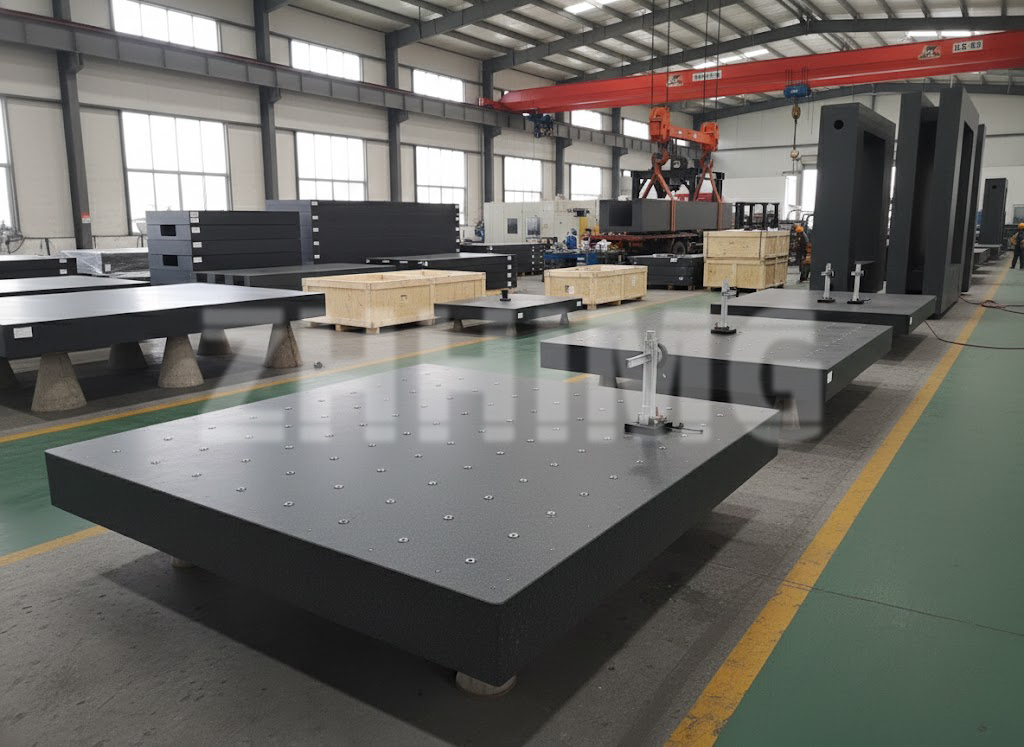
A granite surface plate is cut from a single block of dense, fine-grained natural stone, then ground and lapped in a controlled environment. There is no coating on the working surface — the flatness is in the material itself. When the plate is resurfaced, the same stone is re-lapped and returned to specification. The material is non-metallic, non-magnetic and electrically insulating.
A cast iron surface plate is cast from a high-quality iron alloy, stress-relieved, then planed or ground and hand-scraped or lapped. The working surface carries a finished metal face, and on many plates the underside has a ribbed or box structure to give stiffness without excess mass. The plate is ferromagnetic and electrically conductive.
Those five differences — monolithic stone versus cast and ribbed metal, insulated versus conductive, lapped versus scraped — generate almost every practical advantage and disadvantage in the sections below.
Side-by-side comparison
The table below compares the properties that inspection teams actually feel day to day. The “Basis” column states where each statement comes from, so you can separate material facts from general shop experience.
| Property | Granite surface plate | Cast iron surface plate | Basis |
|---|---|---|---|
| Thermal expansion | Low, roughly 5–7 µm/m·K depending on the stone | Higher, roughly 10–12 µm/m·K for typical iron | Published material data for natural granite and grey cast iron |
| Thermal response speed | Slow — low thermal conductivity, so a warm hand takes effect gradually | Faster — metal conducts heat quickly into the surface | Thermal conductivity values for stone versus metal |
| Corrosion and rust | None. Water, coolant and normal humidity do not attack it | Requires a protective oil film; bare or neglected surfaces rust | Material behaviour and standard workshop practice |
| Behaviour after an impact | A chip leaves a crater that stays below the surface — the damaged spot does not stand proud, so a workpiece placed over it is not lifted | A dent or burr is displaced metal that stands proud of the surface — the raised burr can lift a workpiece or show up in a measurement | Direct consequence of brittle stone fracture versus ductile metal deformation |
| Weight | Around 3.0–3.1 g/cm³ for dense black granite; a large plate is heavy and cannot be moved by one person | Around 7.2 g/cm³ for iron, but ribbed or box-section plates are cast thin, so a comparable plate can be lighter than solid stone | Typical density of the two materials plus common plate section design |
| Magnetic and electrical | Non-magnetic and insulating — safe near magnetic clamps and electrical measurement | Magnetic and conductive — can be used with magnetic chucks and for electrical contact work, but interferes with some setups | Intrinsic material properties |
| Maintenance | Wipe clean, avoid sliding abrasive parts, re-lap when flatness drifts | Wipe, then oil against rust; re-scrape or re-grind when worn or dented | Standard practice for each material |
| Repairability of local damage | A local chip cannot be filled invisibly; the plate is normally re-lapped or the damaged area avoided | A local burr can be stoned or scraped back flush, and the plate can be re-scraped over a wider area | Common reconditioning practice in each case |
| Typical cost position | Higher material and finishing cost for a given flatness grade, but no protective coating upkeep | Lower base material cost in many sizes, offset by rust protection and more frequent reconditioning | General market position, varies with size and grade |
For a wider view of how we grade and verify our stone plates, the resurfacing and inspection pages explain the process step by step: granite surface plate resurfacing and quality inspection.
Thermal behaviour: the difference that shows up in your numbers
Cast iron expands about twice as much as granite for the same temperature change, and it reaches that expansion far faster because metal conducts heat roughly an order of magnitude better than stone. In a room with a well-controlled temperature this barely matters. In a shop where a door opens onto a loading dock, or where a hot part is set down for a quick check, the two materials behave very differently.
Granite’s slow, low response is a real advantage for measurement stability: a plate does not instantly react to a passing heat source, so a short inspection is less disturbed by the person standing next to it. The same slowness, however, means a granite plate takes longer to settle if the whole room drifts. Cast iron reacts quickly in both directions — it absorbs a temperature change fast, and it also recovers fast once the source is removed, provided the room is stable and the measurement is not taken immediately after a thermal event.
The practical rule is not “granite is thermally better”. It is that granite gives you a stable window during short, intermittent measurements, while cast iron demands that you respect the settling time after anything touches the plate. If your workflow involves frequent, brief placements of parts that carry residual heat, plan the waiting time explicitly.
What happens after you damage the surface
This is the comparison most buying guides skip, and it is often the one that decides the purchase.
Granite is brittle. When a hard object lands on it, the stone fractures and a small crater forms. Crucially, the fractured material is removed rather than pushed sideways, so the damaged area sits at or below the original surface. A workpiece placed over that spot still rests on the intact surface around it. The chip looks alarming, and a deep crater in a critical zone may force re-lapping, but a normal chip does not create a high point that disturbs a measurement.
Cast iron is ductile. A hard impact does not remove material — it displaces it. The metal is pushed up around the edge of the dent, forming a burr that stands proud of the working surface. A raised burr of even a few micrometres is enough to lift a workpiece, tilt a height gauge reading, or scratch a precision part slid across the plate. Burrs must be removed before the plate can be trusted again.
Both plates can be reconditioned. The difference is what you have to do first, and how confident you are that a small defect was found. On cast iron, routine maintenance includes checking for burrs; on granite, routine maintenance is mostly about not dropping things on it.
Weight, handling and installation
Dense black granite sits around 3.0–3.1 g/cm³, while cast iron is about 7.2 g/cm³. That sounds like a decisive win for granite on weight, but real plates do not compare that way. Cast iron plates are usually cast with a ribbed or box structure, so they are far from solid slabs of metal; a given plate size may weigh less than the equivalent solid stone block. Granite has to be a solid block for stability, so weight grows quickly with size.
The consequence is about installation rather than muscle. A very large granite plate may need professional rigging, a level, load-spreading stand and a settled floor. A cast iron plate of the same face size is often easier to move but may need a more substantial stand because its stiffness depends on the support and its own rib structure. In both cases the supporting structure, the levelling method and the floor all affect the flatness you actually get, not just the plate itself. If your plate needs a dedicated support, a proper surface plate with stand removes most of that risk.
Maintenance and cost over the life of the plate
Granite maintenance is simple: keep the surface clean, wipe off coolant or oil, and do not slide abrasive or heavy sharp parts across it. There is no rust protection to apply and no coating to renew. When flatness eventually drifts, the plate is re-lapped. Because the material is uniform through its thickness, a granite plate can be re-lapped more than once, and it can be re-verified at the same time — see the inspection documentation that goes with each resurfaced plate.
Cast iron needs an oil film against humidity, and that film has to be renewed regularly. In a humid or coastal environment, or near water-based coolant, neglect shows up as rust within days. Against that, cast iron is easier to repair locally: a burr can be stoned or scraped flush, and the plate can be re-scraped, which is also the traditional way to restore a bearing surface.
On cost, the honest position is that it depends on size, grade and how long you keep the plate. A small cast iron plate is often cheaper to buy. A large granite plate at a high flatness grade is a serious purchase. But the granite plate does not consume oil, does not rust, and does not require burr-hunting after every accident. Over a ten-year horizon in a humid environment, that difference can outweigh the initial price gap.
Choosing by scenario
Instead of a single recommendation, here is how the decision usually goes for common inspection labs.
If your lab measures precision parts in a temperature-controlled room, works with non-magnetic materials, and values a surface that cannot rust or burr, granite is normally the better fit. It is also the safer choice when personnel move parts by hand near the plate, or when the environment cannot be kept dry.
If your work involves magnetic chucks, electrical contact, scraping and fitting operations, or heavy impact-prone environments, cast iron has real advantages. It is also the traditional choice where a plate must double as a scraping or fitting reference, and where local repair has to be quick.
If your lab handles both, the common arrangement is a granite plate as the primary measurement reference and a smaller cast iron plate for fitting, scraping and magnetic work. That combination covers more workflows than either material alone, and it costs less than trying to make one plate do everything.
Whichever material you choose, match the grade to the tolerance you actually need to verify. Over-specifying flatness adds cost without improving the measurement, and under-specifying it turns every borderline reading into a discussion. Related reference tools follow the same logic — for example granite parallel bars and straight rulers are selected by the same grade-versus-application reasoning.
Frequently asked questions
Is a granite surface plate more accurate than a cast iron surface plate?
Not inherently. Flatness grade is a manufacturing and verification result, and both materials are offered in high grades. A well-made cast iron plate can be as flat as a well-made granite plate of the same grade. The difference is in stability, corrosion and damage behaviour, not in the definition of flatness.
Why does a chip in granite not affect measurements the way a dent in cast iron does?
Because granite fractures and removes material, leaving the damaged area at or below the surface, while cast iron deforms and pushes metal up into a burr that stands proud of the surface. A below-surface crater does not lift a workpiece; a proud burr does. That is the whole difference.
Can a cast iron surface plate be repaired after an impact?
Usually yes. A local burr can be stoned or scraped back flush and the plate re-verified. Heavily worn plates can be re-scraped or re-ground. Granite is different: a local chip cannot be filled invisibly, and the practical options are to re-lap the plate or to avoid the damaged area.
Which plate suits a humid or non-air-conditioned workshop?
Granite, in most cases. It does not rust and does not need a protective oil film, so humidity and water-based coolant are far less of a problem. Cast iron can still be used, but it needs disciplined oiling and regular inspection.
What should I prepare before requesting a quotation?
Send the working size you need, the flatness grade or the tolerance you must verify, the working environment including temperature and humidity conditions, whether magnetic or electrical operations are involved, and the support or stand arrangement. With those details we can recommend the material, the grade and the supporting structure together, rather than quoting a plate in isolation.
Summary
Granite and cast iron surface plates are not competing versions of the same product — they are two different sets of trade-offs. Granite offers low and slow thermal response, no corrosion, and damage that stays below the surface. Cast iron offers quick thermal recovery, easy local repair, and compatibility with magnetic and fitting work, at the price of rust protection and burr control. Match the material to your measurement routine, your environment and the parts you inspect, and the choice stops being a matter of opinion.
Share your working size, required flatness grade, environmental conditions and support arrangement, and we will recommend the plate that fits the work rather than the one that looks best on a specification sheet.
Post time: Oct-15-2026