
When specifying a base for a Coordinate Measuring Machine (CMM), engineers are often presented with two primary material choices: granite and ceramic. Both are non-magnetic, thermally stable, and capable of achieving high flatness. However, they are not interchangeable. Understanding the fundamental differences between these two materials is critical to ensuring your CMM delivers accurate, repeatable measurements for years to come.
At ZHHIMG, we specialize in high-density granite for precision metrology. Here is an objective comparison to help you make the right decision for your application.
1. Density and Mass: The Stability Factor
The primary function of a CMM table is to provide a stable, immovable reference plane. The heavier the table, the more resistant it is to vibration and the forces generated by the moving probe and bridge.
- • Granite: ZHHIMG Black Granite has a high density of approximately 3100 kg per cubic meter. This substantial mass provides excellent vibration damping and stability, making it ideal for large CMMs and heavy parts.
- • Ceramic: Advanced ceramic materials (often silicon carbide or aluminum oxide based) are typically lighter than granite, with densities ranging from 2400 to 3200 kg per cubic meter depending on the specific composite. While lighter, this can sometimes mean less inherent damping of low-frequency vibrations.
2. Thermal Stability and Expansion
Both materials outperform steel and aluminum in thermal stability, but they behave differently under temperature changes.
- • Granite: Has a very low coefficient of thermal expansion (approximately 5 to 7 microstrains per degree Celsius). Its high thermal inertia means it resists rapid temperature changes, maintaining dimensional stability even if the ambient temperature fluctuates slightly.
- • Ceramic: Some advanced ceramics have an even lower thermal expansion coefficient than granite. However, ceramics can be more brittle and may require more careful handling to avoid thermal shock.
3. Machinability and Customization
Modern CMMs often require complex table designs with integrated features.
- • Granite: We can machine precise T-slots, mounting holes, air bearing channels, and custom edge profiles directly into the granite. Our 10,000 square meter workshop allows us to manufacture single-piece granite tables up to 6 meters in length, eliminating the need for splicing.
- • Ceramic: Ceramic components are often cast or sintered into shape, which can limit design flexibility. Large ceramic tables may require modular construction, introducing potential alignment issues at the joints.
4. Cost and Lead Time
- • Granite: As a natural stone, granite is generally more cost-effective than high-performance engineered ceramics, especially for large format tables. Lead times are typically shorter as we can begin grinding from stock.
- • Ceramic: The manufacturing process for precision ceramics is energy-intensive and time-consuming, often resulting in higher costs and longer lead times.
5. Why Granite Remains the Industry Standard
While ceramic has its place in specialized applications, granite remains the dominant material for CMM tables worldwide for several reasons:
- • Proven Track Record: Granite has been used in precision metrology for over a century. Its long-term stability and performance are well-documented.
- • Vibration Damping: The internal crystalline structure of granite naturally absorbs vibrations, which is critical for high-accuracy measurements.
- • Non-Magnetic and Insulating: Like ceramic, granite is completely non-magnetic and electrically insulating, making it safe for use with electronic probes and sensitive sensors.
- • Cost-Effectiveness: For most industrial applications, granite offers the best balance of performance, durability, and cost.
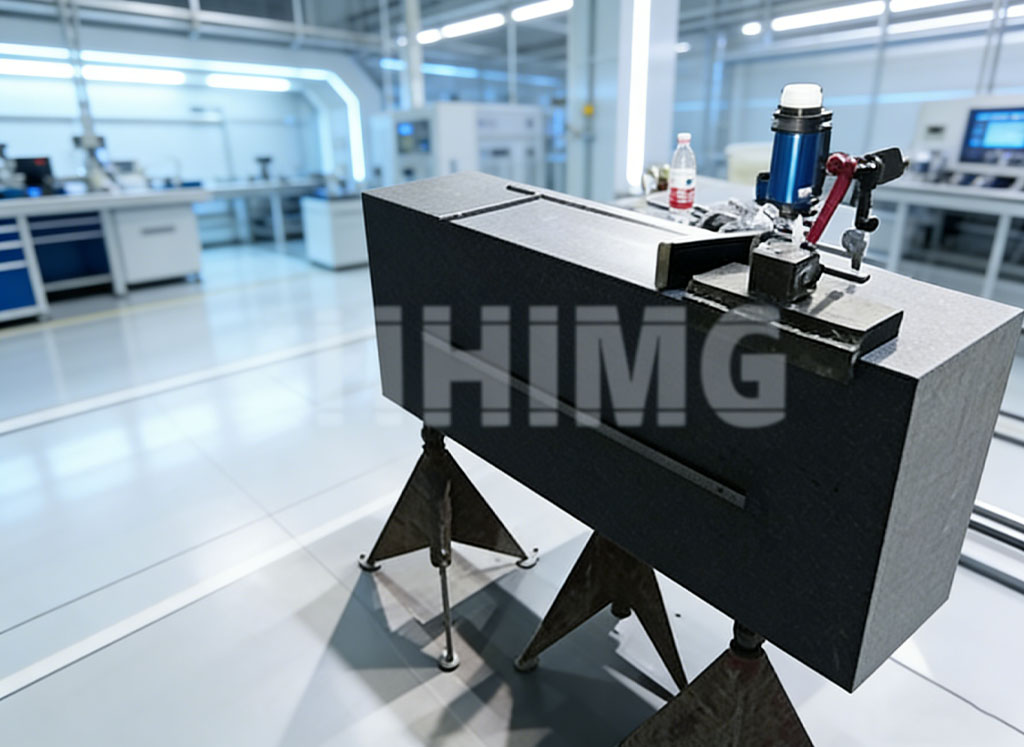
ZHHIMG: Your Partner for CMM Granite Tables
We understand that a CMM table is the foundation of your entire measurement system. That is why we adhere to the strictest quality standards:
- • Precision Grinding: Our master craftsmen with over 30 years of experience achieve flatness that approaches the nanometer level.
- • Certified Calibration: All our tables are calibrated using Renishaw laser interferometers and WYLER electronic levels, with certificates traceable to the National Institute of Metrology.
- • Global Standards: We manufacture to DIN 876, ASME B89.3.1, GB/T 4485, and other international standards to ensure compatibility with your CMM brand.
- • Custom Engineering: Whether you need a standard rectangular table or a custom-shaped base with integrated air bearings, we can engineer it to your exact CAD specifications.
Making the Right Choice
For the vast majority of CMM applications, from tool rooms to calibration labs, high-density granite offers the optimal combination of stability, accuracy, and value. If you are specifying a new CMM or replacing an existing table, we invite you to consider the proven performance of ZHHIMG granite.
Contact our engineering team today to discuss your CMM table requirements and request a custom quote.
Post time: Nov-23-2026