
A high-quality granite surface plate is a long-term investment. Unlike cast iron, it will not rust. Unlike marble, it will not warp from humidity. However, this does not mean it is indestructible. Even the highest grade ZHHIMG Black Granite can lose its reference flatness if it is subjected to poor handling, improper leveling, or harsh cleaning chemicals.
At ZHHIMG, our quality policy is simple: the precision business cannot be too demanding. This applies not only to how we manufacture the plates, but also to how you should maintain them. Proper care ensures your plate remains a reliable reference for decades.
1. Daily Cleaning: The Right Way and the Wrong Way
The most common mistake we see in machine shops is improper cleaning. Workers often use whatever solvent is handy to wipe down the plate after a shift. This can be disastrous for the surface finish and the measuring tools that contact it.
What you should use:
- • A soft, lint-free cloth or a dedicated granite cleaning brush.
- • Mild dish soap mixed with water, or a specialized stone cleaner.
- • Isopropyl alcohol (IPA) for removing oil or grease from precision parts.
What you must never use:
- • Acidic cleaners (like vinegar or descaling agents). These can etch the microscopic pores of the granite, permanently altering the surface texture.
- • Abrasive scrubbing pads. These will create micro-scratches that destroy the flatness at a micron level.
- • Compressed air. Blowing air across the surface can force dust particles into the stone or scratch it with high-velocity debris.
Pro Tip: Always clean the plate before and after use. A single grain of metal swarf left under a precision level can create a false reading of several microns.
2. The Critical Role of Leveling and Support
Granite is extremely rigid, but it is not immune to gravity. If a large surface plate is not supported correctly, its own weight will cause it to deflect, creating a false crown or sag in the center. This is known as deformation due to poor support.
The Airy Points Rule:
For any rectangular surface plate, you must use adjustable support jacks placed at specific intervals, known as Airy points. These points minimize deflection. For most standard plates, supports should be placed at approximately 22 percent of the length from each end.
For any rectangular surface plate, you must use adjustable support jacks placed at specific intervals, known as Airy points. These points minimize deflection. For most standard plates, supports should be placed at approximately 22 percent of the length from each end.
- • Never support a plate at its extreme corners or only at the center.
- • Use a precision spirit level to adjust the jacks until the plate is perfectly level in both the X and Y axes.
- • Re-level the plate whenever it is moved or if the shop floor temperature changes significantly.
3. Temperature Control: The Hidden Enemy of Flatness
Granite has a very low coefficient of thermal expansion, but it is not zero. In a precision environment, a temperature fluctuation of just 2 to 3 degrees Celsius can cause measurable flatness deviations on large plates.
Best practices for thermal stability:
- • Keep the plate in a dedicated, climate-controlled room whenever possible.
- • Allow the plate to acclimate to the room temperature for at least 24 hours before performing high-precision calibration or measurements.
- • Avoid placing the plate near direct sunlight, HVAC vents, or heat-generating machinery like welders or furnaces.
4. When and How to Calibrate Your Surface Plate
Even with perfect daily maintenance, a surface plate will eventually experience wear in high-use areas. This is why regular calibration is mandatory for any facility with ISO 9001 certification.
How often should you calibrate?
- • Grade AA and Grade A plates used in active inspection: Annually.
- • Grade B plates used in general workshop environments: Every 1 to 2 years.
- • After any incident: If a heavy object is dropped on the plate, or if the plate is transported to a new location, immediate recalibration is required.
The Calibration Process:
Professional calibration involves using an electronic level or a laser interferometer to map the surface in a grid pattern (typically 5×5 or 10×10 points depending on size). At ZHHIMG, our calibration certificates are traceable to the National Institute of Metrology, ensuring your quality audits will pass without issue.
Professional calibration involves using an electronic level or a laser interferometer to map the surface in a grid pattern (typically 5×5 or 10×10 points depending on size). At ZHHIMG, our calibration certificates are traceable to the National Institute of Metrology, ensuring your quality audits will pass without issue.
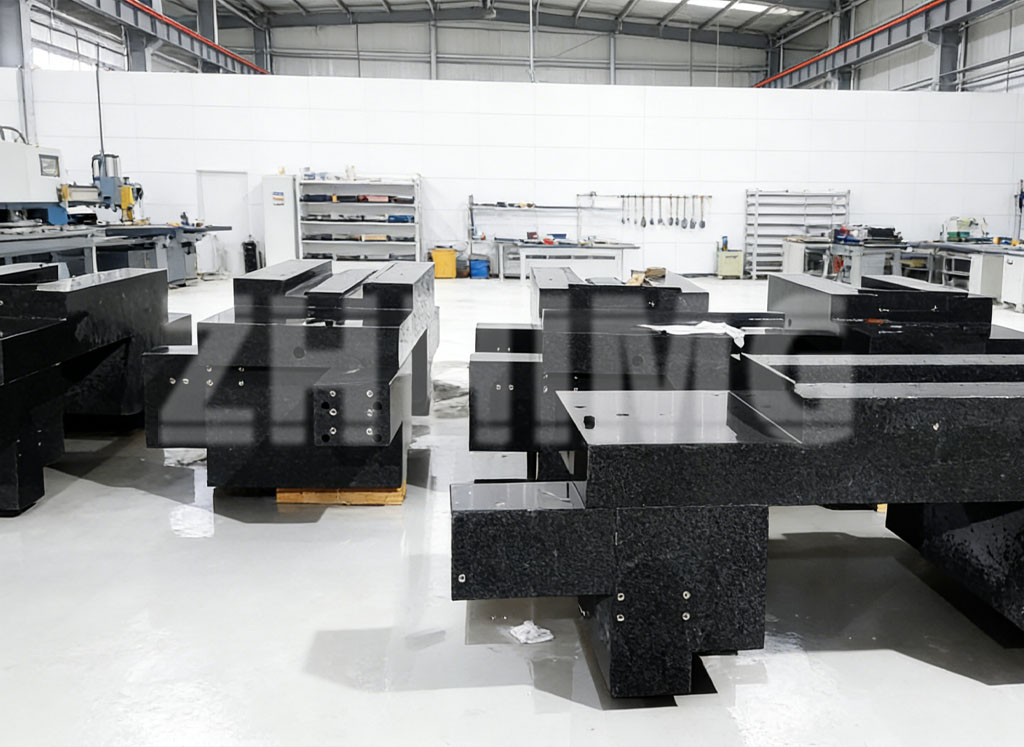
5. Storage and Long-Term Care
If your surface plate is not in daily use, or if you are storing a spare plate, proper storage is critical.
- • Never store a granite plate on its side or edge. The uneven pressure can cause micro-fractures over time. Always store it flat on a stable, level surface.
- • Cover the plate with a protective dust cover when not in use to prevent airborne contaminants from settling on the measuring surface.
- • Do not place heavy machinery, tool boxes, or raw metal stock on the plate when it is not being used for measurement.
The ZHHIMG Advantage: Built to Last
We design our plates to make maintenance as easy as possible. Our proprietary ZHHIMG Black Granite has near-zero water absorption, meaning spills will not stain or degrade the stone. The high density of approximately 3100 kg per cubic meter ensures maximum resistance to impact and wear.
Whether you are maintaining a small 400mm Grade A plate for a tool room or a massive 4000mm Grade AA base for a CMM, following these guidelines will protect your investment.
Need a custom maintenance schedule or a calibration service for your existing plates? Contact our engineering team today.
Post time: Nov-23-2026