
In the semiconductor industry, precision is not just a requirement; it is the entire business model. When you are working with wafer sizes that demand nanometer-level accuracy, even the slightest vibration or thermal expansion can ruin an entire batch of chips. This is why the industry has largely moved away from traditional steel and cast iron bases, turning instead to high-density granite.
At ZHHIMG, we understand the unique demands of the semiconductor sector. Our 10,000 square meter constant-temperature workshop and strict adherence to DIN and ASME standards make us a trusted partner for global equipment manufacturers. Here is why granite is the superior choice for your most critical machinery.
1. Thermal Stability: The Key to Nanometer Accuracy
Semiconductor manufacturing processes, such as lithography and wafer inspection, often involve lasers and optical sensors that are highly sensitive to temperature changes. Steel and aluminum expand and contract significantly with temperature fluctuations. Granite, however, has an extremely low coefficient of thermal expansion.
- • Low Thermal Conductivity: Granite does not transfer heat quickly. If a machine component generates heat, the granite base will not immediately transfer that heat to other parts of the system, preventing thermal distortion.
- • High Thermal Inertia: Once a granite base reaches a stable temperature, it resists change. This means that even if the ambient room temperature fluctuates slightly, the granite structure remains dimensionally stable.
- • Our Process: At ZHHIMG, we grind and inspect our granite components in a strictly controlled environment (typically 20 degrees Celsius plus or minus 1 degree) to ensure that the flatness you see on our certificate is the flatness you get in your cleanroom.
2. Vibration Damping: Eliminating Micro-Vibrations
Modern semiconductor equipment often utilizes high-speed linear motors and air bearings to move wafers or inspection heads. These rapid movements generate micro-vibrations. If these vibrations are transmitted through the machine base, they can cause blurring in lithography patterns or inaccurate readings in metrology tools.
Granite has a unique internal crystalline structure that acts as a natural vibration damper.
- • High Damping Ratio: Granite absorbs vibrational energy much more effectively than steel. Instead of ringing like a bell, the vibrations are dissipated as heat within the stone.
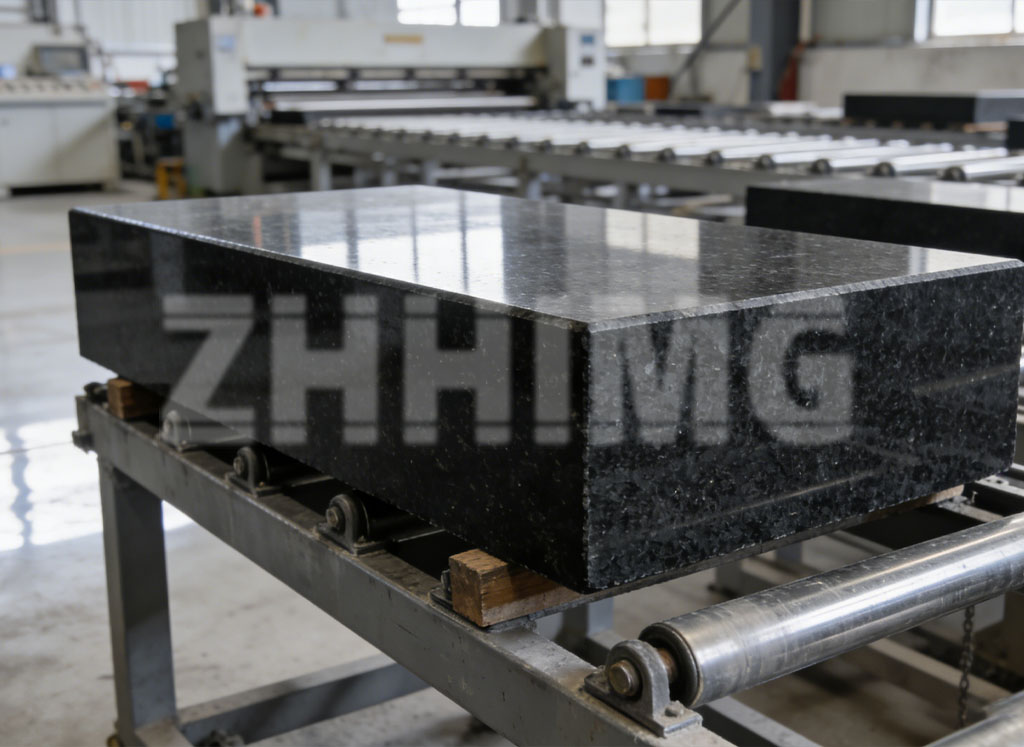
- • Mass Matters: With a density of approximately 3100 kg per cubic meter, ZHHIMG granite provides the necessary mass to stabilize high-speed moving parts, ensuring smooth and precise motion.
3. Non-Magnetic and Electrically Insulating
Many semiconductor processes involve sensitive electronic measurements or magnetic fields. Steel bases can interfere with these processes by becoming magnetized or conducting stray electrical currents.
- • Non-Magnetic: Granite is completely non-magnetic, making it ideal for use in electron beam lithography or other magnetic-sensitive applications.
- • Electrical Insulation: As a natural insulator, granite prevents ground loops and electrical interference that could affect sensitive sensors or control systems.
4. Custom Engineering for Semiconductor Applications
Standard surface plates are often not enough for complex semiconductor machinery. Equipment manufacturers require custom-engineered granite components that integrate multiple functions into a single, monolithic structure.
Common customizations we provide at ZHHIMG include:
- • Integrated Air Bearings: We can machine precise pockets and channels directly into the granite to house air bearings, creating a frictionless motion system.
- • T-Slots and Mounting Holes: We drill and tap mounting holes according to your exact CAD drawings, ensuring perfect alignment with your machine’s uprights and gantries.
- • Edge Profiles and Chamfers: We can create custom edge profiles to accommodate cable carriers or protective covers.
- • Large Format Manufacturing: We have the capability to manufacture single-piece granite bases up to 6 meters in length, eliminating the need for splicing which can introduce weak points and alignment errors.
5. Meeting the Strictest Global Standards
The semiconductor supply chain is global, and your equipment must meet international standards. Our team is fluent in the requirements of:
- • DIN 876 / DIN 875: The German standard for surface plates and straight edges.
- • ASME B89.3.1: The American standard for surface plate specifications.
- • GB/T 4485: The Chinese national standard.
We also work closely with clients in Japan (JIS), the UK (BS), and Russia (TOCT), ensuring that our granite components integrate seamlessly into any global manufacturing ecosystem.
Why Choose ZHHIMG for Your Semiconductor Projects?
We do not just sell stone; we provide precision engineering solutions. With over 30 years of experience, our master craftsmen combine traditional grinding techniques with modern laser interferometry to achieve flatness that approaches the nanometer level.
From initial CAD design to final calibration and packaging, we ensure that every granite component meets your exact specifications. Whether you need a custom base for a wafer prober, a granite beam for an inspection system, or a massive granite table for a lithography machine, we have the capacity and the expertise to deliver.
Contact our engineering team today to discuss your semiconductor equipment requirements.
Post time: Nov-23-2026