
Three materials, three different sets of trade-offs
Ultra-precision equipment is built from three families of structural material, and the choice between them decides how the machine behaves long before the control system is tuned:
- Granite: a quarried stone, sawn and lapped. Low thermal expansion, high internal damping, no rust, and stable geometry over years. It is not cast and cannot be welded, so its shape is limited by what can be cut from a block.
- Technical ceramics (typically alumina-based): a fired material with very high hardness and excellent wear resistance, low thermal expansion and no corrosion. It is stiffer and harder than granite, but more brittle and more expensive per part, and large monolithic pieces are difficult to produce.
- Metals (steel, cast iron, stainless, aluminium): the widest range of properties, the highest available stiffness, and the easiest to machine, weld and integrate into a machine frame. They also expand more with temperature, and steel needs corrosion protection.
None of the three is universally better. A material that wins on stiffness may lose on thermal stability; a material that wins on damping may lose on damage tolerance.
Comparing the three on the properties that decide precision
The table below summarises general material behaviour. Each row states its basis; values for a specific component come from its material data and its own inspection report.
| Property | Granite | Technical ceramic | Metal | Basis |
|---|---|---|---|---|
| Thermal expansion | Low; geometry holds through ambient drift | Low, comparable order to granite | Higher — roughly an order of magnitude above stone for common steels | Material data sheets |
| Vibration damping | High internal damping; ringing decays quickly | Good damping, between granite and metal | Lower in solid form; ringing needs settling time | Material behaviour |
| Stiffness | High modulus but limited to cut shapes | High modulus; excellent stiffness per unit mass | Highest available; adjustable by section design | Material data |
| Hardness and wear | Wears slowly; scratches do not raise burrs | Extremely hard; best wear resistance of the three | Requires hardening; dents and burrs form on impact | Material behaviour |
| Damage tolerance | Chips at edges on hard impact | Brittle — can crack on sharp impact; no burrs | Deforms rather than cracking; damage usually reparable | Workshop experience |
| Corrosion | No rust, unaffected by most coolants | Chemically inert | Needs coating, oiling or a stainless grade | Material behaviour |
| Forming and integration | Cut and lapped; inserts bonded in for threads | Ground and lapped; threaded features need inserts | Machined, welded and cast; integrates directly | Manufacturing process |
| Size capability | Large plates and long beams are routine | Practical size limited by firing and brittleness | Any practical size, fabricated by welding if needed | Production experience |
| Typical use | Metrology plates, machine bases, air-bearing guideways, inspection equipment | Gauge blocks, straight edges, air-bearing pads, wear-critical contacts | Frames, brackets, spindles, drive and load paths | Application practice |
The rows are not a ranking, and they are not additive. A component is not “better” for scoring well in more rows; it is better when the rows that matter to the machine’s dominant error source are the ones it wins.
Matching material to the error source
The fastest way to choose is to name the problem the machine must not have:
- Thermal drift over a long working day: granite wins, because its geometry moves least as the room warms. A machine whose accuracy is dominated by thermal growth should start from stone.
- Chatter, ringing or vibration-limited surface finish: granite and ceramic both help, ceramic where the contact must also resist wear.
- Wear at a sliding or gauging contact: ceramic wins outright — hardness is where it is unmatched.
- Load paths, drive mounting, brackets and frames: metal wins, because stiffness, machinability and integration matter more than thermal expansion in a part that carries force rather than defines geometry.
- Cleanroom and coolant-exposed environments: granite and ceramic remove the corrosion maintenance that steel always requires.
This is also why a real machine is rarely made of one material. The productive design question is not “which material is best” but “which surface defines the geometry, which surface carries the load, and which surface wears” — because those three roles can call for three different materials in the same assembly.
Mixed-material assemblies: where the design work really is
A granite base carrying steel guide rails is the standard example, and the photo below shows exactly that: a black granite plate with stainless rails and threaded inserts mounted on it, being assembled by hand in a clean workspace. The granite provides the reference geometry and the thermal stability; the steel provides the hardened running surface and the load capacity. Neither material could do the whole job alone.
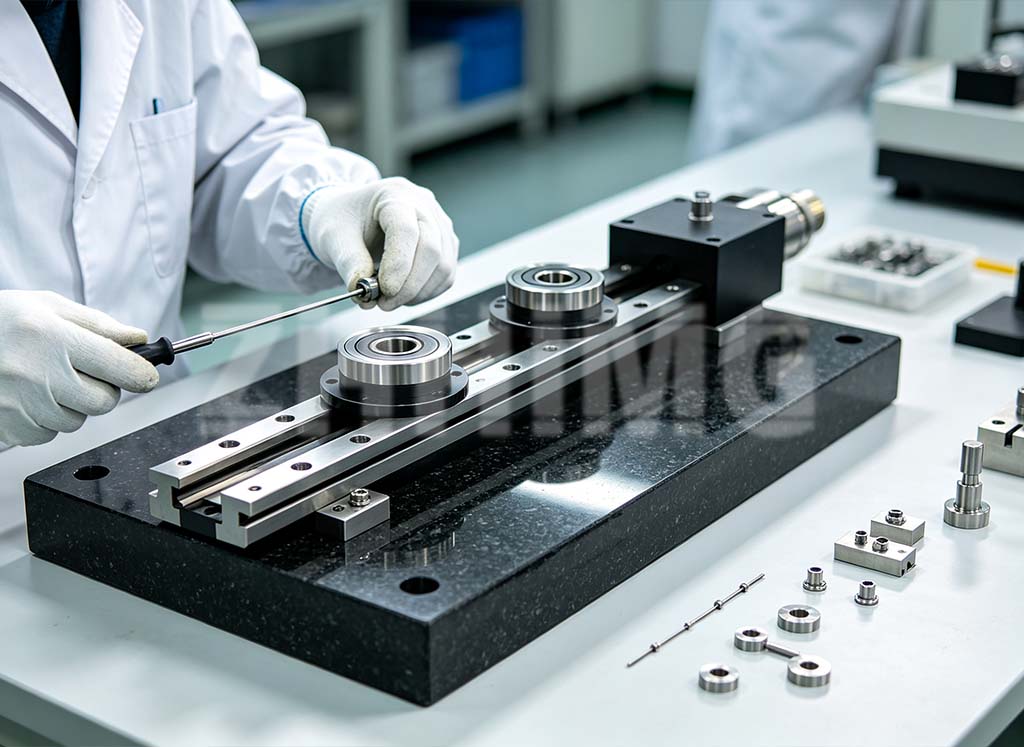
What makes such an assembly work is the interface, not the materials themselves:
- Inserts: threads are provided by bonded metal inserts, sized for the bolt load and positioned from the customer’s model. Where the insert meets stone is a load path and must be designed as one.
- Rail seat preparation: the granite face under a rail must be lapped to the flatness the rail expects, and the two rails must be parallel to each other across the travel.
- Differential expansion: stone and steel move differently with temperature. At the scale of a short bracket this is negligible; across a long rail it is a design input, and the mounting scheme should accommodate it rather than fight it.
- Verification after assembly: flatness of the granite alone does not describe the assembly. Straightness and parallelism are measured on the finished stack, because that is what the motion system sees.
Where each ZHHIMG product line fits
The three material families map onto distinct product lines, and most projects draw on more than one:
- Granite: granite components for ultra-precision machine bases for bed and column structures, and granite surface plates where the part is the reference plane itself.
- Ceramic: ceramic straight edges and ceramic air bearing elements, where hardness and wear resistance at the contact decide performance.
- Metal: precision metal castings and machined metal components for the load-carrying and integration side of the machine, and precision measuring instruments for the metrology that verifies all of it.
What to send for a material and design review
A useful enquiry states the function of the part, the dominant error source or failure mode, the loads and their direction, the required accuracy at the working surface, the operating environment (temperature range, coolant, cleanroom), and the interfaces that must mate to other components. With those, the material selection can be argued from requirements and the design options compared honestly — including the cases where stone is not the right answer and metal is. Send your application details to ZHHIMG for a material and design review.
Post time: Oct-14-2026