
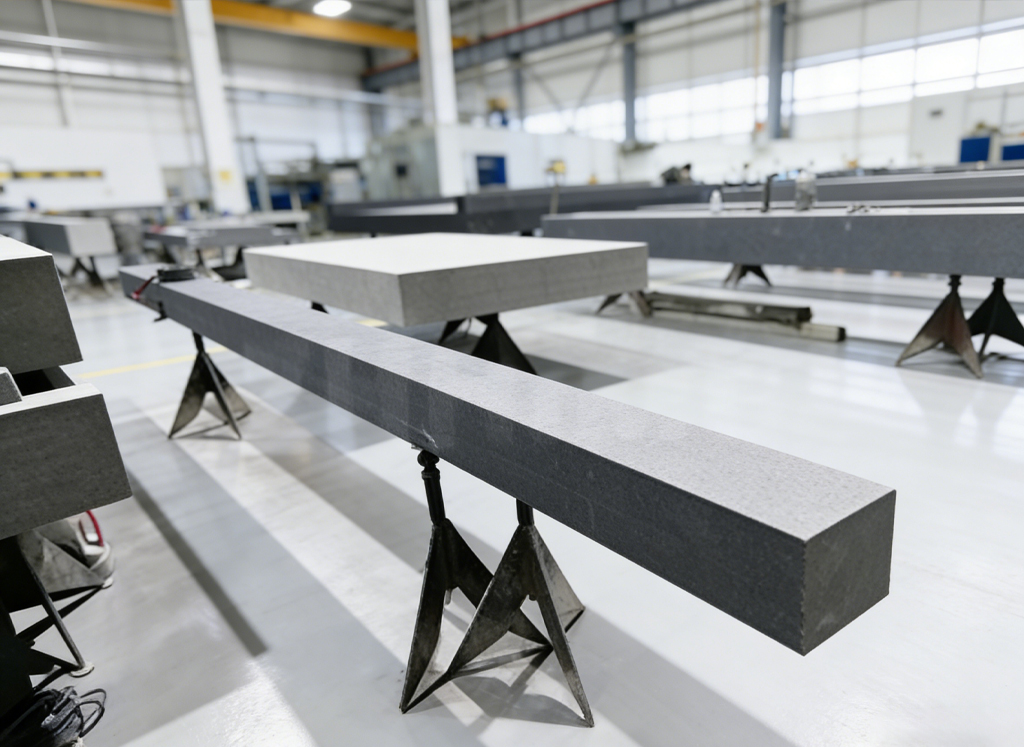
One Question, Many Right Answers
Every ultra-precision machine starts with the same decision: what should the structure be made of? Equipment R&D and sourcing teams searching for granite vs cast iron machine base comparisons or mineral casting vs granite trade-offs are really asking one question — which material protects my error budget best, at my price point, in my environment?
There is no universal winner. There are only well-matched and poorly matched combinations of material, geometry and application. This pillar guide compares the four dominant base materials — plus carbon fiber composites for beams — and gives you a selection framework you can apply directly to your next machine.
The Contenders
- Precision granite — machined natural stone, the reference material for metrology-grade stability.
- Cast iron / welded steel — the industrial default: economical, designable, manufacturable everywhere.
- Engineering ceramics (SiC, alumina, silicon nitride) — extreme stiffness and wear life in compact sizes.
- Mineral casting (epoxy granite) — cast polymer composite with outstanding damping and design freedom.
- Carbon fiber beams — where moving mass, not static mass, dominates the error budget.
Material by Material: What You Gain, What You Accept
Precision Granite
Strengths: exceptional long-term dimensional stability (no foundry stress history to relax), low thermal expansion (5–8 µm/m·°C), high damping, naturally rust-free and non-magnetic, lappable to micron flatness over meters. ZHHIMG® “Jinan Qing” black granite reaches ρ ≈ 3100 kg/m³ with fine, uniform grain.
Trade-offs: brittle — edges and thin features need careful design; mass is high; large parts carry longer machining lead times; no welded modifications after delivery.
Best for: CMMs, metrology frames, semiconductor stage bases, air bearing guideways — anywhere the reference geometry must survive years without recalibration.
Cast Iron & Steel
Strengths: best stiffness-per-dollar, mature global supply chain, short lead times, weldable and machinable anywhere, unlimited design freedom through casting and fabrication.
Trade-offs: thermal expansion roughly twice granite’s; casting stress must be relieved by aging or heat treatment or precision drifts; coatings and corrosion management add lifetime cost.
Best for: machine frames with moderate accuracy targets, high-volume equipment, structures with complex integrated features.
Engineering Ceramics
Strengths: highest specific stiffness (SiC elastic modulus 350–420 GPa), lowest thermal expansion (SiC ≈ 4–5 µm/m·°C), extreme wear life, corrosion and plasma resistance, electrical insulation (or controlled conductivity for SiC chucks).
Trade-offs: brittle, expensive, size-limited by sintering and diamond grinding capacity; best used for targeted components rather than meter-scale monolithic structures.
Best for: wafer handling and chamber components, high-cycle wear parts, insulated precision locating elements — see our precision ceramic components.
Mineral Casting (Epoxy Granite)
Strengths: damping 6–10× cast iron, near-net-shape casting of complex monolithic frames, fast replication across series, thermal expansion close to steel so metal inserts behave predictably, naturally corrosion-free.
Trade-offs: lowest elastic modulus (≈ 35–45 GPa) — sections must be generous; long-term creep behavior needs design attention; surface hardness is limited, so wear faces need inserts.
Best for: medium-precision series machines, vibration-critical medical and lab automation frames, high-mix equipment needing fast model changes.
Carbon Fiber Beams (Hybrid Designs)
Where the structure moves — CMM bridge beams, vertical spindles, gantry carriages — mass is the enemy. Carbon fiber beams cut moving mass dramatically while offering near-zero thermal expansion along the fiber axis. They are almost always used as hybrid elements: carbon beam, granite base, metal interfaces. ZHHIMG® machines and verifies carbon fiber beam precision assemblies alongside our stone and ceramic work.
The Numbers Side by Side
| Property | Granite | Cast Iron | Ceramic (SiC) | Mineral Casting |
|---|---|---|---|---|
| Thermal expansion (µm/m·°C) | 5–8 | ≈ 11–12 | 4–5 | ≈ 10–16 (grade-dependent) |
| Elastic modulus (GPa) | 50–90 | 100–140 | 350–420 | 35–45 |
| Damping | High | Baseline | Low–medium | 6–10× cast iron |
| Long-term stability | Excellent | Good (after stress relief) | Excellent | Good (watch creep) |
| Relative cost | Medium | Low | High | Low–medium (series) |
| Lead time | Weeks (large) | Short | Long | Short (once tooled) |
| Design freedom | Milling + inserts | Casting/welding | Grinding only | Near-net casting |
| Typical role | Reference base, guideways | General frame | Wear/insulation parts | Damped series frame |
Values are indicative ranges for comparison; verify against current datasheets for your specific grade and supplier.
A Five-Question Selection Framework
- What dominates your error budget? Thermal drift → granite or ceramic. Vibration → mineral casting or granite. Moving mass → carbon fiber hybrid. Wear → ceramic inserts.
- What size is the structure? Meter-scale monolithic stability → granite. Compact high-load → ceramic. Complex thin-walled frames → mineral casting or metal.
- What environment? Cleanroom or vacuum → granite and ceramic (no coatings, no outgassing). Humid or corrosive → granite, ceramic, mineral casting over bare cast iron.
- What volume? One-off or low volume → granite (no tooling). High series → mineral casting (tooling amortizes fast) or cast iron.
- How will parts join? Plan datum responsibility early: granite-to-metal inserts, shrink-fit ceramic seats, bonded carbon interfaces — each has rules that must be drawn, not improvised.
The Pain Points Every Material Must Answer
Whatever you choose, your base must control the five failure drivers of ultra-precision equipment: vibration (damping and isolation), thermal deformation (expansion coefficient and gradient behavior), precision drift (stress relaxation and corrosion), unstable assembly datums (coplanar lapped references and engineered inserts), and cleanliness (particle- and outgassing-neutral surfaces). In practice, most winning designs are hybrids: a granite reference base, ceramic wear and insulation points, mineral-cast or metal support frames, and carbon fiber where mass moves.
Where These Decisions Play Out
Semiconductor equipment, CMM manufacturing, laser systems, AOI and industrial CT, precision XY tables, and lithium battery & electronics inspection all sit inside this framework — differing only in where they land on the stability-stiffness-cost-volume trade surface.
Why ZHHIMG® Is a Rare Kind of Supplier
Suppliers usually push the material they make. ZHHIMG® works granite, ceramics, metals and hybrid carbon assemblies side by side — so our recommendation starts from your error budget, not our product line:
- Multi-material capability: precision granite (ρ ≈ 3100 kg/m³ black granite), engineering ceramics, metal integration and carbon fiber hybrid assemblies under one roof.
- Constant temperature and humidity, dust-controlled workshops for grinding, lapping and full assembly.
- Large-format machining and complete assembly: from ceramic inserts to meter-scale granite bases with air bearing surfaces.
- Complete in-house metrology: calibrated, traceable instruments; documented inspection reports for every deliverable.
- Multi-standard experience: DIN 876, ASME B89.3.7, GB/T 20428, JIS — plus ISO 9001 / ISO 14001 / ISO 45001 certified management.
Credentials You Can Verify
- ISO 9001 / ISO 14001 / ISO 45001 certifications; CE documentation for assemblies.
- Internationally registered trademarks and patents on precision granite and related products.
- Cooperation with universities and provincial metrological institutes for calibration and verification.
- Long-term customers in semiconductor, metrology, laser and inspection equipment across Europe, North America and Asia.
Send Drawing for Quotation
Unsure which material fits your error budget? Send us the drawing — we will review it across all our materials, not just one. Three ways to start:
- Send drawing for quotation: share your STEP or PDF with accuracy targets and environment notes — we reply with a multi-material manufacturability review and quotation within a few working days.
- Request technical datasheet: ask for granite, ceramic and mineral casting material data and tolerance capability tables.
- Book a video audit: tour our constant-temperature workshops and metrology lab live, remotely.
Start from our granite machine bed solutions, browse all precision granite components, or see our full ultra-high precision granite solutions.
Post time: Sep-28-2026