
Where Metal Reaches Its Limits, Ceramics Take Over
As semiconductor tools push toward finer process nodes, battery inspection demands higher throughput, and medical equipment demands cleaner, more stable mechanics, design engineers keep hitting the same wall: metals deform, wear, contaminate and drift. Precision ceramic components — alumina, silicon nitride, zirconia-toughened alumina (ZTA) and silicon carbide — remove that wall by offering hardness, thermal stability, electrical insulation and wear life that no metal can match.
But ceramics reward good design and punish careless translation of metal part drawings. This guide covers material selection, ceramic CNC machining and grinding considerations, and the design inputs that make the difference between a ceramic part that performs for a decade and one that chips in the first fixture.
Choosing the Right Ceramic Material
| Material | Key Properties | Typical Parts |
|---|---|---|
| Alumina (Al₂O₃, 95–99.7%) | Excellent electrical insulation, high hardness, chemical inertness, economical | Insulators, guide pins, seal rings, wafer handling components |
| Silicon nitride (Si₃N₄) | High fracture toughness, thermal shock resistance, low density | Locating pins, bearings, fixtures in thermal cycling environments |
| Zirconia / ZTA | Highest toughness among oxides, fine surface finish capability | Wear inserts, nozzles, medical components |
| Silicon carbide (SiC) | Highest stiffness, outstanding wear and corrosion resistance | Conductive wafer chucks, mechanical seals, high-load guides |
Design and Machining Considerations for Ceramic Parts
- Design for the green-to-fired journey. Ceramics are pressed, sintered and then ground. Sintering shrinks parts — tolerance-critical features must be finished-ground after firing, while non-critical features can stay as-sintered to save cost.
- Respect the material’s brittleness. Avoid sharp internal corners (use radii), specify generous chamfers on edges, and design load paths in compression where possible. A ceramic part is strong for decades until a stress concentrator says otherwise.
- Diamond tooling only. Alumina and silicon nitride parts are machined with diamond grinding wheels and CNC-controlled creep-feed and jig grinding. Expect grinding to define the achievable tolerances: flatness at the micron level, hole diameters ±0.005 mm, and fine surface finishes for sealing faces.
- Holes, threads and inserts. Threads in ceramics are possible but best avoided in high-load features; where metal interfaces are needed, design for shrink-fit or bonded metal inserts and declare the loads.
- Dimensional anchors matter. Define one functional datum system; grinding all critical surfaces in one setup from a common datum preserves geometry that would otherwise be lost in refixturing.
- Cleanliness by nature. Ceramics do not rust, do not outgas and do not shed corrosion products — a natural fit for cleanroom semiconductor tools and medical device assembly.
The Pain Points Ceramic Components Solve
- Vibration & wear: high hardness and stiffness keep guides, pins and contact faces dimensionally stable under millions of cycles.
- Thermal deformation: low thermal expansion (alumina ≈ 7–8 µm/m·°C; SiC ≈ 4–5) and high temperature capability hold critical gaps stable through thermal cycles.
- Precision drift: no corrosion, no creep under typical loads — calibration intervals stretch and equipment accuracy holds.
- Unstable assembly datum: ground ceramic datums paired with granite bases create reference stacks that stay true year after year.
- Contamination & cleanliness: particle-neutral, insulating and plasma-resistant — exactly what wafer processing and medical environments demand.
Application Scenarios
| Industry | Typical Ceramic Components |
|---|---|
| Semiconductor equipment | Wafer handling parts, insulators, chamber components, guide pins, chuck parts |
| CMM & precision metrology | Probe stylus components, air bearing inserts, wear-free locating elements |
| Laser equipment | Reflective-mount insulators, beam-line fixtures, wear guides |
| AOI / industrial CT / XY tables | High-stiffness stages inserts, precision spacers, insulated mounts |
| New energy & battery inspection | Insulating fixtures, guide rollers, wear parts for high-throughput lines |
| Medical equipment | Pump components, seal rings, biocompatible wear parts |
The ZHHIMG® Difference: Ceramics Engineered Together with Granite
Most ceramic suppliers sell you a part. ZHHIMG® delivers precision structures — because we machine technical ceramics and precision granite in the same facilities and assemble them into complete, verified systems:
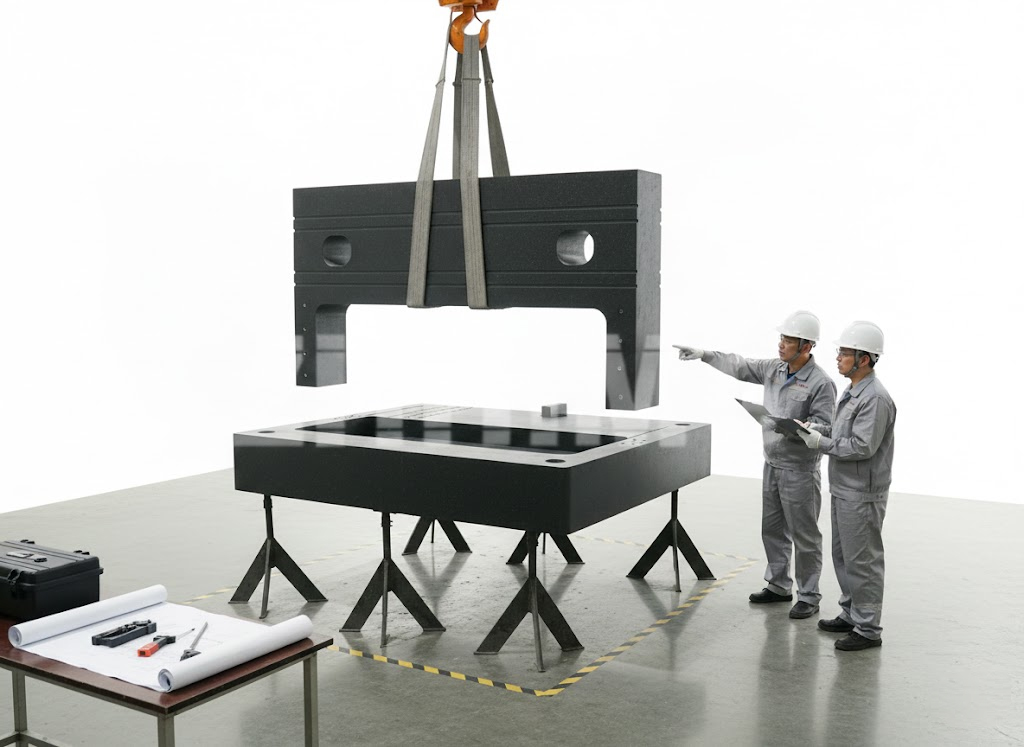
- Granite & ceramics under one roof: ZHHIMG® black granite (ρ ≈ 3100 kg/m³) bases, beams and tables machined alongside alumina, ZTA and SiC components — datum-compatible by design, assembled in one shop.
- Constant temperature and humidity, dust-controlled workshops for grinding, lapping and assembly.
- Large-format machining and full-assembly capability: from small ceramic inserts to meter-scale granite-ceramic assemblies with metal integration.
- Complete in-house metrology: calibrated, traceable inspection equipment; every part and assembly ships with a documented report.
- Multi-standard experience: DIN 876, ASME B89.3.7, GB/T 20428 and JIS tolerance systems, applied consistently across granite and ceramic deliverables.
Credentials You Can Verify
- ISO 9001 / ISO 14001 / ISO 45001 certifications; CE documentation for supplied assemblies.
- Internationally registered trademarks and patents on precision granite and ceramic products.
- Cooperation with universities and provincial metrological institutes for calibration and verification.
- Trusted by customers in semiconductor, new energy, medical, laser and metrology equipment across Europe, North America and Asia.
Design Inputs to Confirm Before Ordering
- Material and grade (or let us propose 2–3 candidates with trade-offs).
- Critical tolerances vs. as-sintered features — marking them on the drawing saves real money.
- Load direction and magnitude, impact events, and mating materials.
- Temperature range, thermal cycling frequency and environment (vacuum, plasma, cleanroom class).
- Electrical requirements: insulation resistance, dielectric strength, or controlled (anti-static) behavior.
- Interfaces: metal inserts, shrink-fit seats, adhesive channels, mounting torque.
- Documentation: which dimensions and material properties must appear on the inspection report.
Send Drawing for Quotation
ZHHIMG® manufactures precision ceramic components and granite-ceramic hybrid assemblies to customer drawings, with traceable inspection reports. Three ways to start:
- Send drawing for quotation: share your STEP or PDF drawing with material, tolerances and application notes — we reply with a manufacturability review and quotation within a few working days.
- Request technical datasheet: ask for ceramic material data, achievable tolerance tables and granite-ceramic assembly examples.
- Book a video audit: tour our constant-temperature machining and metrology workshops live, remotely.
Explore our precision ceramic components, browse ceramic component solutions, or see how ceramics combine with granite in our precision granite components.
Post time: Sep-28-2026