
One question, not one answer
ZHHIMG manufactures both granite and mineral casting, so this article has no material to sell in advance. The honest version of the question “granite vs mineral casting” for a precision base is: which set of properties your specific structure, tolerances and production volume reward. The two materials are made by completely different processes — granite is cut and lapped from natural stone blocks, mineral casting is cast as an epoxy-bonded composite into a mold — and almost every practical difference between them follows from that fact.
Comparison by design decision
Each row below states where the assessment comes from, because “better” without context is marketing. Where we give no number, it is because the honest answer depends on the specific project.
| Design aspect | Granite | Mineral casting | Basis |
|---|---|---|---|
| Geometry and structural complexity | Limited by what can be cut and ground from a block; deep pockets, closed ribbing and highly contoured forms are costly or impossible | Cast into a mold, so complex outer shapes, ribbed sections and integrated channels are natural to the process | Manufacturing process; supplier technical data |
| Achieving precision datum surfaces | Directly lapped to flatness grades per recognized standards; the reference surface is the material itself | Cast surface is not a metrology datum; precision surfaces are achieved by machining or by granite/steel inserts cast in, then finished | Manufacturing process; our production practice |
| Inserts, mounting holes and interfaces | Drilled and fitted with steel inserts individually; positions are flexible but each insert is manual work | Inserts and boxes can be positioned in the mold before casting; excellent for repeating the same interface across a series | Manufacturing process; specific project experience |
| Temperature and vibration design | Low thermal expansion, proven long-term stability; heavy sections provide damping | Composite formulation gives good damping and lower thermal conductivity; exact values depend on the mix, so they must come from the supplier’s material data sheet for the specific formulation | Material data sheets; project-specific measurement |
| One-off versus batch production | Strong for one-offs and small series: no mold needed, cost scales roughly with material removed | Mold cost must be amortized; becomes attractive at volume, or when identical bases are repeated | Cost structure; supplier technical data |
| Inspection, assembly, lead time and cost | Inspection per recognized flatness standards; lead time driven by cutting, lapping and insert work; cost dominated by material and machining hours | Inspection focuses on machined features and cast-in interfaces; lead time includes mold making and casting cure; cost dominated by mold amortization and casting volume | Our production and inspection workflow |
Note what is missing from this table: performance multiples. Terms like “X times better damping” are only meaningful for a specific mix and a specific test method. When we quote, damping and thermal figures come from the data sheet of the actual formulation being offered, and we encourage customers to ask any supplier — us included — for exactly that.
Where granite tends to be the better fit
Granite is usually the stronger candidate when the base needs metrology-grade reference surfaces as an integral part of its function (CMM bases, measuring instruments), when the geometry can be expressed in prismatic forms, when only one or a few units are needed, and when the acceptance criterion is a recognized flatness standard on the granite surface itself.
Where mineral casting tends to be the better fit
Mineral casting is usually the stronger candidate when the structure is geometrically complex or needs integrated channels and ribbing, when the same base will be produced in a series, when inserts and interfaces can be pre-positioned in the mold, and when the design damping and thermal behavior requirements should be met by a formulated composite rather than by the properties of natural stone. Our mineral casting machine base solutions follow this route: cast body, machined or cast-in precision interfaces.
A decision checklist before you commit
- Does the base need complex internal geometry, or are prismatic forms sufficient?
- Are the precision surfaces integral granite datums, or machined features on a cast body?
- How many units — one, a few, or a repeating series with mold amortization?
- Which interfaces must repeat exactly across units: inserts, boxes, locating features?
- Are damping and thermal figures required from a specific formulation’s data sheet, or from measurement on the finished part?
- What acceptance evidence will you require: flatness standard on granite, machined-feature report on casting, or both?
- Delivery and assembly constraints: crane access, section weight limits, mate-in-plant versus on-site alignment.
The photo below shows a granite gantry-style structural frame being lifted in our works — a geometry chosen because the application needed lapped datum surfaces in a structural arrangement, which is exactly the kind of decision the checklist above is meant to support.
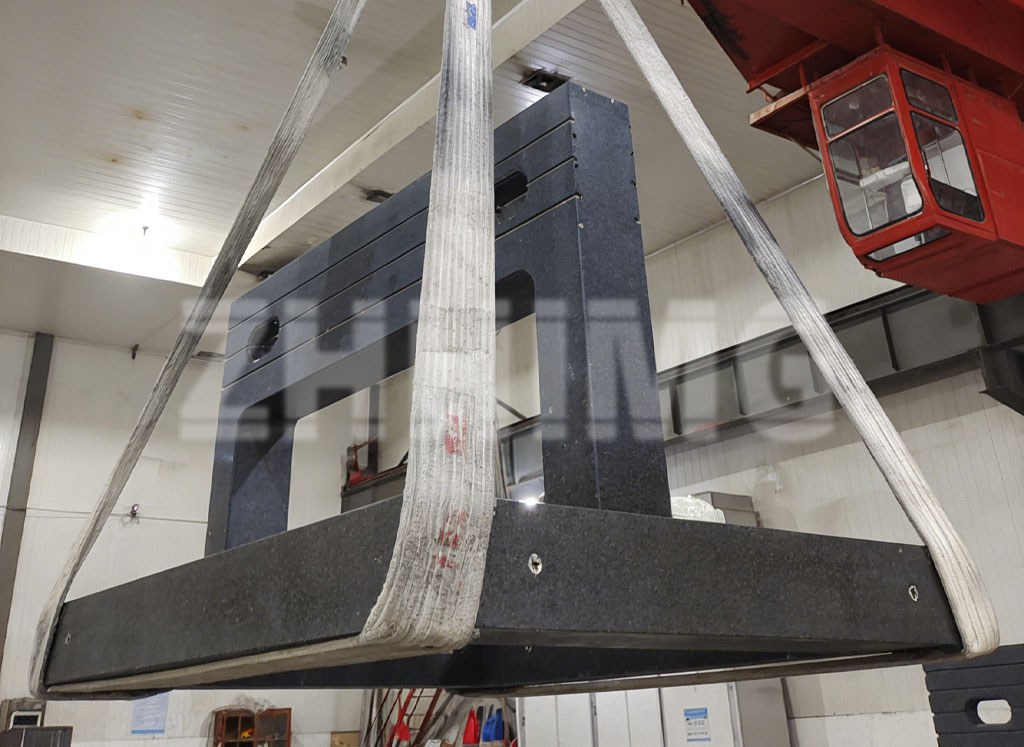
Anonymized project example
A customer came to us with an inspection machine concept: the base needed a lapped reference plane for the measuring axis, but also deep pockets for cable routing and a moderate series volume across two machine sizes. Neither pure answer worked — a full mineral casting body could not deliver the required integral flatness standard on the reference plane, and a full granite block could not carry the pockets economically. The delivered solution used granite for the datum-carrying sections, with the structural requirements coordinated across the assembly, and the acceptance was defined per section: flatness standard on the granite reference, dimensional report on the machined interfaces. The lesson is not that “hybrid is always right”, but that defining which surfaces are metrology datums and which are structure tells you where each material belongs.
Send your structure for a material review
Send your structural requirements for a granite or mineral-casting solution review. Describe the geometry, the surfaces that carry precision functions, the production volume and the acceptance evidence you need, and ZHHIMG engineers will return an honest material recommendation with the data sources behind it — contact ZHHIMG to start the review.
Post time: Oct-12-2026