
When specifying bases for ultra-precision inspection equipment — whether for coordinate measuring machines (CMMs), optical comparators, or semiconductor wafer handlers — engineers face a critical material decision: granite or mineral casting. Both offer advantages over traditional cast iron, but their performance diverges significantly under real-world metrology conditions. Drawing from two decades of manufacturing precision granite components for global clients like Samsung, Bosch, and national metrology institutes, we’ve observed that while mineral casting has its place, granite remains the gold standard for applications demanding nanometer-level repeatability and long-term dimensional stability.
Mineral casting, often marketed as a cost-effective alternative, is a composite material made from epoxy resin and mineral aggregates. Its primary selling point is design flexibility — complex geometries can be molded in a single pour, reducing assembly steps. However, this advantage comes with trade-offs. Epoxy-based matrices are inherently sensitive to temperature fluctuations. Even minor ambient shifts can induce micro-expansion or contraction, compromising measurement integrity in environments where thermal drift must be minimized. Additionally, mineral casting lacks the intrinsic damping properties of natural stone. Vibrations from nearby machinery or floor movement transmit more readily through the base, introducing noise into sensitive readings.
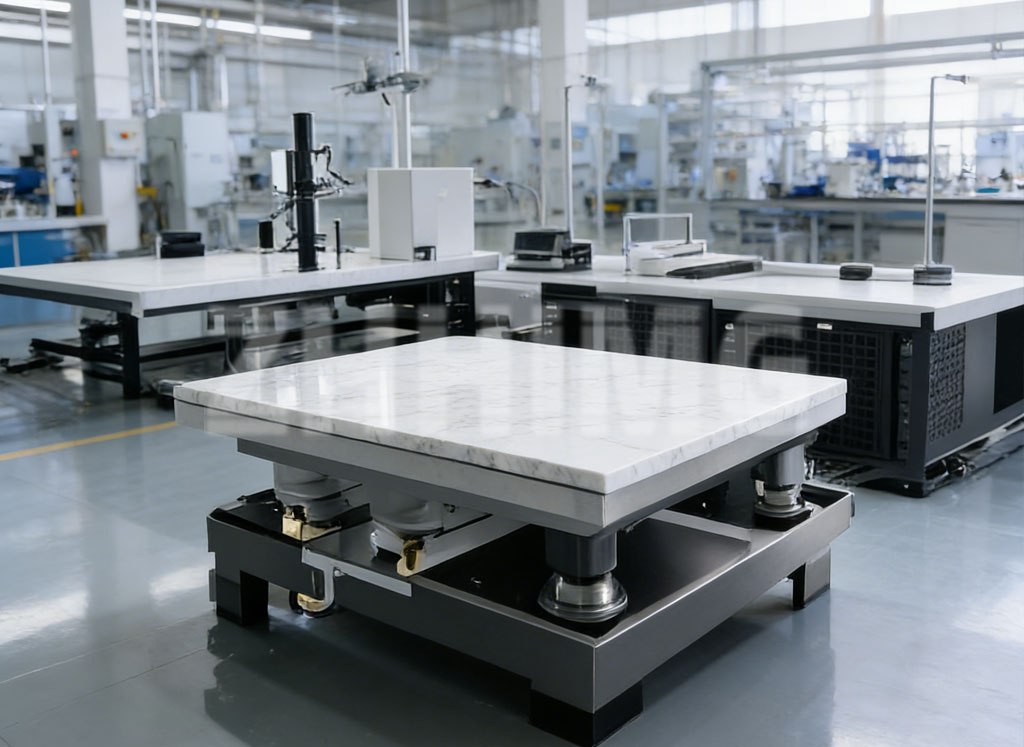
Granite, particularly high-density varieties like ZHHIMG®’s proprietary black granite (density ≈3100 kg/m³), offers superior performance in these areas. Its crystalline structure provides exceptional thermal stability — expanding and contracting at a predictable, minimal rate across typical lab temperatures. More importantly, granite’s internal friction naturally dissipates vibrational energy, creating a quieter measurement environment. This isn’t theoretical; it’s measurable. In our 10,000 m² Constant temperature and humidity workshop, equipped with Renishaw laser interferometers and Mahr dial indicators calibrated to national standards, we consistently verify that granite bases maintain flatness within ±0.5 μm over 24-hour cycles — a benchmark mineral casting struggles to match without active environmental control.
The choice also hinges on longevity and maintenance. Granite components, when properly lapped by experienced craftsmen (many of our Master Grinder / Grinding Specialist have over 30 years of hand-finishing experience), retain their accuracy for decades. They resist wear, corrosion, and chemical exposure far better than polymer-based alternatives. For labs operating 24/7 or in harsh industrial settings, this durability translates to lower total cost of ownership. Mineral casting, while initially cheaper, may require recalibration or replacement sooner due to creep, aging of the resin matrix, or surface degradation.
That said, mineral casting isn’t obsolete. It excels in applications where weight reduction is paramount or where highly customized, one-off geometries are needed without expensive tooling. But for core metrology functions — surface plates, V-blocks, air bearing stages, and CMM bases — granite’s physical properties align more closely with the demands of ultra-precision work. Our production capacity (20,000 sets/month of 5,000 mm granite beds) and investment in Taiwanese Nantec grinders (capable of 6,000 mm precision grinding) ensure we can meet volume demands without sacrificing the hand-finished quality that defines true precision.
Global buyers should also consider certification and traceability. ZHHIMG® holds ISO 9001, ISO 45001, ISO 14001, and CE certifications, with 20+ international patents registered via CCPIT. Every component we ship comes with calibration certificates traceable to national metrology institutes — a level of documentation rarely matched by mineral casting suppliers. This matters not just for compliance, but for audit readiness and customer trust.
Ultimately, the “right” base depends on your specific tolerance requirements, environmental conditions, and lifecycle expectations. If your application demands the highest possible stability, damping, and longevity — especially in semiconductor, aerospace, or national lab contexts — granite remains unmatched. For less critical or highly specialized form factors, mineral casting may suffice. We recommend evaluating both options against your actual measurement uncertainty budget, not just upfront cost.
Ready to evaluate granite for your next inspection system? Contact our engineering team for a free consultation and sample testing. We’ll help you specify the optimal material, geometry, and finish based on your unique requirements — no obligation, just expert guidance grounded in real-world metrology experience.
Post time: Aug-10-2026