
Choosing the right structural material is a critical decision when designing a precision machine bed. The material affects dimensional stability, vibration behavior, thermal performance, structural rigidity, manufacturing flexibility and long-term equipment accuracy.
Traditional machine structures are commonly manufactured from cast iron, steel or natural granite. However, as industrial equipment moves toward higher accuracy, faster positioning and more demanding operating conditions, advanced alternatives such as mineral casting and Ultra-High-Performance Concrete (UHPC) are receiving increasing attention.
Granite, mineral casting and UHPC each offer different engineering characteristics. None is automatically the best choice for every machine. The right solution depends on the machine’s operating environment, load requirements, accuracy targets, structural design and manufacturing process.
This article compares these three materials from an engineering perspective and explains how to select a suitable material for precision machine beds, machine bases and structural components.
Understanding the Three Materials
GRANITE — Natural Stone for Precision Reference Structures
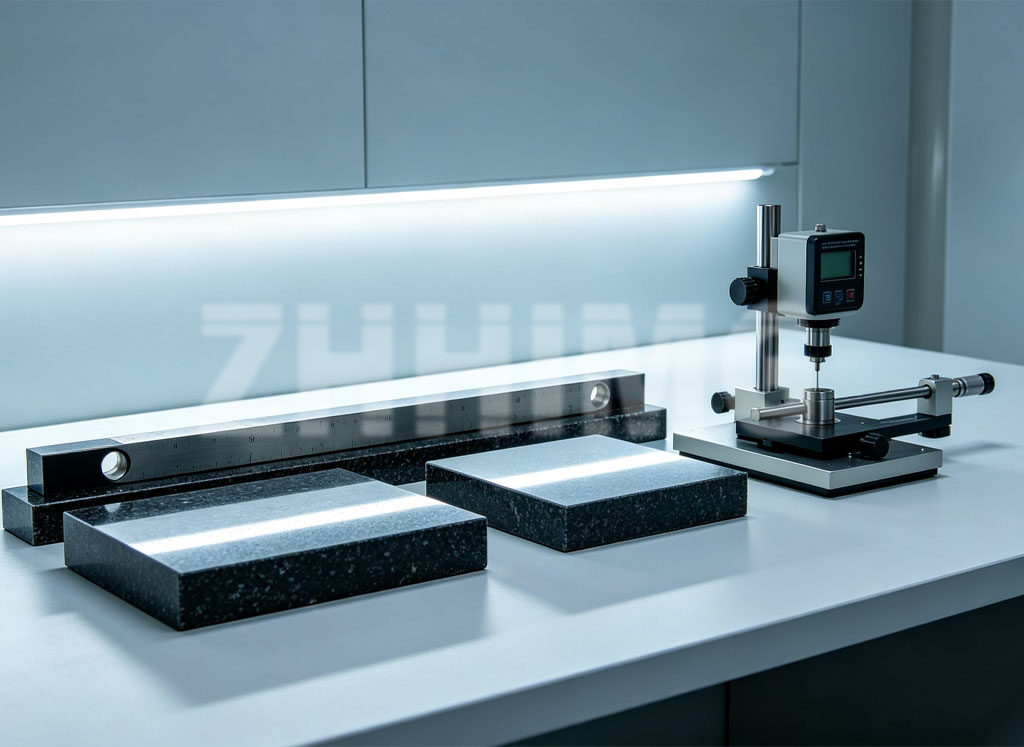
Precision granite is a natural stone material widely used in coordinate measuring machines, precision inspection equipment, optical systems and high-accuracy machine structures.
Its value comes from its dimensional stability, compressive strength, wear resistance and ability to provide accurately finished reference surfaces. Granite also has useful vibration-damping characteristics compared with many conventional metallic structures.
For precision applications, material selection is important. Granite quality depends on its mineral composition, grain structure, density, internal defects, geological origin and processing quality.
ZHHIMG® uses high-density black granite with a typical density of approximately 3,100 kg/m³ for selected precision applications. Actual material properties should be confirmed through the relevant material inspection and technical documentation.
Granite components can be manufactured through cutting, CNC machining, drilling, grinding, lapping and precision inspection. They can also be designed with mounting holes, inserts, grooves and other functional features according to engineering drawings.
Typical applications include CMM bases, precision machine beds, optical inspection platforms, semiconductor equipment structures and granite measuring instruments.
MINERAL CASTING — Engineered Composite Material for Machine Structures
Mineral casting, commonly known as epoxy granite in many machine-tool applications, is an engineered composite material typically produced by combining selected mineral aggregates with a polymer binder, often epoxy resin.
Unlike natural granite, mineral casting is manufactured through a controlled mixing and casting process. The aggregate composition, particle-size distribution, resin formulation, mixing method and curing conditions all influence the final properties.
One important characteristic of mineral casting is its potential for vibration damping. The composite structure can dissipate vibrational energy effectively, making it attractive for certain machine-tool beds and precision equipment structures.
Mineral casting also provides considerable design flexibility. Complex shapes, internal cavities, cable channels and mounting features can sometimes be incorporated directly into the casting design, reducing the need for extensive machining and assembly.
However, mineral casting is not a single standardized material. Its performance varies significantly with formulation, manufacturing quality, curing conditions and structural design.
Engineers should evaluate its elastic modulus, thermal expansion, creep behavior, dimensional stability, chemical resistance and long-term performance under actual operating conditions.
Typical applications include precision machine bases, machine-tool beds, vibration-sensitive equipment frames and complex structural components.
UHPC — Ultra-High-Performance Concrete for Advanced Structural Applications
UHPC stands for Ultra-High-Performance Concrete. It is an advanced cementitious material engineered to achieve high strength, improved durability and a dense microstructure.
UHPC generally uses carefully selected fine aggregates, cementitious materials, optimized particle packing and a low water-to-binder ratio. Some formulations also incorporate fibers to improve tensile behavior and crack resistance.
Compared with conventional concrete, UHPC can provide substantially higher mechanical strength and improved durability when properly designed and manufactured.
For precision equipment applications, UHPC offers opportunities for large and rigid structural components. It can be considered for machine support structures, equipment foundations, heavy-duty frames and selected precision manufacturing applications.
However, high compressive strength alone does not guarantee precision performance.
Machine-bed applications require careful evaluation of elastic modulus, thermal expansion, shrinkage, creep, moisture sensitivity, fiber distribution, internal stress and long-term dimensional stability.
The actual performance of a UHPC structure depends on its formulation, production process, curing regime, reinforcement design and environmental conditions.
UHPC should therefore be engineered and validated for the intended machine application rather than selected solely because of its high compressive strength.
Granite vs Mineral Casting vs UHPC: Key Engineering Differences
The three materials have different compositions and manufacturing characteristics. Understanding these differences helps engineers identify the most suitable solution for a specific machine structure.
MATERIAL COMPOSITION
Granite is a naturally formed stone with a mineral structure developed through geological processes. Its properties depend on the selected stone and its natural characteristics.
Mineral casting is an engineered composite consisting of mineral aggregates and a polymer binder. Its properties can be adjusted through material formulation and production control.
UHPC is a cementitious composite designed through optimized particle packing and binder systems. Its final performance depends on the mix design, curing process and structural configuration.
DIMENSIONAL STABILITY
Dimensional stability is essential for machine beds because geometric changes can influence guideway alignment, positioning accuracy and measurement repeatability.
Precision granite offers stable behavior under suitable environmental conditions. Its relatively low thermal expansion and natural material structure make it useful for precision reference components.
Mineral casting can provide good dimensional stability when its resin formulation, curing process and structural design are properly controlled. However, polymer-related thermal expansion, creep and long-term behavior must be considered.
UHPC can provide a rigid and durable structure, but shrinkage, creep, moisture variation and temperature-related dimensional changes require attention during design and validation.
For all three materials, the final machine-bed accuracy depends not only on the material itself but also on component geometry, support conditions, machining accuracy, installation and operating temperature.
VIBRATION DAMPING
Vibration behavior is particularly important for high-precision machining, optical inspection, metrology and semiconductor equipment.
Granite has inherent vibration-damping characteristics and is widely used in precision platforms and machine structures.
Mineral casting is often selected for its potential to dissipate vibration effectively. Depending on the formulation and structure, it can be suitable for vibration-sensitive machine-tool applications.
UHPC provides a rigid structural material, but its damping performance must be evaluated through testing and engineering analysis. It should not be assumed to have the same vibration behavior as mineral casting or granite.
The most suitable material depends on the vibration frequency range, machine mass, structural geometry, excitation sources and required positioning accuracy.
STRUCTURAL RIGIDITY AND LOAD CAPACITY
Structural rigidity determines how much a machine bed deforms under static and dynamic loads.
Granite provides high compressive strength and can be machined into rigid precision structures. Its suitability depends on component dimensions, support design, local stress concentrations and the loads applied during operation.
Mineral casting offers design flexibility and can be engineered for large structural sections. Its stiffness depends on aggregate composition, binder properties, curing quality and the geometry of the casting.
UHPC is designed for high mechanical strength and can be considered for heavy-duty structural applications. However, compressive strength should not be confused with elastic modulus or overall machine-system stiffness.
For all three materials, engineers should evaluate the complete structure rather than relying on a single material-property value.
THERMAL PERFORMANCE
Temperature changes can affect machine geometry and measurement accuracy.
Granite is commonly selected for precision reference structures because of its relatively low thermal expansion and useful thermal stability.
Mineral casting contains a polymer binder, so its thermal expansion and temperature-dependent behavior need to be considered carefully. Different formulations may produce different results.
UHPC is a cement-based composite whose thermal behavior depends on its composition, moisture condition, curing history and operating environment.
When a machine requires high thermal stability, engineers should evaluate the coefficient of thermal expansion, temperature gradients, heat sources, thermal equilibrium time and the operating environment.
MANUFACTURING FLEXIBILITY
Manufacturing processes also influence material selection.
Granite components are typically produced through stone cutting, CNC machining, drilling, grinding and lapping. Precision reference surfaces and mounting interfaces can be finished to meet defined engineering requirements.
Mineral casting can be poured into molds, allowing complex geometries and integrated structural features. This can reduce machining operations for certain designs, although mold design, casting quality and curing control are essential.
UHPC can also be cast into complex structural forms. Reinforcement, fiber distribution, mold design, curing and dimensional inspection must be carefully controlled.
The best manufacturing method depends on the required geometry, tolerance, production volume, surface finish and integration requirements.
Which Material Is Best for Different Applications?
There is no universal winner among granite, mineral casting and UHPC. The appropriate material depends on what the machine needs to achieve.
CMM AND PRECISION MEASUREMENT EQUIPMENT
For coordinate measuring machines and precision inspection equipment, granite is a well-established choice because it can provide stable reference surfaces and accurately machined structural interfaces.
Applications requiring defined flatness, straightness, parallelism and squareness should specify the relevant tolerances and inspection methods.
Mineral casting and UHPC may be considered for supporting structures or specially engineered components, but their suitability must be demonstrated through dimensional stability and performance validation.
SEMICONDUCTOR AND OPTICAL EQUIPMENT
Semiconductor and optical equipment may require high structural stability, low vibration sensitivity, precise alignment and controlled thermal behavior.
Granite can be suitable for precision bases and reference structures. Mineral casting may be considered where vibration damping and complex structural geometry are important. UHPC may be evaluated for selected large support structures.
Material selection should consider the equipment’s actual positioning accuracy, vibration spectrum, thermal environment and integration requirements.
PRECISION CNC MACHINE TOOLS
Precision CNC machine tools require a combination of rigidity, vibration control, thermal stability and long-term geometric accuracy.
Mineral casting is worth considering for machine beds where vibration damping and complex integrated structures are priorities.
Granite may be suitable for high-accuracy reference structures and selected machine bases.
UHPC may be considered for engineered structural applications where its strength, dimensions, curing characteristics and long-term stability meet the machine’s requirements.
The final decision should be based on structural analysis, manufacturing feasibility and machine-level performance testing.
LARGE EQUIPMENT BASES AND SUPPORT STRUCTURES
Large equipment structures may involve substantial static loads, complex geometries and specific installation requirements.
Granite, mineral casting and UHPC can all be considered in different situations.
Granite is useful when precision reference surfaces and dimensional stability are central requirements.
Mineral casting is attractive when complex shapes and vibration-damping characteristics are important.
UHPC may offer advantages for large structural components where high strength and durability are required.
Transportation, installation, foundation design, environmental conditions and maintenance requirements should also be included in the engineering evaluation.
Important Factors When Selecting a Precision Machine Bed Material
Material selection should begin with the machine’s technical requirements rather than a general comparison of material advantages.
ACCURACY REQUIREMENTS
Define the required flatness, straightness, parallelism, perpendicularity and dimensional tolerances.
These requirements should be specified for the finished component and verified using suitable measurement equipment and documented inspection procedures.
LOAD AND DEFORMATION REQUIREMENTS
Determine the static load, dynamic load, component weight, equipment center of gravity and expected operating forces.
Finite element analysis can help evaluate structural deformation, stress distribution and stiffness before manufacturing.
VIBRATION ENVIRONMENT
Identify external vibration sources, machine excitation frequencies and the vibration limits required by the application.
Material damping alone cannot guarantee machine stability. The complete system, including the foundation, supports, isolation elements and equipment layout, must be considered.
THERMAL ENVIRONMENT
Evaluate ambient temperature, temperature fluctuations, heat generated by motors and other equipment, and temperature gradients across the structure.
Thermal expansion and long-term dimensional changes should be included in the design process.
MANUFACTURING AND INSPECTION CAPABILITY
A suitable material must also be compatible with the manufacturer’s production and inspection capabilities.
Consider whether the supplier can manufacture the required dimensions, machine functional interfaces, control environmental conditions and provide inspection documentation.
TOTAL PROJECT COST
The initial material price is only one part of the total project cost.
Manufacturing time, machining requirements, mold development, transportation, installation, maintenance and long-term performance should all be considered.
A material that appears less expensive initially may require additional engineering or processing. The best choice is the one that meets the technical requirements with an appropriate total lifecycle cost.
Why Engineering and Manufacturing Capability Matter
A precision machine bed is more than a block of material. It is a functional structural component that influences the accuracy and stability of the complete machine.
Even a material with excellent theoretical properties can produce an unsatisfactory result if the manufacturing process is not properly controlled.
For granite components, stone selection, stress condition, machining strategy, grinding, lapping and inspection are important.
For mineral casting, aggregate grading, resin formulation, mixing, mold preparation, curing and post-processing influence the final component.
For UHPC, mix design, material consistency, reinforcement, casting, curing and dimensional verification are essential.
A capable manufacturing partner should understand both material science and precision engineering. The supplier should be able to review engineering drawings, identify potential manufacturing risks and recommend a suitable production and inspection approach.
ZHHIMG: Multi-Material Solutions for Ultra-Precision Manufacturing
ZHHIMG, part of ZHONGHUI Group, focuses on ultra-precision manufacturing and engineered structural components for demanding industrial applications.
Its product and manufacturing scope covers several material categories, including precision granite, precision ceramic, precision metal, precision glass, mineral casting, UHPC precision structures, carbon fiber precision beams and precision 3D-printed components.
This multi-material approach allows engineering teams to evaluate different material solutions according to the requirements of each project.
For precision granite manufacturing, ZHHIMG works with high-density black granite with a typical density of approximately 3,100 kg/m³ for selected applications. Manufacturing processes include precision machining, grinding, lapping and dimensional inspection.
For mineral casting and UHPC projects, material formulation, structural design and process requirements should be evaluated according to the specific application.
The company’s manufacturing capabilities include large-scale component processing and precision finishing. Its stated maximum processing capacity can reach 100 tons for suitable projects, with maximum component dimensions of approximately 20,000 mm in length, 4,000 mm in width and 1,000 mm in thickness, subject to engineering review, equipment limitations and project-specific manufacturing conditions.
ZHHIMG also emphasizes dimensional inspection and controlled manufacturing conditions for precision components. Actual achievable tolerances depend on material, geometry, component size, process capability and inspection conditions.
Rather than assuming that one material is suitable for every application, ZHHIMG aims to provide engineering-based manufacturing solutions across multiple material systems.
How to Request a Custom Precision Machine Bed
When requesting a quotation for a precision machine bed or structural component, providing complete technical information helps the manufacturer evaluate the project more accurately.
ENGINEERING DRAWINGS
Provide 2D drawings and 3D models where available. Include overall dimensions, critical interfaces, mounting holes, inserts, grooves and assembly requirements.
MATERIAL REQUIREMENTS
Specify whether the project requires natural granite, mineral casting, UHPC or another material. If the material has not yet been determined, provide the application and performance requirements so that alternative solutions can be evaluated.
ACCURACY SPECIFICATIONS
Clearly define the required flatness, straightness, parallelism, perpendicularity, surface roughness and dimensional tolerances. Identify critical surfaces and reference datums.
LOAD AND OPERATING CONDITIONS
Provide static and dynamic load information, operating temperature, vibration conditions and installation environment.
INSPECTION REQUIREMENTS
Specify the required inspection method, measurement report, material documentation and any applicable industry standards.
PROJECT QUANTITY AND SCHEDULE
Include the expected quantity, prototype requirements, production schedule and delivery destination.
With this information, the manufacturer can assess material suitability, manufacturing feasibility and inspection requirements before quotation.
Frequently Asked Questions
Is granite better than mineral casting for precision machine beds?
Not in every application. Granite is widely used for precision reference structures because of its dimensional stability and machinable reference surfaces. Mineral casting is often considered for its vibration-damping potential and design flexibility. The better choice depends on the machine’s accuracy, load, thermal environment and vibration requirements.
Is mineral casting the same as epoxy granite?
The terms are often used in similar contexts, but mineral casting is a broader description of composite materials containing mineral aggregates and a binder. Epoxy granite generally refers to mineral aggregate combined with an epoxy resin system.
Is UHPC suitable for precision machine bases?
UHPC can be considered for selected machine bases and structural applications. However, high compressive strength does not automatically guarantee precision performance. Engineers must evaluate stiffness, shrinkage, creep, thermal behavior and long-term dimensional stability.
Which material has the best vibration damping?
Mineral casting is often selected for its vibration-damping characteristics. Granite also provides useful inherent damping. UHPC requires application-specific evaluation. Actual vibration performance depends on material formulation, geometry, mass, support conditions and excitation frequency.
Can granite, mineral casting and UHPC be used in the same machine?
Yes. A machine can use different materials for different structural functions. For example, a precision granite reference component may be integrated with a metal assembly or another engineered structural material. The design must account for thermal expansion, mechanical interfaces, load transfer and alignment.
What information is needed to manufacture a custom machine bed?
The most important information includes engineering drawings, material requirements, critical tolerances, loading conditions, operating temperature, mounting interfaces, inspection requirements and project quantity.
How do I choose a manufacturer for precision machine bed materials?
Evaluate the manufacturer’s material knowledge, engineering support, production equipment, dimensional inspection capability, quality management, manufacturing experience and ability to provide documented results. The supplier should understand the complete machine application rather than simply quote a material block.
Conclusion: Select the Material Based on Engineering Requirements
Granite, mineral casting and UHPC each have a role in modern precision manufacturing.
Granite is a strong candidate for precision reference structures and dimensionally stable machine components. Mineral casting is attractive for applications where vibration damping and complex structural designs are important. UHPC provides an advanced cementitious option for selected high-strength structural applications.
The correct material is not necessarily the one with the highest strength, lowest price or best single performance indicator. It is the material and manufacturing solution that meets the complete engineering requirements of the machine.
ZHHIMG supports ultra-precision manufacturing projects across multiple material categories, helping customers evaluate and manufacture customized structural components for precision equipment.
Looking for a suitable material for your next precision machine bed project?
Contact ZHHIMG with your engineering drawings, technical specifications and application requirements. Our team can review your project and discuss suitable material and manufacturing solutions.
Website: https://www.zhhimg.com/
Post time: Nov-24-2026