
As industrial manufacturing continues to advance toward higher accuracy, smaller structures, and more demanding operating environments, precision ceramic components are becoming increasingly important in modern engineering.
From semiconductor manufacturing and optical inspection to vacuum equipment, precision measuring instruments, and advanced automation systems, technical ceramics offer a combination of material properties that conventional metals and other structural materials may not provide.
High stiffness, low thermal expansion, excellent wear resistance, corrosion resistance, and electrical insulation make advanced ceramics valuable for demanding industrial applications.
However, manufacturing precision ceramic components is not simply a matter of selecting a ceramic material and machining it into a required shape. Material selection, forming technology, sintering, precision grinding, dimensional inspection, and application-specific engineering all influence the final component performance.
As a professional precision manufacturing brand of Zhonghui Group, ZHHIMG® provides customized precision ceramic manufacturing solutions for industrial customers worldwide.
This article explains the major types of precision ceramics, their physical properties, manufacturing processes, industrial applications, and the key factors to consider when choosing a reliable precision ceramic components manufacturer.
1. What Are Precision Ceramic Components?
Precision ceramic components are engineered parts manufactured from advanced technical ceramic materials and processed to meet specific dimensional, geometric, and surface finish requirements.
Unlike ordinary pottery or traditional ceramic products, industrial technical ceramics are designed for demanding mechanical, thermal, electrical, and chemical environments.
They are widely used in applications where material stability, wear resistance, electrical insulation, and dimensional consistency are important.
Typical precision ceramic components include:
- • Ceramic structural frames
- • Ceramic machine bases and support structures
- • Ceramic measuring components
- • Ceramic positioning components
- • Ceramic guide structures
- • Ceramic shafts and bushings
- • Ceramic plates and blocks
- • Ceramic fixtures and tooling
- • Ceramic insulation components
- • Custom ceramic components for semiconductor equipment
These components can be manufactured according to customer engineering drawings, 2D specifications, and 3D CAD models.
Depending on the selected material and manufacturing process, precision ceramic components can be designed for applications requiring high stiffness, low thermal expansion, electrical insulation, chemical resistance, or high-temperature stability.
2. Why Are Precision Ceramics Used in Advanced Manufacturing?
Material selection is a critical factor in the performance of precision equipment.
Metals, granite, polymers, and technical ceramics each have different advantages and limitations.
Precision ceramics are particularly useful when a component requires a combination of mechanical, thermal, electrical, and chemical properties.
2.1 High Stiffness and Elastic Modulus
Stiffness is an important consideration for precision structural components.
Certain technical ceramics, including alumina and silicon carbide, offer relatively high elastic modulus compared with many conventional engineering materials.
This makes them suitable for applications requiring structural rigidity and dimensional stability.
For precision equipment, high stiffness can help limit elastic deformation under specified loading conditions.
However, structural performance also depends on component geometry, material grade, mounting conditions, and applied loads.
2.2 Low Thermal Expansion
Temperature variations can influence the dimensions and positioning accuracy of precision components.
Some advanced ceramics have relatively low coefficients of thermal expansion, making them useful for applications where dimensional stability under temperature changes is important.
For example, certain low-expansion ceramic materials are used in precision optical structures, measuring equipment, and semiconductor-related systems.
The actual thermal behavior depends on the ceramic composition, temperature range, and operating environment.
2.3 Excellent Wear Resistance
Many technical ceramics have high hardness and excellent resistance to abrasive wear.
These properties are useful for components exposed to repeated contact, friction, or mechanical movement.
Typical applications include:
- • Precision bearings
- • Guide components
- • Mechanical seals
- • Wear-resistant fixtures
- • Industrial positioning components
Material selection should consider the contact conditions, surface finish, lubrication, and operating environment.
2.4 Corrosion and Chemical Resistance
Certain technical ceramics offer excellent resistance to many corrosive chemicals.
This makes them useful in specialized industrial equipment, chemical processing systems, and semiconductor manufacturing environments.
However, chemical compatibility varies significantly between ceramic materials and specific chemicals.
The selected material should always be evaluated against the actual process conditions.
2.5 Electrical Insulation
Alumina and several other technical ceramics provide excellent electrical insulation.
This property makes them suitable for electrical isolation structures, semiconductor equipment components, electronic manufacturing fixtures, and specialized industrial assemblies.
2.6 High-Temperature Performance
Some advanced ceramics maintain useful mechanical and chemical properties at temperatures where conventional polymers and certain metals may become unsuitable.
Alumina, silicon carbide, and other technical ceramics are used in applications involving elevated temperatures.
The maximum operating temperature depends on the material grade, mechanical loading, atmosphere, and thermal cycling conditions.
3. Common Types of Precision Ceramic Materials
Choosing the correct ceramic material is one of the most important steps in custom ceramic component manufacturing.
Different materials offer different advantages.
The following are some of the most commonly used technical ceramics in precision engineering.
3.1 Alumina Ceramic (Aluminum Oxide, Al₂O₃)
Alumina is one of the most widely used industrial technical ceramics.
It offers a combination of:
- • High hardness
- • Good wear resistance
- • Excellent electrical insulation
- • Good corrosion resistance
- • High compressive strength
- • Good thermal stability
Alumina ceramic is widely used in semiconductor equipment, electronic components, electrical insulation structures, precision fixtures, and industrial machinery.
Different alumina grades are available, such as 95%, 96%, 99%, and 99.5% alumina.
The appropriate grade depends on the application’s mechanical, electrical, thermal, and dimensional requirements.
3.2 Zirconia Ceramic (Zirconium Dioxide, ZrO₂)
Zirconia is known for its relatively high fracture toughness compared with many conventional technical ceramics.
Its characteristics include:
- • High strength
- • Good wear resistance
- • High fracture toughness for a ceramic material
- • Good corrosion resistance
- • Low thermal conductivity compared with many other engineering ceramics
Zirconia is commonly used in precision mechanical parts, wear-resistant components, medical equipment components, industrial tooling, and specialized positioning structures.
Different zirconia formulations have different stabilization systems and properties, so material selection must consider the operating environment.
3.3 Silicon Carbide Ceramic (SiC)
Silicon carbide is a high-performance technical ceramic used in demanding industrial applications.
Its major characteristics include:
- • Very high hardness
- • High stiffness
- • Excellent thermal conductivity
- • Good thermal shock resistance
- • Excellent wear resistance
- • Good chemical resistance in many environments
Silicon carbide is used in semiconductor manufacturing equipment, mechanical seals, high-temperature structures, precision fixtures, and specialized industrial components.
Its combination of thermal and mechanical properties makes it particularly valuable for demanding engineering applications.
3.4 Silicon Nitride Ceramic (Si₃N₄)
Silicon nitride is another important advanced ceramic material.
It offers:
- • High strength
- • Good fracture toughness
- • Good thermal shock resistance
- • Excellent wear resistance
- • Good high-temperature mechanical performance
Typical applications include precision bearings, rollers, mechanical components, and specialized industrial systems.
3.5 Other Advanced Ceramic Materials
Depending on the project, additional technical ceramic materials may be considered, including:
- • Aluminum Nitride (AlN)
- • Macor Machinable Glass Ceramic
- • Boron Nitride (BN)
- • Cordierite
- • Quartz Glass and other specialized inorganic materials
Each material has different characteristics and manufacturing requirements.
A qualified manufacturer should evaluate the intended application before recommending a specific ceramic material.
4. Precision Ceramic Components for Semiconductor Manufacturing
Semiconductor equipment is one of the important application areas for advanced technical ceramics.
Modern semiconductor production involves highly controlled manufacturing environments, precise positioning systems, vacuum technology, wafer handling, and sensitive inspection processes.
Ceramic components can provide useful material properties for these applications.
4.1 Wafer Handling and Positioning Systems
Certain ceramic materials are used in wafer handling structures, positioning components, support structures, and specialized fixtures.
Important considerations include:
- • Dimensional stability
- • Surface cleanliness
- • Wear resistance
- • Chemical compatibility
- • Particle generation
- • Electrical properties
The exact requirements depend on the semiconductor process and equipment design.
4.2 Semiconductor Inspection Equipment
Precision ceramic structures can be used in optical inspection and semiconductor measurement systems.
These components may support sensitive mechanical or optical assemblies where structural rigidity and dimensional consistency are important.
4.3 Vacuum Equipment
Some technical ceramics are suitable for vacuum-related applications because of their low vapor pressure and material stability.
However, vacuum compatibility cannot be assumed for every ceramic component.
Material porosity, processing residues, surface treatment, outgassing, cleaning procedures, and assembly materials must all be considered.
4.4 Precision Motion Systems
Ceramic components can be used in specialized positioning and motion systems.
Their stiffness, wear resistance, and thermal properties may offer advantages in applications involving high-accuracy movement and repeatability.
Material selection must also consider friction, contact geometry, mechanical loads, and the required surface finish.
5. Precision Ceramics for Optical and Metrology Equipment
Optical and metrology systems require stable structures to maintain the geometric relationships between sensitive components.
Precision ceramics can be considered for applications involving:
- • Optical mounting structures
- • Precision measuring frames
- • Reference structures
- • Inspection fixtures
- • Positioning components
- • Specialized measuring instruments
Why Is Thermal Stability Important?
Optical systems can be sensitive to small dimensional changes.
Temperature variations may affect component positioning, alignment, and measurement results.
Ceramic materials with suitable thermal expansion characteristics can help reduce certain temperature-related dimensional changes.
For demanding optical applications, engineers should evaluate:
- Coefficient of thermal expansion.
- Elastic modulus.
- Material homogeneity.
- Structural geometry.
- Mounting and connection conditions.
- Operating temperature range.
It is important to select the material according to the actual optical system requirements rather than assuming all ceramics have the same thermal behavior.
6. How Are Precision Ceramic Components Manufactured?
Manufacturing advanced ceramic components requires specialized processes that differ from conventional metal machining.
The final dimensional accuracy depends on material preparation, forming, sintering, machining, and inspection.
A typical manufacturing process includes the following stages.
Step 1: Material Selection
The manufacturer selects the ceramic material according to the component’s functional requirements.
Important factors include:
- • Mechanical strength
- • Elastic modulus
- • Thermal expansion
- • Hardness
- • Electrical properties
- • Chemical resistance
- • Operating temperature
- • Required dimensional tolerances
Step 2: Ceramic Powder Preparation
Technical ceramics are generally produced using carefully controlled raw material preparation.
Depending on the material and process, this stage may involve powder selection, mixing, milling, granulation, and preparation for forming.
Powder characteristics can influence the final density, microstructure, and mechanical properties.
Step 3: Ceramic Forming
Different forming methods are available depending on the material and component geometry.
Common methods include:
- • Dry pressing
- • Isostatic pressing
- • Extrusion
- • Injection molding
- • Slip casting
- • Tape casting
The selection depends on component dimensions, complexity, material characteristics, and production volume.
Step 4: Sintering
Sintering is a critical stage in technical ceramic manufacturing.
The formed ceramic body is heated under controlled conditions to develop its final microstructure and mechanical properties.
Depending on the ceramic material, the process may involve different temperature profiles, atmospheres, pressures, and specialized equipment.
Dimensional changes during sintering must be considered during the manufacturing design stage.
Step 5: Precision Ceramic Machining
After sintering, ceramic components may require precision machining to achieve the specified dimensions and surface quality.
Because technical ceramics are generally hard and brittle, specialized machining processes are often necessary.
These may include:
- • Diamond grinding
- • Precision surface grinding
- • Cylindrical grinding
- • Lapping
- • Polishing
- • Precision drilling
- • Specialized hole machining
The appropriate process depends on the ceramic material, component geometry, and required tolerances.
Step 6: Dimensional Inspection
Precision ceramic components require appropriate inspection procedures.
Typical inspection items include:
- • Dimensional accuracy
- • Flatness
- • Parallelism
- • Perpendicularity
- • Straightness
- • Surface roughness
- • Hole position
- • Geometric tolerances
For demanding applications, material density, porosity, and other material properties may also require verification.
7. Precision Ceramic Components vs. Metal and Granite Components
Different engineering materials have different strengths and limitations.
There is no universally best material for every precision application.
The correct choice depends on the equipment design, operating environment, required accuracy, and total manufacturing cost.
| Performance Factor | Technical Ceramics | Metals | Natural Granite |
|---|---|---|---|
| Hardness | Generally high | Varies by alloy | High |
| Elastic Modulus | High for many ceramics | Varies by alloy | Depends on granite |
| Thermal Expansion | Material-dependent | Material-dependent | Generally relatively low |
| Electrical Insulation | Excellent for many grades | Generally conductive | Generally insulating |
| Corrosion Resistance | Excellent for selected grades | Depends on alloy and treatment | Generally good |
| Wear Resistance | Excellent for many grades | Depends on alloy and treatment | Good |
| Fracture Behavior | Generally brittle | Generally more ductile | Brittle |
| Machining | Specialized processes | CNC machining and grinding | CNC machining, grinding and lapping |
| Typical Applications | Insulation, wear parts, precision structures | Structural and mechanical components | Precision bases and measuring references |
The table provides a general engineering comparison. Actual performance depends on the selected material grade and component design.
When Should You Choose Precision Ceramics?
Consider technical ceramics when your application requires:
- • High hardness and wear resistance.
- • Electrical insulation.
- • Chemical resistance.
- • High stiffness.
- • Suitable thermal stability.
- • Specialized vacuum or high-temperature performance.
When Should You Choose Metal?
Metal may be preferable when the application requires:
- • High ductility.
- • Complex threaded structures.
- • High impact resistance.
- • Convenient mechanical joining.
- • Economical machining of certain geometries.
When Should You Choose Granite?
Natural granite may be preferable for applications requiring:
- • Large precision reference structures.
- • Stable measuring surfaces.
- • Vibration-damping characteristics.
- • Large machine bases.
- • Precision metrology platforms.
ZHHIMG supports multiple material categories, helping customers evaluate different manufacturing solutions according to their actual engineering requirements.
8. What Determines the Accuracy of Precision Ceramic Components?
Manufacturing accuracy is influenced by several interconnected factors.
8.1 Material Quality
Material composition, density, microstructure, and internal defects can influence the final component performance.
8.2 Sintering Quality
Sintering conditions influence material density, grain structure, shrinkage, and mechanical properties.
Poorly controlled processing may result in dimensional variation or defects.
8.3 Machining Technology
Specialized grinding and finishing equipment is necessary to achieve demanding dimensional and surface specifications.
8.4 Component Geometry
Thin walls, small holes, complex profiles, and large structures can introduce additional manufacturing challenges.
Design geometry should be evaluated before production.
8.5 Measurement and Inspection
Accurate inspection is essential for confirming whether the final component meets its engineering drawing.
The measurement method must be appropriate for the material, geometry, and specified tolerance.
At ZHHIMG, we believe that reliable precision manufacturing must be supported by reliable measurement.
9. How to Choose a Reliable Precision Ceramic Components Manufacturer
Selecting a ceramic manufacturing partner requires more than comparing quotations.
Customers should evaluate the manufacturer’s technical capabilities and quality management processes.
Here are seven important considerations.
1. Material Expertise
A reliable manufacturer should understand the characteristics and limitations of different ceramic materials.
Ask about available grades, material specifications, and relevant technical data.
2. Manufacturing Process Capabilities
Check whether the supplier can support the necessary forming, sintering, grinding, lapping, and finishing processes.
3. Complex Geometry Manufacturing
Custom ceramic components often involve special holes, thin walls, precision mounting surfaces, and complicated structures.
Make sure the manufacturer can assess your design and manufacturing feasibility.
4. Dimensional Inspection Capabilities
Ask which measuring instruments and inspection procedures are used.
For critical components, request inspection reports and material certificates where applicable.
5. Quality Management Systems
Verify the manufacturer’s quality management certifications and production control procedures.
6. Engineering Communication
The manufacturer should be able to understand your application and communicate clearly about material selection, manufacturing limitations, and technical requirements.
7. Custom Manufacturing Experience
Choose a supplier with experience in producing non-standard components according to customer drawings.
This is particularly important for semiconductor equipment, optical systems, and specialized precision machinery.
10. Why Choose ZHHIMG® for Custom Precision Ceramic Components?
ZHHIMG® is a precision manufacturing brand of Zhonghui Group.
Our manufacturing portfolio covers multiple advanced material categories:
- • Precision Granite
- • Precision Ceramic
- • Precision Metal
- • Precision Glass
- • Mineral Casting
- • UHPC Precision
- • Carbon Fiber Precision Structures
- • Precision 3D Printing
We focus on customized industrial components and structural manufacturing solutions for customers in advanced manufacturing industries.
10.1 Multi-Material Manufacturing Experience
Unlike manufacturers focusing on only one material category, ZHHIMG provides multiple material solutions.
This allows customers to discuss different structural materials and manufacturing approaches within one manufacturing group.
For projects involving granite, ceramic, metal, glass, or composite structures, our team can evaluate the requirements and discuss suitable production solutions.
10.2 Advanced Manufacturing Facilities
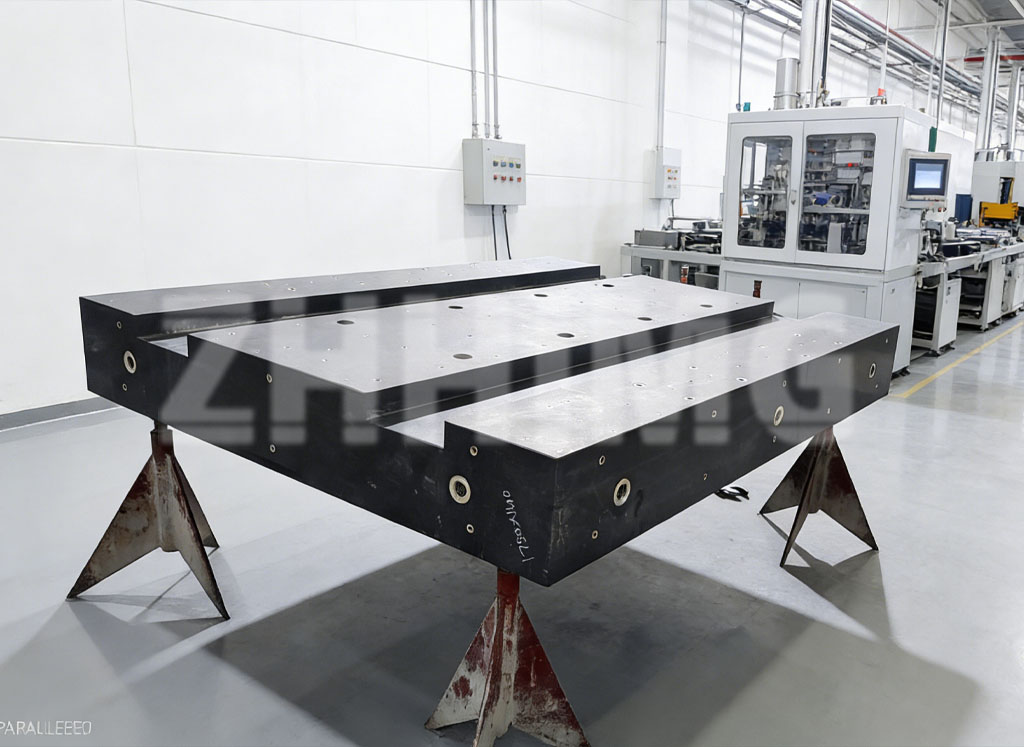
Zhonghui Group operates two manufacturing facilities with a combined industrial site area of approximately 200,000 m², together with a dedicated raw stone storage area of approximately 20,000 m².
Our production infrastructure includes large-scale CNC machining equipment, precision grinding machines, specialized processing equipment, and controlled inspection environments.
10.3 Professional Metrology and Quality Control
Precision is not established by machining alone.
Our inspection capabilities include equipment from internationally recognized manufacturers, such as:
- • Mahr
- • Mitutoyo
- • WYLER
- • Renishaw
Our measurement instruments are supported by relevant calibration documentation and traceability procedures.
Inspection requirements are established according to customer drawings, technical specifications, and applicable standards.
10.4 Experienced Technical Personnel
Our technical team has extensive experience in precision manufacturing, measurement, surface finishing, and quality inspection.
We emphasize continuous training, technical improvement, and understanding of international measurement standards.
10.5 International Quality Certifications
Zhonghui Group maintains the following management system certifications:
- • ISO 9001
- • ISO 14001
- • ISO 45001
Applicable CE conformity documentation is provided according to relevant product requirements.
These systems support our commitment to quality management, environmental responsibility, and occupational health and safety.
10.6 Customer-Centered Engineering Solutions
Every precision project has different technical requirements.
We welcome customer drawings, technical specifications, and application information.
Our goal is to understand the actual requirements before recommending manufacturing approaches.
We believe transparent technical communication is essential for successful international cooperation.
11. Custom Precision Ceramic Components: What Information Should You Provide?
To evaluate a custom ceramic manufacturing project, customers should prepare the following information:
- 2D engineering drawings or 3D CAD files.
- Required ceramic material and grade, if specified.
- Overall dimensions and component weight.
- Required dimensional and geometric tolerances.
- Surface roughness requirements.
- Operating temperature and environmental conditions.
- Chemical exposure or vacuum requirements, if applicable.
- Mechanical loading and assembly conditions.
- Required inspection reports and material certificates.
- Estimated order quantity and annual demand.
Providing complete technical information helps the manufacturer evaluate material suitability, machining feasibility, production requirements, and quality inspection procedures.
ZHHIMG welcomes customized ceramic component projects, from individual prototypes to recurring industrial production orders.
Frequently Asked Questions (FAQ)
Q1: What are precision ceramic components used for?
Precision ceramic components are used in semiconductor manufacturing equipment, optical inspection systems, vacuum equipment, precision measuring instruments, industrial machinery, electronic manufacturing, and specialized automation systems.
Q2: Which ceramic material is best for precision components?
There is no single best ceramic material for every application.
Alumina is widely used for electrical insulation and wear resistance. Zirconia is valued for its relatively high fracture toughness. Silicon carbide offers excellent hardness, stiffness, and thermal conductivity. Silicon nitride provides a combination of strength and fracture toughness.
Material selection should be based on actual operating conditions and engineering requirements.
Q3: Can precision ceramic components be customized according to drawings?
Yes. Custom ceramic components can be manufactured according to customer 2D drawings, 3D CAD files, and technical specifications.
Manufacturing feasibility depends on material selection, geometry, tolerances, and available processing technology.
Q4: Are precision ceramics suitable for semiconductor equipment?
Yes. Selected technical ceramics are widely used in semiconductor equipment because of their electrical, thermal, mechanical, and chemical properties.
The appropriate ceramic grade depends on the specific semiconductor process and equipment environment.
Q5: Are ceramic components better than metal components?
Not necessarily. Ceramics offer advantages such as hardness, electrical insulation, and wear resistance, while metals generally offer greater ductility and easier mechanical processing.
The best material depends on the component’s functional requirements.
Q6: Can ceramic components achieve micron-level accuracy?
Precision ceramic components can be manufactured to demanding dimensional tolerances using appropriate grinding and finishing processes.
Achievable tolerances depend on material, component geometry, dimensions, manufacturing processes, and inspection methods. Specific requirements should be reviewed before production.
Q7: What is the difference between alumina and zirconia ceramics?
Alumina generally offers excellent electrical insulation, hardness, and wear resistance. Zirconia is known for its higher fracture toughness compared with many conventional technical ceramics.
Their thermal, mechanical, and chemical characteristics differ, so the choice depends on the intended application.
Q8: How do I obtain a quotation for custom precision ceramic components?
Send your engineering drawings, material requirements, dimensions, tolerances, and estimated order quantity to ZHHIMG.
Our team can review the project requirements and discuss manufacturing feasibility and quotation details.
Conclusion: Your Partner for Advanced Precision Ceramic Manufacturing
Precision ceramic components play an increasingly important role in semiconductor manufacturing, optical engineering, precision measurement, and advanced industrial equipment.
Successful manufacturing requires more than high-quality raw materials. It depends on material expertise, controlled processing, precision machining, appropriate inspection, and experienced engineering personnel.
ZHHIMG® is committed to providing customized precision manufacturing solutions across multiple advanced material categories.
Whether you require alumina ceramic components, zirconia precision parts, silicon carbide structures, or customized ceramic measuring components, we welcome the opportunity to discuss your project.
ZHHIMG® — Your Global Partner for Ultra-Precision Manufacturing.
Contact ZHHIMG today to discuss your custom precision ceramic component requirements.
Website: https://www.zhhimg.com/
Send us your engineering drawings and technical specifications. Let’s explore the right manufacturing solution for your next precision engineering project.
Post time: Nov-24-2026