
In modern precision manufacturing, accuracy is not a feature—it is a prerequisite. From aerospace component inspection to semiconductor lithography, precision measuring tools form the foundation of dimensional control. Among these tools, granite components have emerged as the benchmark material for high-precision applications, outperforming traditional steel in critical performance metrics. This article examines the technical rationale behind granite’s dominance in metrology and explains why industry leaders are making the transition from steel to granite.
The Evolution of Metrology Materials: From Steel to Granite
Before World War II, manufacturers predominantly used steel surface plates for dimensional inspection. However, the war created unprecedented demand for steel, leading to widespread melting of steel surface plates for military production. This crisis forced the industry to seek alternatives, and granite emerged as the superior choice—a decision that would reshape precision manufacturing forever.
The transition was not merely opportunistic; it was based on granite’s inherent metrological properties. Manufacturers discovered that granite could be lapped to much greater flatness than steel, offered superior thermal stability, and required less maintenance. These advantages have only become more pronounced as manufacturing tolerances have tightened from thousandths of an inch to microns and nanometers.
Thermal Stability: The Critical Differentiator
Understanding Thermal Expansion in Metrology
In precision measurement environments, thermal expansion is perhaps the most critical factor affecting accuracy. Even minor temperature fluctuations can introduce measurable dimensional changes in steel components.
Steel’s Thermal Challenge:
- Coefficient of Thermal Expansion (CTE): 11-13 µm/m·°C
- Temperature fluctuation of just 1°C can produce 0.01mm/m linear error
- Thermal gradients can induce warping and internal stress
- Requires complex temperature compensation systems
Granite’s Thermal Advantage:
- CTE: 4.5-9 × 10⁻⁶/°C (approximately 1/4 that of steel)
- Near-zero expansion characteristics under controlled conditions
- Isotropic structure ensures consistent behavior in all directions
- High thermal inertia reduces sensitivity to short-term temperature fluctuations
For high-precision applications requiring micron-level accuracy, this thermal stability difference is decisive. A 1,000mm granite component experiencing a 5°C temperature change will expand by only 0.0225mm, while an equivalent steel component would expand by 0.065mm—a difference of nearly 300%.
Real-World Impact
The thermal stability advantage translates directly into reduced measurement uncertainty and lower calibration frequency. While steel squares and surface plates require recalibration every 3-6 months, granite components typically maintain calibration for 1-2 years or longer. This extended calibration interval reduces downtime and total cost of ownership while improving measurement confidence.
Vibration Damping: Granite’s Hidden Strength
The Physics of Vibration in Metrology
Metrology accuracy is highly sensitive to environmental vibrations—whether from nearby machinery, foot traffic, building resonance, or HVAC systems. These vibrations can introduce measurement errors that are difficult to detect but significantly impact results.
Steel’s Vibration Characteristics:
- Low inherent damping capacity (damping ratio ≈ 0.001)
- Vibrations propagate and resonate through the structure
- Requires auxiliary damping systems for precision applications
- Susceptible to harmonic amplification
Granite’s Superior Damping:
- Natural damping ratio: 0.012-0.015 (10-15× better than cast iron)
- Vibration attenuation: 95% at 50-500Hz frequencies
- Heterogeneous crystalline structure dissipates mechanical energy
- Internal grain boundaries convert vibration energy to heat
This exceptional damping performance is rooted in granite’s crystalline structure. Composed of interlocking mineral grains—primarily quartz, feldspar, and mica—granite naturally disrupts the propagation of mechanical waves. This property makes granite ideal for applications requiring sub-micron precision, such as semiconductor lithography and optical alignment systems.
Industrial Applications
Coordinate Measuring Machines (CMMs) exemplify the importance of vibration damping. A CMM base serves as the reference platform upon which all measurements are built. Any vibration at this level propagates through the entire system, introducing cumulative errors. Granite bases reduce vibration-induced measurement errors by up to 40% compared to steel-aluminum hybrid structures, without requiring auxiliary damping mechanisms.
Dimensional Stability and Long-Term Accuracy
Internal Stress and Material Memory
One of granite’s most significant advantages over steel lies in its internal stress characteristics.
Steel’s Stress Challenges:
- Residual stresses from machining and heat treatment
- Stress relaxation over time causes gradual deformation
- Handling and impact can introduce new stresses
- Requires stress-relieving treatments that may not be permanent
Granite’s Stress-Free Nature:
- Naturally stress-relieved over geological time scales
- No internal stress concerns
- Dimensional stability over decades of service
- Impact-resistant geometry maintenance
This fundamental difference explains why granite components maintain their precision for extended periods. A properly manufactured granite component can maintain flatness within 0.5µm/m² for 15+ years, while steel alternatives require periodic resurfacing to maintain equivalent accuracy.
Wear Resistance and Surface Integrity
Steel’s Wear Characteristics:
- Softer than granite (typically Rockwell C 58-62 for hardened steel)
- Repeated contact with metal parts causes gradual wear
- Wear directly impacts measurement reliability
- Requires frequent recalibration or replacement
Granite’s Superior Wear Resistance:
- Mohs hardness: 6-7 (significantly harder than hardened steel)
- Surface roughness achievable: Ra 0.05-0.4µm
- Wear occurs linearly over time, enabling calibration compensation
- Retains accuracy for decades with proper maintenance
The wear resistance advantage is particularly significant in high-use environments. While steel squares show measurable wear along reference edges within months of intensive use, granite squares maintain their reference surfaces for years, reducing replacement frequency and ensuring measurement consistency.
Corrosion and Environmental Resistance
Chemical Stability
Steel’s Environmental Vulnerabilities:
- Susceptible to oxidation and rust
- Requires protective coatings or controlled environments
- Humidity and temperature cycling accelerate degradation
- Chemical exposure can compromise surface integrity
Granite’s Chemical Resistance:
- Naturally corrosion-resistant
- Non-magnetic and non-reactive
- pH stability range: 1-14
- Zero corrosion in coolants, hydraulic oils, and process chemicals
This chemical stability makes granite ideal for demanding environments including semiconductor cleanrooms, chemical processing facilities, and marine applications. Unlike steel, granite requires no protective coatings and maintains its properties even under aggressive chemical exposure.
Cleanroom Compatibility
Semiconductor manufacturing demands non-magnetic surfaces to prevent interference with sensitive components. Major semiconductor manufacturers specify granite plates for all photolithography equipment setups, citing the material’s complete lack of magnetic permeability as critical for maintaining nanoscale precision.
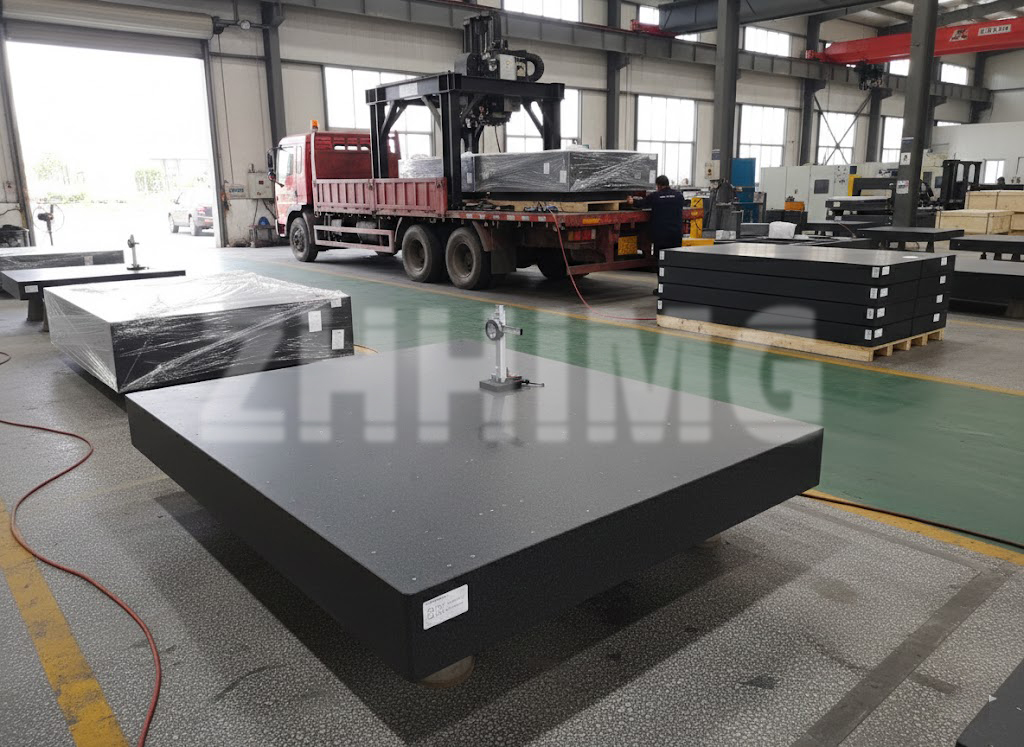
Cost-Benefit Analysis: Total Cost of Ownership
While initial investment in granite components typically exceeds steel by 30-50%, lifecycle costing reveals a different picture. A comprehensive 2023 study compared 1,000×800mm surface plates over a 15-year service life:
Steel Surface Plate:
- Resurfacing every 4 years: €1,200 per service
- Annual rust prevention: €200/year
- Total maintenance over 15 years: €5,600
- Significant production disruptions during maintenance
Granite Surface Plate:
- Annual calibration: €350/year
- Total maintenance over 15 years: €5,250
- Minimal production disruption
- Superior measurement accuracy throughout service life
The study concluded that granite plates delivered 12% lower total cost of ownership despite higher upfront cost. When factoring in improved measurement accuracy and reduced scrap rates, return on investment typically occurs within 24-36 months.
Industry Applications: Where Granite Excels
Semiconductor Manufacturing
Precision granite components are essential in semiconductor fabrication equipment:
- Photolithography stages achieve 0.12nm vibration isolation
- Wafer processing platforms maintain sub-micron flatness
- Chemical resistance withstands aggressive process chemicals
- Non-magnetic properties prevent interference with sensitive components
Aerospace and Defense
Aerospace applications demand the highest measurement precision:
- Coordinate measuring machine bases
- Assembly alignment tools
- Quality inspection platforms
- Structural components for precision equipment
Automotive Manufacturing
Modern automotive manufacturing increasingly relies on granite:
- Battery module alignment systems for EV production
- Powertrain component inspection
- Body-in-white dimensional control
- Automated measurement systems
Precision Machining
CNC machining centers benefit from granite bases:
- Reduced thermal drift error by 60% vs. polymer-concrete bases
- Superior surface finish through vibration control
- Extended machine accuracy over service life
- Reduced tool chatter by up to 40%
Manufacturing Process: Ensuring Quality
Modern precision granite components require sophisticated manufacturing processes:
Material Selection
- Only Class-A granite (ASTM C615) with <0.05% quartz variance
- Fine to medium-grained texture for optimal properties
- Selection based on application requirements
Stress Relieving
- 6-month natural aging
- Thermal cycling at controlled temperatures
- Elimination of residual stresses
Precision Machining
- 5-axis CNC milling with ≤±0.01mm positional accuracy
- Diamond-wheel grinding achieving Ra 0.1-0.4µm
- Manual fine grinding for ultimate precision
Quality Verification
- Laser interferometry for flatness verification
- Electronic level testing for repeatability
- 21-parameter QA per ISO 8512-2/ANSI B89.3.7
Selection Guidelines
When evaluating granite components, consider:
Precision Grades:
- Commercial Grade: ±0.02mm/m² (general industrial applications)
- Precision Grade: ±0.005mm/m² (automotive, aerospace)
- Ultra-High Grade: ±0.0015mm/m² (optical, semiconductor)
Material Specifications:
- Fine-grained, dense igneous rock (black diabase preferred)
- Thermal stability appropriate for environment
- Hardness and wear resistance ratings
Supplier Qualifications:
- Minimum 10 years granite machining experience
- On-site laser calibration capabilities
- Custom design support
- International certifications (ISO 8512-2, ASME B89.3.7)
The Future of Metrology: Granite’s Role
As manufacturing tolerances continue to tighten toward nanometer precision, the choice of metrology materials becomes increasingly critical. Global trends favoring granite include:
- Semiconductor expansion: 78 new 300mm fabs under construction globally
- EV manufacturing: 220% increase in battery alignment systems
- Quantum computing: Sub-micron stability requirements for cryogenic chambers
- Advanced aerospace: Increasingly stringent quality requirements
The granite machine components market is projected to grow at 6.8% CAGR through 2030, driven by these demanding applications.
Conclusion
The comparison between granite and steel in precision metrology applications is not a matter of preference—it is a matter of physics and performance. Granite’s superior thermal stability, exceptional vibration damping, dimensional integrity, and environmental resistance make it the material of choice for applications where accuracy is non-negotiable.
For engineers, quality managers, and procurement specialists evaluating metrology solutions, the evidence is clear: granite delivers superior measurement accuracy, lower total cost of ownership, and enhanced reliability over the equipment lifecycle. As industries push toward ever-tighter tolerances and higher quality standards, precision granite components will continue to serve as the foundation upon which measurement accuracy is built.
The future of metrology is granite. The question is not whether to transition from steel to granite, but how quickly your organization can make the change.
Post time: Apr-17-2026