
When engineering ultra-precision equipment—whether it’s a CMM, a semiconductor inspection machine, or a high-speed laser cutter—the foundation material dictates the final accuracy. Over the years, global buyers sourcing from Asia are often presented with a confusing array of materials: Jinan Black granite, Indian Black granite, South African Black granite, cast iron, or modern mineral casting.
At ZHHIMG, we specialize in manufacturing ultra-precision granite components. We frequently encounter international clients who ask: What is the actual difference between these materials, and which one truly guarantees long-term stability for high-end machinery?
Here is an objective, engineering-focused comparison to help you make the right decision for your precision bases.
1. The Premium Standard: Jinan Black Granite
Jinan Black granite is widely recognized in the global metrology industry as a top-tier material for precision structures. Sourced directly from the quarries surrounding Jinan, China, this specific stone is highly sought after for its exceptional physical properties.
- • High Density & Low Porosity: Premium Jinan Black granite boasts a high density of approximately 3100kg/m³. This dense, non-porous structure ensures the material does not absorb moisture or oil, preventing the microscopic swelling and deformation that plague lesser materials.
- • Zero Magnetic & Thermal Stability: It is completely non-magnetic and possesses a very low coefficient of thermal expansion. This makes it immune to the electromagnetic interference found in modern factory floors and highly resistant to ambient temperature fluctuations.
- • Internal Damping: The crystalline structure of high-quality Jinan Black granite provides excellent vibration damping, which is critical for high-speed pick-and-place machines and precision laser equipment.
At ZHHIMG, we strictly utilize AAA-grade Jinan Black granite. We坚决 reject the use of cheap marble or low-grade stone, ensuring our components deliver superior physical performance compared to standard alternatives.
2. Indian Black Granite: The Budget Alternative
Indian Black granite is another common material found in the global market, often exported from India. While it shares a similar dark aesthetic, its physical characteristics often differ significantly from Jinan Black.
- • Density Variations: Indian Black granite typically has a lower density and a more porous structure compared to premium Jinan Black.
- • Structural Inconsistencies: It is not uncommon for Indian Black granite to contain natural fissures, micro-cracks, or inconsistent grain sizes. For standard machine bases, this might be acceptable, but for nanometer-level metrology or semiconductor equipment, these inconsistencies can lead to unpredictable deformations over time.
- • Machining Challenges: Due to its varied mineral composition, it can be more brittle and prone to chipping during the precision grinding process.
3. South African Black Granite: The Historic Standard
South African Black granite (often associated with the historic “Dolerite” or “Diabase” standards) has been used in precision engineering for decades.
- • Proven Track Record: Historically, it has been a reliable material with good hardness and wear resistance.
- • Supply & Cost: However, in recent years, the global supply chain for South African Black granite has become less consistent, and the cost of extraction and export has increased significantly.
- • Performance: While still a viable option, modern testing often shows that top-tier Jinan Black granite matches or exceeds its compressive strength and density, while offering much better cost-efficiency and supply stability from Asian manufacturing hubs.
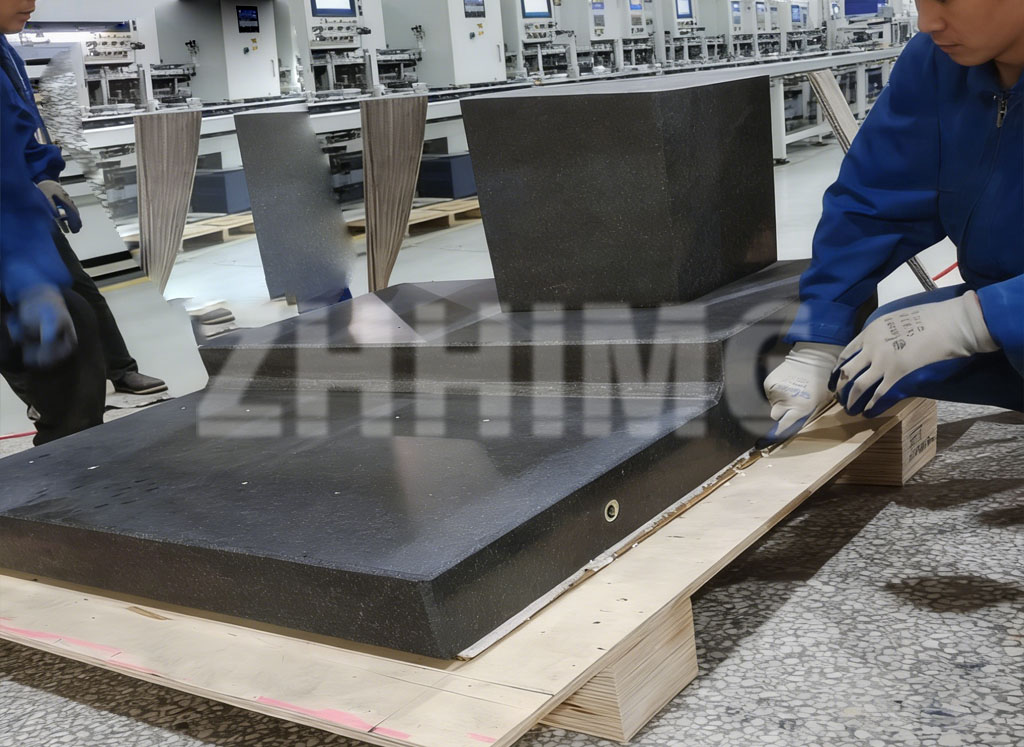
4. Cast Iron: The Traditional Workhorse
Cast iron has been the traditional backbone of machine tool manufacturing for over a century.
- • Pros: It is relatively easy to cast into complex shapes, has good vibration absorption, and is highly cost-effective for mass production.
- • Cons: The fatal flaw of cast iron in ultra-precision applications is its susceptibility to internal stress and thermal expansion. Cast iron expands and contracts significantly with temperature changes. Furthermore, it is magnetic, which can interfere with sensitive electronic sensors, and it is prone to rust if not constantly oiled and maintained. Over time, residual casting stresses can cause the base to warp, destroying machine calibration.
5. Mineral Casting: The Modern Composite
Mineral casting (a mixture of granite aggregates, quartz sand, and synthetic epoxy resins) has gained popularity as a modern alternative.
- • Pros: It offers excellent damping characteristics (often better than cast iron) and can be molded into highly complex, integrated shapes without the need for heavy machining. It is also non-magnetic.
- • Cons: The primary drawback is its long-term stability. The resin component can undergo slight curing shrinkage over time. Additionally, mineral casting is highly sensitive to temperature spikes and chemical spills. While excellent for certain machine tool beds, it generally cannot achieve the absolute nanometer-level flatness stability required for primary metrology reference plates or high-end semiconductor bases.
Summary: Which Material Should You Choose?
| Material | Density | Thermal Stability | Vibration Damping | Best Application |
|---|
| Material | Density | Thermal Stability | Vibration Damping | Best Application |
|---|---|---|---|---|
| Jinan Black Granite | ~3100kg/m³ (Excellent) | Outstanding | Excellent | Semiconductor, CMM, Laser, Metrology |
| Indian Black Granite | Moderate | Moderate | Moderate | General machinery, lower precision bases |
| South African Black | High | High | High | Traditional high-end machine tools |
| Cast Iron | High | Poor | Good | General machine tools, heavy machinery |
| Mineral Casting | Medium-High | Moderate | Outstanding | Complex machine beds, automated lines |
The ZHHIMG Advantage
For applications requiring absolute, unwavering precision, Jinan Black granite remains the undisputed champion.
At ZHHIMG, we leverage our deep understanding of this material to produce granite bases, surface plates, and air bearings that meet the strictest global standards (DIN, ASME, JIS). With our massive manufacturing capacity—including 200,000m² of factory space, 10,000m² climate-controlled workshops, and the ability to machine single blocks up to 20 meters long and 100 tons—we deliver the highest density and most stable precision components in the industry.
If you are engineering equipment that demands zero compromise, [Contact ZHHIMG today] to discuss how our premium Jinan Black granite components can elevate your machine’s performance.
Post time: Nov-26-2026