
In high-precision CNC machining, vibration is not merely a noise problem. It can affect surface finish, dimensional consistency, tool life, cycle time, and the confidence a quality team has in a process.
A machine may have accurate linear scales, capable servo drives, and well-designed tooling, yet still struggle when structural vibration enters the cutting loop. The source may be a high-speed spindle, intermittent cutting, axis acceleration, a long tool projection, floor disturbance, or resonance in the machine frame. Once the structure begins to store and release energy, chatter can develop quickly.
Mineral casting, also known as polymer concrete or epoxy granite, is increasingly used for precision CNC machine bases because it can dissipate vibration energy more effectively than many conventional metallic structures. It is not a universal replacement for cast iron, steel, or natural granite. Its value depends on the machine architecture, required stiffness, manufacturing volume, thermal environment, and level of functional integration. For many high-precision CNC applications, however, mineral casting provides a practical route to a quieter and more stable machine structure.
Why Vibration Controls Machining Results
Every cutting process produces force variation. Milling teeth engage and disengage. Grinding wheels introduce periodic excitation. A drill can create thrust and torsional loads. During rapid traverses, high acceleration and deceleration place additional dynamic loads into the frame.
The machine structure responds according to its mass, stiffness, damping, and natural frequencies. Stiffness determines how much a component deflects under load. Damping determines how quickly vibration energy is dissipated after the load changes.
A very stiff structure with limited damping can still resonate near a natural frequency. In practical machining, that resonance may appear as chatter marks, unstable cutting noise, variable tool wear, excessive spindle load, or inconsistent surface roughness. The process then has to be slowed down, cutting parameters are restricted, or the part must be reworked.
The goal is not to eliminate all vibration. That is unrealistic in a machine tool. The goal is to prevent vibration from growing into an unstable condition and to reduce the time required for the structure to settle after a disturbance.
What Mineral Casting Is
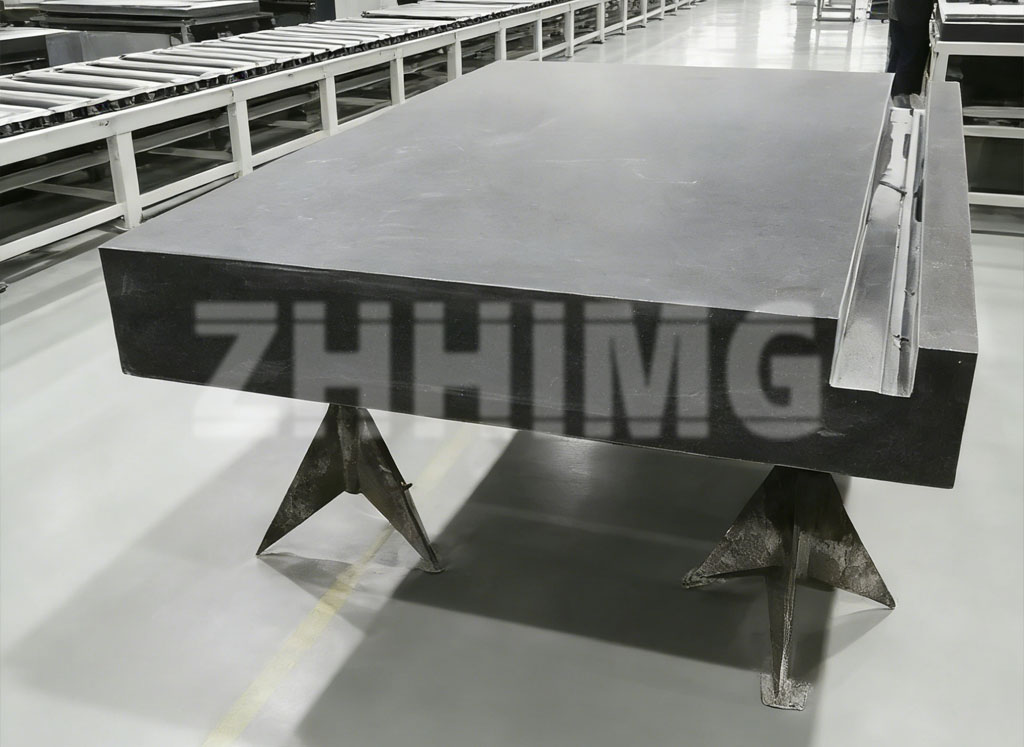
A mineral casting machine base is an engineered composite rather than a machined piece of natural stone or a conventional metal casting. It commonly consists of graded mineral aggregates—often quartz, basalt, granite, or similar hard materials—bonded with a polymer resin system.
The aggregate contributes mass and rigidity. The polymer binder joins the particles and provides internal energy dissipation. Instead of vibration travelling through a comparatively continuous metallic lattice, the composite structure contains numerous aggregate-binder interfaces. Under dynamic loading, these interfaces contribute to material damping.
Published machine-tool research supports this general behavior. One study comparing an epoxy-granite lathe bed with a cast-iron bed of equivalent stiffness found the fabricated epoxy-granite structure achieved a damping ratio about 2.2 times higher, while weighing about 38.6% less in that particular design. The result should not be applied as a universal number: geometry, aggregate grading, resin formulation, reinforcement, and boundary conditions all affect final performance.
How Damping Changes CNC Behavior
The practical effect of damping is easier to understand than the material science behind it. After a cutting force changes, a high-damping structure generally loses its vibration energy more rapidly. This can reduce the amplitude and duration of structural ringing.
For a high-speed milling machine, that may mean the machine is less sensitive to certain unstable cutting conditions. For a precision grinding machine, it can help reduce the effect of periodic excitation on the workpiece finish. For an inspection or drilling machine, it may shorten settling time before the next positioning or measuring event.
Mineral casting does not automatically create a chatter-free CNC machine. Tool geometry, holder rigidity, spindle condition, fixturing, control-loop tuning, workpiece material, cutting parameters, and guideway design remain important. The machine base is one element of the complete dynamic system.
Still, the base matters more than many early-stage designs acknowledge. A well-selected mineral-cast frame can help engineers move structural resonances away from critical operating ranges and improve the damping of vibrations that cannot be avoided. RAMPF, a specialist supplier of mineral-cast machine beds, describes mineral casting as offering high damping, low thermal conductivity, material homogeneity, and flexible shaping for precision machine structures.
Advantages Beyond Vibration Damping
Vibration control is the most visible reason to choose a mineral-cast CNC base, but it is not the only one.
Complex geometry without extensive machining
Mineral casting is formed in molds at relatively low temperatures. This allows machine designers to integrate structural ribs, equipment cavities, cable routes, hydraulic channels, coolant passages, mounting pockets, and embedded steel inserts into the base design.
For a compact CNC machining center, this can simplify assembly. Linear-guide pads, motor mounts, spindle-support interfaces, and enclosure mounting points can be incorporated as part of the structural concept. The final precision surfaces are then machined, ground, or fitted with inserts where required.
Thermal behavior
Mineral casting usually has lower thermal conductivity than metal. In a stable production environment, this can help slow the transfer of local heat through the machine base. It does not eliminate thermal error, and slower heat transfer can also mean longer stabilization after a major temperature change. Designers should therefore consider spindle heat, coolant temperature, motors, electronics, ambient variation, and warm-up strategy as a complete thermal-management problem.
Corrosion resistance and manufacturing efficiency
A mineral-cast structure does not require the same corrosion-protection strategy as an unprotected ferrous casting. Low-temperature curing can also reduce energy demand compared with melting and pouring metal, although overall environmental performance should be assessed case by case, including resin selection, tooling, transport, and expected service life.
The molding process is especially attractive for repeatable machine designs. At low volumes or during frequent design changes, mold cost and engineering effort should be included in the total project calculation.
Design Details That Determine Results
The phrase “high damping” can be misleading when it is separated from actual machine design. A mineral-cast base will not compensate for poorly positioned support feet, undersized guideway interfaces, weak bolted joints, or an unstable foundation.
Before specifying a mineral-casting machine bed, engineering teams should review:
- Load paths: Cutting and axis forces should travel through short, stiff structural paths into the base and foundation.
- Wall and rib geometry: The molding design should provide stiffness where guideways, spindles, rotary axes, and workholding systems create concentrated loads.
- Embedded inserts: Steel inserts must be correctly located, supported, and stress-managed before casting and final machining.
- Guideway interfaces: Precision rails and bearing surfaces need controlled flatness, parallelism, and fastening design.
- Support conditions: Three-point or multi-point support arrangements can strongly affect machine geometry and dynamic response.
- Curing and inspection: Resin system, aggregate preparation, curing cycle, dimensional verification, and post-machining all influence repeatability.
In our work with precision granite, mineral casting, ceramic components, and precision metal structures, one pattern is consistent: the highest-value designs consider the base, guideway, motion system, and measurement datum together. Treating the machine frame as a commodity late in development often creates avoidable adjustment work during final assembly.
Where Mineral Casting Fits Best
Mineral casting is often evaluated for high-precision CNC machining centers, grinding machines, laser-processing equipment, semiconductor machinery, automated inspection systems, precision drilling equipment, and special-purpose production machines.
It can be particularly suitable when the design requires strong vibration damping and a complex, integrated base with embedded functional features. Natural precision granite may be preferred where large lapped reference surfaces and metrology-oriented structural stability dominate. Cast iron or welded steel may remain the practical choice where conventional production methods, weldability, or very high local load capacity determine the design.
There is no single “best” machine-base material. A sensible selection compares measurable requirements: static stiffness, modal behavior, damping, thermal stability, size, manufacturing route, integration needs, cost, and service conditions.
Selecting a Mineral-Cast Machine Base
Purchasers should ask suppliers for more than general damping claims. Request the material specification, aggregate and resin approach, insert strategy, machining plan, inspection method, tolerance capability, support recommendations, and application references relevant to the intended machine type.
At ZHHIMG®, custom mineral-casting structures are evaluated alongside precision granite, ceramics, UHPC, and metal components. This multi-material approach helps match the machine base to the actual working conditions instead of forcing every project into one material category.
For high-precision CNC machining, mineral casting earns its place when it is engineered as part of the system: a stable structure that absorbs energy, supports accurate guideway alignment, and gives the machine more room to perform consistently under real production conditions.
Post time: Aug-21-2026