
Under high-speed cutting conditions, high-speed spindle rotation and intermittent cutting of workpieces by cutting tools continuously release alternating impact energy, generating forced vibration and cutting chatter. Such high-frequency micro-vibrations propagate upward along the machine tool structure, triggering chatter marks, shortening tool life, and in severe cases, directly undermining microscale machining accuracy. Many manufacturers tend to improve rigidity merely by thickening cast iron beds and adding stiffeners, yet boosting stiffness alone can only slow deformation instead of dissipating vibration energy. The ZHHIMG® precision granite base relies on three core mechanisms: intrinsic material damping, structural mechanical design, and a full-chain vibration reduction system, to absorb, block and attenuate vibration shocks brought by high-speed cutting from the source, establishing a stable benchmark for ultra-precision machining.
The crystal structure of the material itself forms the underlying core for granite bases to dissipate cutting shocks. ZHHIMG® self-developed black granite reaches a density of 3100kg/m³ with tightly interlocked mineral grains and numerous natural grain boundaries inside. When vibration shocks generated in high-speed cutting transmit into the base, vibration waves undergo tiny slippage among countless mineral grain interfaces, converting mechanical impact energy into trace heat for rapid dissipation. Unlike cast iron and steel that suffer sustained resonance and prolonged residual vibration, ordinary marble features loose minerals and abundant cracks. Under external impact, it is prone to local microcracks and insufficient dynamic stability, making it unable to continuously suppress high-frequency cutting vibration. After long-term natural aging to fully release internal stress, ZHHIMG® black granite maintains stable damping attenuation performance when facing intermittent shocks from high-speed reciprocating cutting. It can quickly suppress cutting chatter within the 200–1500Hz frequency band, which exactly covers mainstream high-speed machining scenarios such as femtosecond laser processing, PCB drilling and precision milling.
Beyond material damping, the overall mass and topological structural design of the base realize inertial stabilization against impacts. The essence of high-speed cutting impact is instantaneous dynamic load. The heavy-weight base resists instantaneous structural displacement relying on great inertia. ZHHIMG is capable of processing oversized integrated granite components with a maximum single-piece length of 20 meters. We can optimize the cavity layout and weight distribution of the base according to dynamic simulation of machine tools to avoid weak points of local rigidity. Spliced multi-section bases easily produce secondary vibration caused by gap slippage under impact loads; integrated granite bases have no splicing interfaces, so cutting shocks will not be amplified at joints. In the design phase, our team cooperates with many universities and metrology institutions to predict machine resonance points via modal simulation and adjust base mass distribution, keeping the system’s natural frequency away from the excitation frequency of high-speed cutting. This avoids resonance amplification risks at the design stage, rather than passively adding vibration isolators after machining.
Apart from the base itself, the matched foundation isolation system cuts off two-way transmission of vibration between external environment and internal cutting. Even with excellent shock absorption of the base itself, operation of other equipment in the workshop and ground traffic disturbance may superimpose cutting vibration and amplify errors. ZHHIMG’s constant-temperature workshop adopts ultra-thick superhard concrete foundation paired with vibration isolation trenches of 500mm in width and 2000mm in depth, building an independently isolated foundation to mechanically separate the machine base from the factory ground. For high-precision scenarios like semiconductor and optical inspection, the granite base can be equipped with air-bearing guideway structures to further weaken residual vibration transmitted from the base to motion platforms and achieve dual vibration reduction. Many manufacturers only focus on the base while ignoring foundation coupling effects. Superposition of ambient vibration and cutting shock during high-speed machining eventually leads to precision drift.
A reliable vibration reduction solution cannot be separated from full-process precision machining and metrology control. “If you cannot measure it, you cannot control vibration.” This is the fundamental logic of ultra-precision manufacturing. The flatness and assembly reference accuracy of the granite base directly determine the vibration transmission path. ZHHIMG uses extra-large grinders to grind base blanks. Polishing technicians with decades of hand-grinding experience control reference surfaces to nanometer-level flatness. Meanwhile, metrology tools including Germany Mahr, Swiss Wyler and UK Renishaw laser interferometer are adopted to complete modal testing and vibration amplitude inspection. All measuring instruments are traceable to the national metrology institute. Before delivery, each base undergoes dynamic frequency sweep vibration testing to verify the amplitude attenuation curve under simulated high-speed cutting shock, ensuring every delivered base stably suppresses cutting chatter. 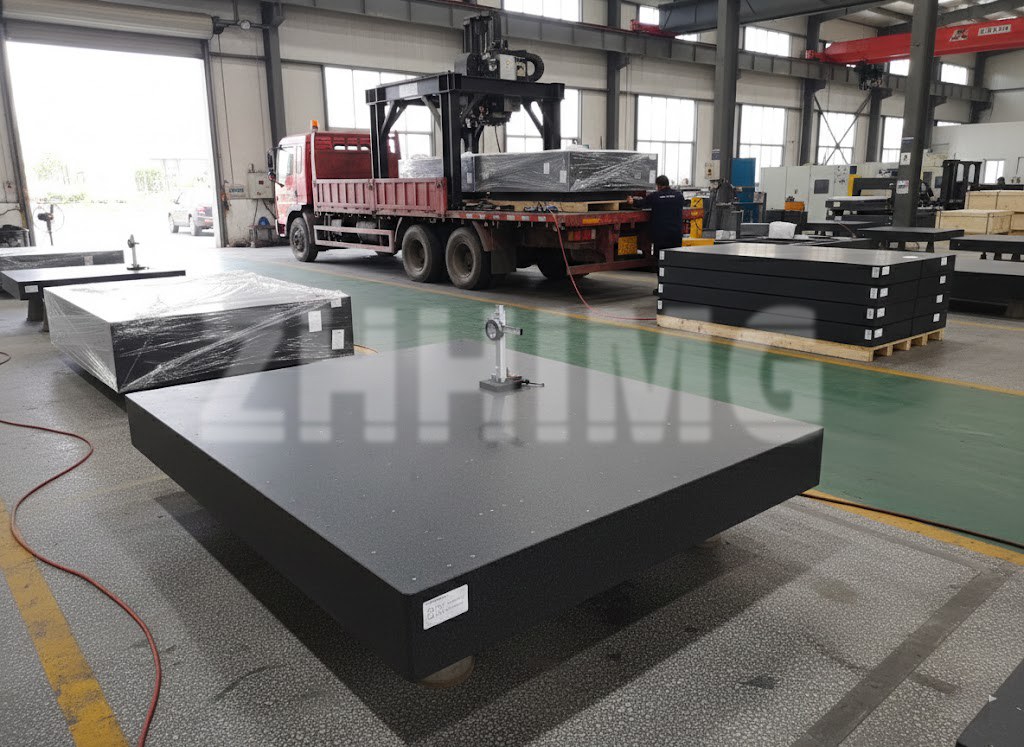
In terms of multi-material composite solutions, ZHHIMG can flexibly adopt various precision substrates such as mineral castings, UHPC and carbon fiber beams according to working conditions to deliver customized vibration reduction schemes for different cutting loads. For heavy continuous cutting scenarios, composite bases with mineral casting are available. For lightweight high-speed linear motor platforms, carbon fiber precision beams combined with granite bases balance self-weight, rigidity and damping, adapting to high-speed motion and processing requirements of perovskite coating, XRAY inspection and AOI optical inspection equipment.
From energy dissipation via material damping, resonance avoidance through integrated structure, to foundation isolation and dynamic inspection before delivery, the ZHHIMG® precision granite base is far more than a simple heavy stone block. It serves as a complete vibration control system. Vibration and shock in high-speed cutting are not isolated problems. Only by consuming impact energy generated in cutting, avoiding resonance intervals and blocking cross-structure vibration transmission can micron to nanometer-level machining standards be maintained for a long time, helping high-end equipment in semiconductor, precision CNC and optical inspection fields break precision bottlenecks in high-speed machining.
Post time: Oct-14-2026