
The claim, and what it actually rests on
Titles like this one are common in the machine tool press, and they deserve a more careful reading than they usually get. Machine bed materials are not chosen by fashion, and no serious manufacturer switches materials because a trend said so. What is actually happening in the industry is narrower and more defensible: an increasing number of design teams are evaluating mineral casting for machine beds where its specific properties match the machine’s dominant error source — and in those applications, some have changed their default material.
That distinction matters. This article does not claim that mineral casting is replacing cast iron across the board. It explains which properties drive the evaluation, where the switch makes sense, and where it does not — so that a reader can decide for their own machine rather than follow a headline.
What mineral casting is, and what it is not
A mineral casting machine bed is a composite: graded mineral aggregate bound in an epoxy or similar resin matrix, cast in a mould and cured. It is also sold as epoxy granite, polymer concrete or granite polymer — the names overlap and describe the same family. It is not natural granite; the aggregate is stone, but the material is manufactured, and its properties come from the mix design and the mould, not from the quarry.
Cast iron, by contrast, is molten metal poured into a pattern, then stress-relieved and machined. It has been the default bed material for over a century for good reasons: high stiffness, established supply chains, and repairability.
The properties that put mineral casting on the evaluation list
The comparison below summarises general material behaviour. Each row states its basis; project-specific figures come from the supplier’s mix data and test reports.
| Property | Mineral casting | Cast iron | Basis |
|---|---|---|---|
| Vibration damping | High — typically the primary reason for evaluation; the polymer matrix and aggregate interfaces dissipate energy | Lower; improved partly by section design | Published material comparisons and supplier data |
| Thermal expansion | Low, closer to stone than to steel | Higher; long beds move more with ambient drift | Material data sheets |
| Thermal conductivity | Low — slows heat input, but holds heat locally | High — spreads heat, whole structure moves together | Material data sheets |
| Stiffness | Lower modulus; recovered through section thickness and rib layout | High modulus; thin sections stay stiff | Material data and design practice |
| Complex geometry | Internal ribs, cavities and cable routes come with the mould at no machining cost | Complex internals need cores and extra machining | Manufacturing process |
| Lead time and tooling | Mould cost up front, amortised across a batch; cure cycle sets minimum lead time | Pattern and casting cost, then machining; mature supply chain | Production experience |
| Repairability | Limited — damaged castings are usually replaced or rebuilt by the supplier | Can often be repaired by welding and remachining | Service practice |
Two of these rows deserve more attention than they usually get. Low thermal conductivity is a genuine advantage against short heat events but a liability for steady-state heat sources: a motor bolted to a mineral casting heats its own neighbourhood rather than warming the whole structure, so the placement of heat sources relative to the metrology loop becomes a design input. And repairability runs the other way — iron can be welded and remachined in the field, while a damaged mineral casting generally goes back to the supplier. For a single high-value machine in a remote location, that can outweigh every damping figure.
Where the switch makes sense — and where it does not
The evaluation usually concludes in favour of mineral casting when most of the following are true:
- The machine’s dominant error is dynamic — chatter, vibration-limited surface finish, or settling time after fast moves — rather than raw load capacity.
- The design benefits from complex internal geometry: ribbed sections, integrated cable or coolant channels, or a shape that would need heavy machining if cast in iron.
- Production runs in batches, so the mould cost is amortised and the per-part economics work.
- Thermal drift of the reference structure is a measurable contributor to the machine’s accuracy budget.
It usually concludes in favour of cast iron when the opposite holds: very high static loads, a one-off machine where mould cost cannot be amortised, field repairability is a priority, or the design team’s existing validation data is all in iron and the project cannot absorb a material change.
Neither conclusion is a judgement about the materials; both are judgements about the machine.
What a bed looks like in production
The photograph below shows a production hall scene: large bed blanks with a characteristic exposed-aggregate surface, dark finished structures with machined faces, and support fixtures arranged along an assembly line. Two things are visible that matter to a buyer. First, mineral castings at this scale are industrial products, produced and handled in volume — not laboratory curiosities. Second, the exposed-aggregate surface is normal: the as-cast faces are stable and do not need finishing except where a functional interface requires it.
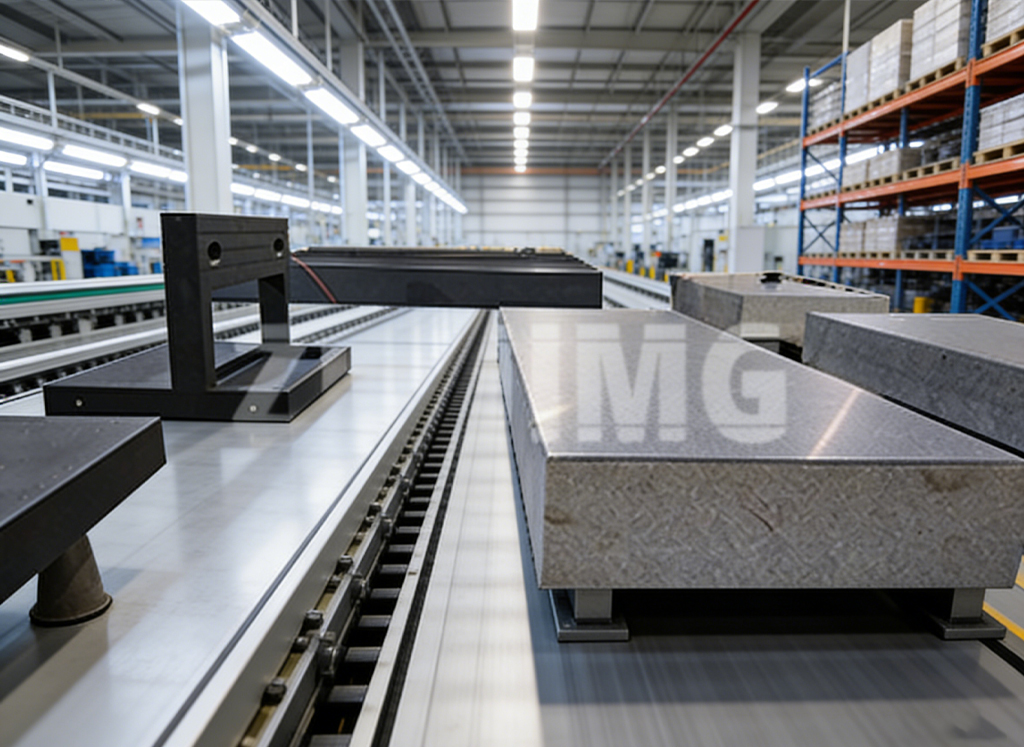
Beds and structures of this type are produced as mineral casting machine bed solutions and as related epoxy granite composite components, so the material question can be settled against parts and test data rather than against a brochure.
The questions to ask before switching a design
A responsible evaluation asks the supplier — and the internal team — a short list of questions:
- Which machine error dominates: static deflection, vibration, thermal drift, or motion error? The answer points to the material that addresses it.
- What are the supplier’s measured damping and stiffness figures for the actual mix, at the actual section, under the actual support — not generic values from a brochure?
- Where do the heat sources sit relative to the measuring system, and how does the low conductivity of the material change that layout?
- What is the insert and interface plan, and has the insert-to-composite load path been designed for the bolt loads?
- What does the batch quantity justify in mould cost, and what is the realistic cure and delivery schedule?
- What is the service and repair story for a damaged casting?
If those questions have answers, the material decision makes itself. Send your machine type, the dominant error source, the loads and the batch quantity to ZHHIMG for a mineral casting versus cast iron review of your specific bed design.
Post time: Oct-14-2026