
确定新闻稿翻译任务
How Strong Is the Vibration Damping Performance of Granite Bases?
In precision manufacturing workshops, the most destructive errors often come not from cutting tools or sensors, but from micro-vibrations generated by footsteps on the floor. When machining precision reaches the micrometer or even nanometer level, a forklift passing outside the wall, low-frequency resonance from an air-conditioning compressor, or even the footsteps of an operator can shift a laser focal point or cause a CMM probe reading to fluctuate. Vibration damping has therefore become the most underrated yet critical performance metric for precision equipment bases—and granite is one of nature’s optimal solutions.
1. Why Granite: The Material Itself Is a “Damper”
Many people know that granite is hard and stable, but few understand why it dampens vibration. The secret lies in its internal grain structure. Black granite is composed of tightly interlocked mineral crystals such as quartz, feldspar, and mica, with a density of approximately 3100 kg/m³ and numerous microscopic interfaces between grains. When vibration waves propagate through the material, these grain boundaries dissipate vibrational energy into 微弱 heat through internal friction—effectively embedding countless “micro-dampers” within the material itself.
By contrast, although cast iron bases offer high rigidity, their uniform metallic crystal structure allows vibration waves to propagate with slow attenuation, easily causing resonance and amplification. Marble, being softer and more porous, is prone to creep under long-term loading, and its damping stability is far inferior to that of dense granite. This is precisely why ZHHIMG insists on using high-density black granite and firmly resists the practice of passing off marble as granite—the gap in damping performance is determined at the raw-stone stage.
2. Damping Is Not Mysticism: Measurable and Repeatable
The damping capability of a granite base is not a matter of “it feels steadier”; it can be quantified by instruments. Within ZHHIMG’s metrology system, equipment including a British Renishaw laser interferometer, a Swiss WYLER electronic level, and a German Mahr dial indicator (0.5 μm) can capture minute displacements and vibration attenuation curves of a base under controlled external excitation. Inspectors apply excitation at different locations on the base and record the time and amplitude required for vibration to decay from peak to negligible levels—data that directly reflects the base’s actual damping performance.
More importantly, all inspection instruments at ZHHIMG are calibrated by the Jinan Institute of Metrology and the Shandong Institute of Metrology, with measurements traceable to the National Institute of Metrology, ensuring that every set of damping data carries international credibility. For products exported to Germany, the UK, France, and other markets, the team also issues inspection reports in accordance with local standards such as DIN and BS, so that overseas customers receive not just a block of stone, but a set of verifiable damping parameters.
3. From a Block of Stone to a Damping System: ZHHIMG’s Systems Engineering
Truly effective damping requires more than the material alone. ZHHIMG has turned vibration damping into a systems-engineering discipline, most visibly embodied in its 10,000 m² constant-temperature, constant-humidity workshop.
The workshop floor is monolithically poured with ultra-hard concrete at a thickness of no less than 1000 mm, effectively providing every piece of equipment with a massive “inertia base” that fundamentally suppresses ground-borne vibration transmission. Around the perimeter, anti-vibration trenches 500 mm wide and 2000 mm deep cut off vibration paths from external roads and adjacent areas. All overhead cranes inside the workshop are low-noise models, preventing the impact vibration of lifting operations from interfering with precision machining and measurement. On this basis, a dedicated constant-temperature, constant-humidity cleanroom simulating a semiconductor fab environment has been built for precision assembly of granite components—with temperature, humidity, and vibration all controlled in tandem, ensuring that bases leave the factory in a stable environment matching the customer’s site.
This five-layer damping system—”material + foundation + isolation trench + quiet equipment + environmental control”—elevates the damping performance of granite bases from an inherent material property to an engineering-replicable system capability. 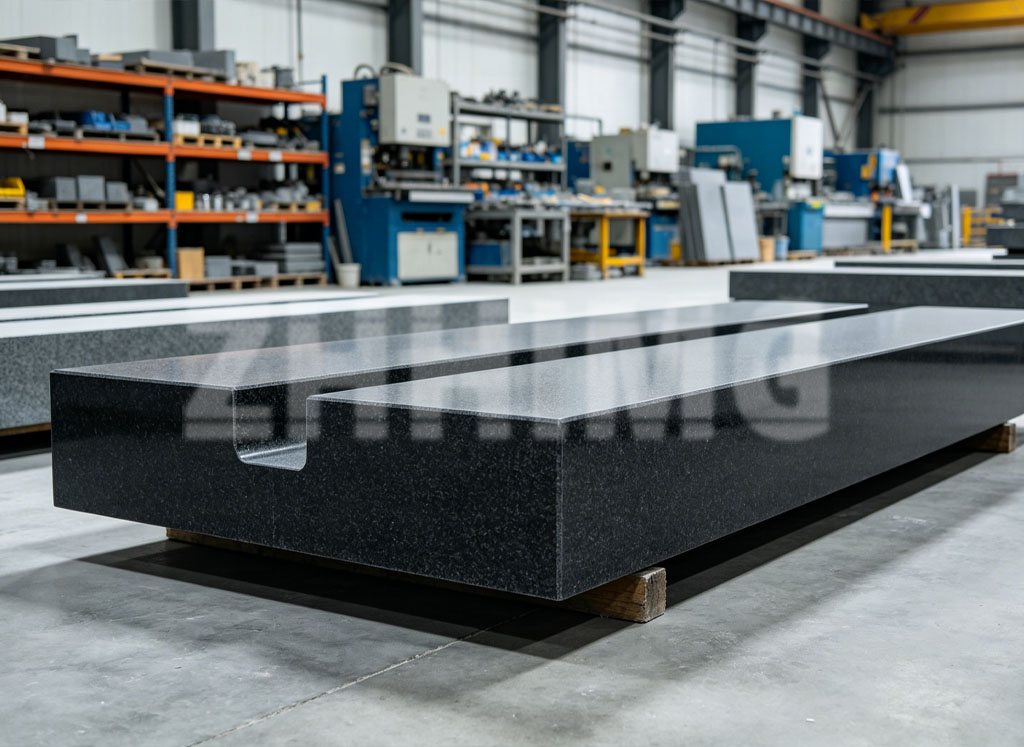
4. The Ultimate Value of Damping: Safeguarding Nanometer Precision Downstream
Damping performance ultimately delivers value on the customer’s production line. In semiconductor equipment, granite bases absorb vibration from vacuum pumps and robotic arms, ensuring positional stability of wafer stages during lithography and etching. In femtosecond and picosecond laser equipment, the low-vibration characteristics of the base allow ultra-short pulse lasers to focus to diffraction-limited spot sizes. In coordinate measuring machines and AOI optical inspection equipment, a stable base enables probes and cameras to sample at the micrometer level without external interference. In XY tables and linear-motor stages, the high damping of granite bases suppresses residual oscillation during high-speed start-stop motion, improving dynamic positioning accuracy.
It is for these reasons that ZHHIMG’s granite bases have entered the supply chains of global precision manufacturers including GE, Samsung, Bosch, Flex (Israel), 5th Axis (U.S.), Akribis (Singapore), Schunk (Germany), THK, HIWIN, and MISUMI (Japan). They also serve national metrology institutes in Germany, the UK, France, and Russia, as well as research institutions such as the National University of Singapore and Nanyang Technological University—customers most sensitive to vibration, whose long-term stable orders are a vote of confidence in the damping performance of granite bases.
5. Conclusion: Invisible Precision Is True Precision
Flatness and surface roughness are the “visible precision” written on inspection reports, while damping performance is the “invisible precision” hidden within the material and foundation. The former determines how accurate a base is when it leaves the factory; the latter determines whether it can remain that accurate after ten or twenty years on the customer’s site. As the only company in the industry simultaneously holding ISO 9001, ISO 45001, ISO 14001, and CE certifications, and with more than 20 international trademarks and patents registered in the EU, the U.S., Southeast Asia, and other regions, ZHHIMG’s understanding of damping has evolved from “choosing a good block of stone” to “building a stable system.”
The next time you see a nanometer-level piece of equipment running steadily, take a moment to notice the silent granite base beneath it—its damping performance is the invisible guardian of that equipment’s precision.
Post time: Aug-19-2026