
Keeping a Granite Surface Plate Accurate
A granite surface plate stays accurate for many years if you keep it clean, use it evenly, calibrate it on a schedule, and resurface it before wear goes out of tolerance. Granite does not rust and shows very little thermal drift, but it is not wear-free: dust, grit and heavy use slowly wear the most-used area.
A plate that is out of tolerance without anyone knowing is worse than a worn plate that is known to be worn. Every reading taken on it carries hidden error, so regular calibration matters as much as cleaning.
This guide covers daily care, calibration, resurfacing and repair, so you know what to do at each stage of the plate’s life.
Daily Care: Cleaning, Handling and Storage
The best maintenance is to keep grit off the surface, because loose abrasive particles trapped under a workpiece wear the plate more than anything else.
Do
- Wipe the surface with a clean, lint-free cloth and a cleaner made for granite surface plates before and after each use. Isopropyl alcohol also works.
- Let workpieces reach room temperature before placing them on the plate. A warm part can locally distort the surface and the reading.
- Spread the work across the whole surface instead of always using the same area.
- Keep the plate on its specified support points, level and stable.
- Cover the plate when it is not in use, and keep it away from direct sunlight, heaters and air vents.
Don’t
- Don’t use household cleaners, soap, ammonia or acids. They can leave residue or react with the stone.
- Don’t slide heavy or rough parts across the surface. Lift and place them.
- Don’t hammer, punch or clamp against the plate, or use it as a general workbench.
- Don’t leave oil, coolant or cutting fluid on the surface, because they attract dust and grit.
- Don’t move a plate by its edges or by anything other than its lifting points.
A cleaning fluid made for granite plates is available in our accessories range.
Calibration: How Often, What and How
Most users calibrate a granite surface plate about once every 12 months, and more often for heavy use, high grades or when a quality system requires it. If a plate is dropped, moved or hit, check it before using it again.
What a calibration measures
- Overall flatness. The working surface is mapped and compared with the tolerance for the plate’s grade and size.
- Local flatness (repeatability). The variation over small areas, which matters when you check small parts or use height gauges and indicators.
- Parallelism and squareness, where the plate has two working faces or reference edges.
How it is measured
The flatness survey is normally made with electronic levels, an autocollimator or a laser interferometer, and local flatness with a sensitive indicator or probe. At ZHHIMG we use WYLER electronic levels and a Renishaw laser interferometer, in a temperature- and humidity-controlled measuring room.
What the certificate should show
A useful calibration certificate lists the plate identification, the standard and grade, the measured flatness values, the instruments used, the temperature, the date, and the traceability of the instruments to a national metrology institute. A certificate that only says “Grade 0″ without measured values is of limited use.
We offer assembly, calibration and inspection for granite plates and components.
Signs Your Plate Needs Attention
Most problems show up as inconsistent readings long before the plate looks damaged.
| Symptom | Likely cause | What to do |
|---|---|---|
| Readings differ between areas of the plate | Uneven wear in the most-used area | Calibrate, then resurface if out of tolerance |
| Repeat readings drift during a session | Temperature change, or grit on the surface | Clean, let the plate and parts stabilize, repeat the check |
| Calibration shows flatness outside the grade | Cumulative wear, or a shifted support | Check the supports, then resurface |
| Visible chip or ding on the working surface | Impact or a dropped tool | Inspect the area; small chips can often be repaired |
| Crack or long fracture | Severe impact or overload | Stop using the plate for precision work; assess for repair or replacement |
| Stained or dull patches | Oil, coolant or the wrong cleaner | Clean with a suitable cleaner; stubborn marks may need relapping |
Resurfacing: Restoring the Plate’s Grade
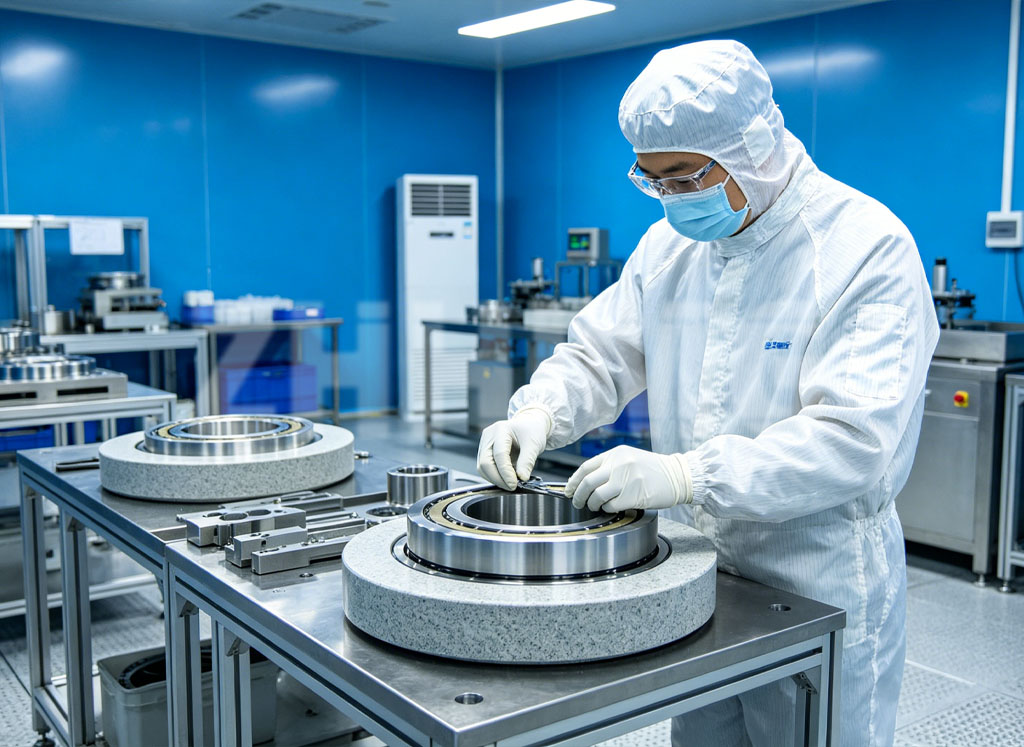
Resurfacing, also called relapping, restores a worn plate to its original grade, and it is usually far cheaper than buying a new plate. It makes sense when calibration shows flatness outside tolerance and the plate still has enough thickness and no structural damage.
The process follows six steps:
- Inspect and map. The surface is measured to find where and by how much it deviates, and the plate’s thickness and condition are checked.
- Decide the approach. The supplier confirms the target grade and whether the work can be done in the workshop or, for very large plates, on site.
- Rough lapping. Material is removed from the high areas with abrasive lapping to bring the surface close to flat.
- Fine lapping. Finer abrasives and careful, repeated hand lapping refine the surface to the target flatness. This is where an experienced lapping technician makes the difference.
- Re-measure. The plate is measured again in a controlled environment and the process repeats until it meets the grade.
- Certify. A new calibration certificate with measured values is issued.
Our grinding technicians have more than 30 years of hand-lapping experience, and many of our customers describe them as walking electronic levels. Learn more about our resurfacing service.
Repairing Chips and Damage
Small chips and edge damage can often be repaired, but a structural crack usually means the plate should be retired from precision work.
Granite has one advantage over metal here: an impact leaves a small pit or chip, not a raised burr, so a minor ding does not push the surrounding surface out of flat. Even so, repair needs a careful assessment.
- Small chips and edge damage away from the main working area can usually be filled with a stone-colored epoxy filler and then relapped locally.
- Damage on the working surface needs the area relapped, often with the whole surface, to bring it back to the grade.
- Cracks and long fractures reduce the structural integrity of the plate. They can sometimes be repaired for non-critical use, but for precision metrology replacement is usually the safe choice.
If you are unsure, send photos and the plate size to our team for an assessment. See our granite repair service.
Frequently Asked Questions
How do I clean a granite surface plate?
Wipe it with a clean, lint-free cloth and a cleaner made for granite plates, or with isopropyl alcohol, then dry it. Avoid soap, ammonia, acids and oily cleaners.
How often should I calibrate my granite surface plate?
About once every 12 months is common. Calibrate more often for heavy use or high grades, and after any impact, move or doubtful reading.
Can a granite surface plate be resurfaced on site?
Often yes for large plates that are hard to move, but the best results come from a controlled workshop or measuring room. The supplier can advise based on the plate size and grade.
How many times can a plate be resurfaced?
It depends on the remaining thickness and the structure of the plate. Each relapping removes a thin layer, so a plate that is thick and sound can be restored several times.
Is it worth repairing an old plate, or should I buy a new one?
For a sound plate with wear or minor chips, resurfacing is usually cheaper than replacement. If the plate has a structural crack or is too thin, a new plate is the safer investment.
Get the Most from Your Plate
Clean the plate before and after every use, spread the wear, calibrate it about once a year, and resurface it when calibration shows it has drifted. Following this routine keeps a precision granite plate accurate for decades.
ZHHIMG provides calibration, resurfacing and repair for granite surface plates, along with new plates, square rulers, straight edges and other granite measuring tools. Send us the plate size, grade and condition, with photos if you have them, through our contact page, or browse our granite surface plates first.
Post time: Oct-30-2026