
Choosing the right precision granite machine base manufacturer is an important step in building accurate, stable, and reliable industrial equipment. For coordinate measuring machines (CMMs), semiconductor equipment, optical inspection systems, precision laser machines, and high-accuracy motion platforms, the machine base directly affects structural stability, geometric accuracy, vibration behavior, and long-term performance.
However, not all granite machine bases are manufactured to the same requirements. Differences in raw material selection, machining capability, dimensional control, inspection methods, and manufacturing experience can significantly affect the final result.
If you are sourcing a custom granite machine base for an OEM project or precision equipment application, here are 10 key factors to evaluate before selecting a manufacturer.
1. Verify the Granite Material Quality
Material selection is the starting point of a reliable precision granite machine base.
Granite is widely used in precision engineering because of its dimensional stability, natural vibration-damping characteristics, corrosion resistance, and suitability for precision surface finishing. However, different stone materials and grades can have different physical properties.
When evaluating a manufacturer, ask about:
- The type and grade of granite used
- Material density and its supporting test data
- Thermal expansion characteristics
- Material homogeneity and visible defects
- Internal stress and dimensional stability
- Material inspection and traceability procedures
Density alone does not determine the performance of a granite component. Thermal behavior, elastic properties, damping characteristics, material consistency, and the final component design must also be considered.
At ZHHIMG®, precision granite machine bases are manufactured using ZHHIMG® Black Granite, with a nominal density of approximately 3,100 kg/m³. Material selection is an important part of our approach to manufacturing precision components for demanding industrial applications.
When comparing suppliers, request documented material specifications rather than relying exclusively on marketing descriptions.
2. Evaluate Thermal Stability
Temperature changes can cause dimensional changes in machine structures. In high-precision applications, even small dimensional variations may affect the relative positions of linear guides, optical components, measuring probes, and other critical elements.
A suitable granite machine base can help reduce temperature-related dimensional variation, depending on the material properties, geometry, operating environment, and system design.
Before choosing a manufacturer, consider:
- The coefficient of thermal expansion of the proposed material
- Expected operating temperature and temperature variation
- Temperature differences across the machine structure
- The dimensional stability required by the application
- Whether temperature-controlled machining, assembly, and inspection are available
It is also important to distinguish material thermal expansion from the thermal behavior of the complete machine. Mounting interfaces, inserts, fasteners, guideways, and other materials may respond differently to temperature changes.
For semiconductor equipment, optical inspection systems, and precision metrology machines, the thermal behavior of the complete assembly should be evaluated during the design stage.
3. Check Vibration-Damping Performance
Vibration can affect measurement repeatability, positioning stability, image quality, and machining performance. This is particularly important for equipment using optical measurement, high-magnification imaging, precision probing, or high-accuracy motion systems.
Granite is often selected for precision machine structures because of its vibration-damping characteristics. Nevertheless, actual system performance depends on more than the material itself.
A manufacturer’s engineering team should consider:
- Machine mass and structural geometry
- Natural frequencies and dynamic response
- External vibration sources
- Foundation and support conditions
- Motion acceleration and operating speed
- The location of motors, guideways, and precision instruments
For applications with demanding dynamic requirements, ask whether the manufacturer can support structural design reviews, interface checks, or vibration-related testing where necessary.
The objective is not simply to choose a heavy base. It is to create a stable structural foundation that meets the machine’s actual operating requirements.
4. Confirm Custom Machining Capability
Many precision equipment manufacturers require more than a standard granite block. A custom machine base may include mounting holes, threaded inserts, counterbores, recessed pockets, reference surfaces, cable-routing features, and interfaces for linear guides or other mechanical components.
Poorly controlled interfaces can complicate assembly and affect the alignment of the complete machine.
Before placing an order, confirm that the supplier can manufacture according to your engineering drawings and specified tolerances.
Key questions include:
- Can the manufacturer process the required overall dimensions?
- Can it machine complex mounting features and recessed structures?
- Can critical surfaces be ground and lapped to the specified requirements?
- Can mounting positions and geometric relationships be inspected?
- Can the supplier handle the component’s weight safely throughout production?
- Can the manufacturer provide technical feedback before machining begins?
ZHONGHUI Group (ZHHIMG®) has manufacturing facilities in Jinan, China, with large-format processing capabilities for oversized precision components. Our stated maximum single-component capability reaches approximately 20 m in length, 4,000 mm in width, 1,000 mm in thickness, and 100 metric tons in weight, subject to project-specific feasibility and processing requirements.
For large machine bases and integrated structures, this capability can be particularly relevant when a project requires substantial dimensions or fewer component joints.
5. Understand the Manufacturer’s Precision Grinding and Lapping Processes
Precision machining is not just about removing material. It is about achieving the required geometry, surface condition, and dimensional relationships consistently.
For granite components, grinding and lapping are important processes used to establish precision reference surfaces and mounting interfaces.
When evaluating a supplier, ask how it controls:
- Flatness of critical surfaces
- Parallelism between reference surfaces
- Squareness and perpendicularity
- Position and spacing of mounting holes
- Surface finish and local surface defects
- Dimensional changes during processing
The appropriate tolerances depend on the application, component dimensions, drawing requirements, and inspection method.
A qualified manufacturer should review critical dimensions before production and identify which features require special machining or inspection procedures.
ZHHIMG® combines large-format grinding equipment with experienced granite-processing technicians. Our manufacturing approach emphasizes the relationship between precision machining, skilled finishing, and dimensional verification.
Rather than accepting a general statement such as “high precision,” customers should request measurable tolerances and inspection results for the features that matter to their equipment.
6. Examine the Inspection Equipment and Measurement Methods
A manufacturer cannot reliably demonstrate precision without suitable measurement equipment and appropriate inspection procedures.
For a precision granite machine base, inspection may involve flatness, parallelism, squareness, dimensional measurements, mounting-hole positions, and the relationships between multiple reference surfaces.
Depending on the tolerance and geometry, relevant equipment may include:
- Precision dial indicators and electronic measuring instruments
- Electronic levels
- Surface and dimensional measuring equipment
- Autocollimators
- Laser interferometers or laser tracking systems, where appropriate
- Other calibrated instruments suitable for the specified measurement task
The instrument must be appropriate for the required tolerance, measurement range, uncertainty, and inspection environment.
Ask the supplier how measuring instruments are calibrated and whether calibration records are available. Also confirm that the inspection method is suitable for the component’s size and geometry.
ZHHIMG® uses precision measuring equipment from established instrument manufacturers, including Mahr, Mitutoyo, WYLER, and Renishaw, in relevant inspection and measurement applications.
The specific instrument and method used for a project depend on its requirements. Inspection reports and supporting calibration documentation should be agreed upon before production whenever they are necessary for acceptance.
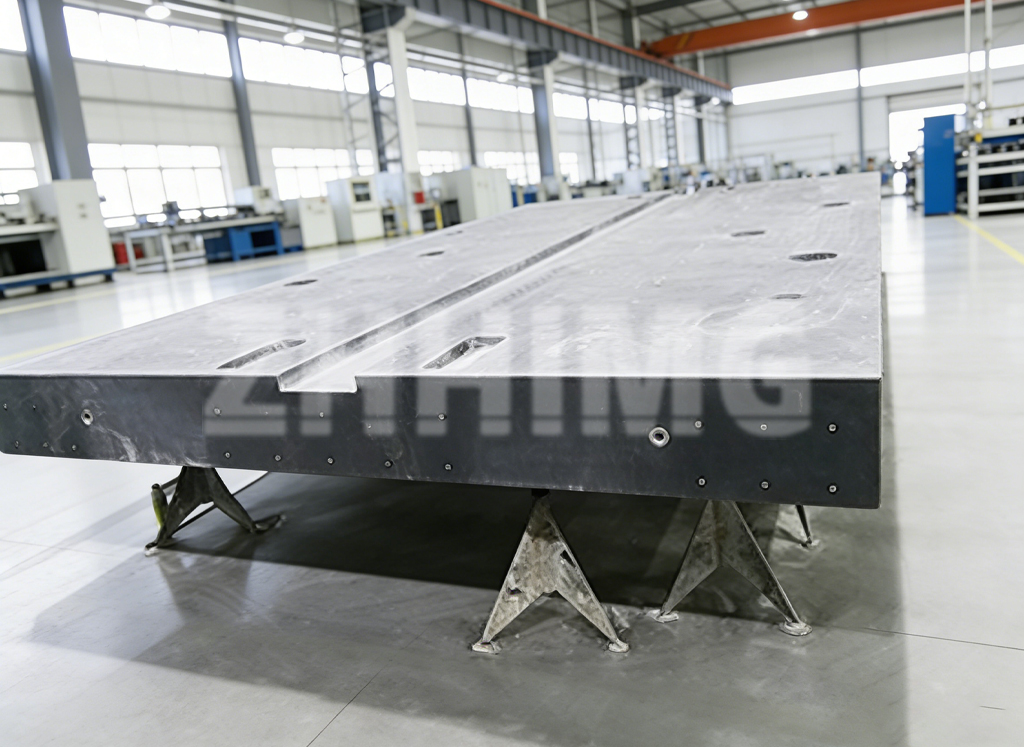
7. Check Temperatuontrolled and Vibration-Controlled Facilities
The manufacturing environment can influence the reliability of precision machining and inspection.
Temperature variations may affect measured dimensions, while floor vibration and unstable support conditions may interfere with sensitive measurements.
For demanding applications, evaluate whether the manufacturer has suitable facilities for:
- Temperature-controlled machining or inspection
- Stable support and handling of large components
- Vibration management in measurement areas
- Clean assembly of precision structures
- Controlled measurement procedures
- Safe lifting and movement of heavy components
ZHHIMG® reports a temperature- and humidity-controlled workshop area of approximately 10,000 m², with engineered floor and vibration-isolation features intended to support stable precision manufacturing and measurement.
For projects involving semiconductor equipment, optical systems, and other sensitive assemblies, dedicated controlled-environment assembly facilities may also be relevant.
When assessing a supplier, look beyond the facility description. Ask how environmental conditions are monitored, what controls apply during inspection, and whether the conditions are suitable for your specified acceptance requirements.
8. Evaluate Engineering Support and Assembly Experience
A granite machine base is often one part of a larger precision system. Its performance depends on how accurately it interfaces with other components.
For example, a base used in a coordinate measuring machine may require carefully controlled guideway mounting surfaces. A semiconductor inspection platform may need precise interfaces for motion stages, optical components, and cable-management structures.
A capable manufacturer should be able to review:
- Engineering drawings and 3D models
- Critical dimensions and geometric tolerances
- Mounting-hole locations and insert specifications
- Assembly datums and alignment requirements
- Component handling and installation constraints
- Inspection and acceptance criteria
Where appropriate, the manufacturer should identify potential manufacturing issues before processing begins.
ZHHIMG® manufactures granite components, machine bases, frames, gantry structures, and related precision assemblies for a range of industrial applications.
For custom projects, providing complete drawings, material requirements, tolerance specifications, and assembly information helps the manufacturing team evaluate feasibility and identify the most appropriate production approach.
9. Verify Quality Management, Documentation, and Traceability
Quality documentation is an important part of supplier evaluation, particularly for international OEM projects and equipment requiring controlled inspection procedures.
Before selecting a manufacturer, clarify which quality records can be provided with your order.
Depending on the project, these may include:
- Material specifications or material inspection records
- Dimensional inspection reports
- Calibration documentation for relevant measuring instruments
- Certificates of conformity
- Production or inspection records
- Packaging and shipping documentation
Also verify the manufacturer’s certifications directly and confirm their scope, issuing body, and validity where applicable.
ZHONGHUI Group identifies ISO 9001, ISO 45001, ISO 14001, and CE-related credentials within its company information. Buyers should verify the applicable certificate or conformity documentation for the specific entity, product, and project.
A reliable supplier should explain clearly what is included in the quotation, what inspection documentation is available, and which acceptance requirements must be agreed upon before manufacturing begins.
10. Compare Total Project Value, Not Just the Purchase Price
The lowest initial quotation does not necessarily represent the lowest total project cost.
A granite machine base that fails to meet mounting tolerances may require additional machining, rework, alignment, or assembly adjustments. Delays in manufacturing or incomplete inspection documentation can also affect the customer’s equipment delivery schedule.
When comparing suppliers, evaluate:
- Material quality and documented specifications
- Machining and finishing capabilities
- Inspection methods and acceptance criteria
- Engineering communication and drawing review
- Production capacity and realistic lead times
- Export packaging and logistics
- Quality documentation and technical support
The right manufacturer should be able to explain its capabilities clearly and identify any limitations before accepting the order.
For international customers, it is also useful to confirm the quotation basis, shipping terms, packaging requirements, and responsibilities for transport and installation.
A transparent quotation and a technically complete manufacturing plan can help reduce uncertainty throughout the project.
Why Consider ZHHIMG® for Custom Precision Granite Machine Bases?
ZHONGHUI Group (ZHHIMG®) manufactures precision granite components and related structural solutions for customers in precision engineering, metrology, semiconductor equipment, optical inspection, and industrial automation.
Our manufacturing capabilities include:
High-density black granite: ZHHIMG® Black Granite has a nominal density of approximately 3,100 kg/m³. Material selection and the required physical properties should be evaluated against each project’s specifications.
Large-format manufacturing: Our stated processing capability includes single components up to approximately 20 m in length and 100 metric tons, subject to engineering and manufacturing feasibility.
Precision grinding and finishing: Large-format grinding equipment and experienced technicians support the processing of precision reference surfaces and custom interfaces.
Measurement and inspection: We use precision measuring equipment and project-appropriate inspection procedures to verify critical dimensions and geometric requirements.
Controlled manufacturing environments: Temperature- and humidity-controlled facilities support precision manufacturing, measurement, and assembly operations.
Custom engineering: Granite bases, frames, gantry structures, and related components can be evaluated according to customer drawings, specified tolerances, and equipment integration requirements.
Our goal is to support customers who need more than a standard granite block: they need a precision-manufactured structural component that fits their equipment design and documented quality requirements.
Frequently Asked Questions
What is a precision granite machine base used for?
A precision granite machine base provides structural support and stable reference surfaces for equipment such as coordinate measuring machines, semiconductor inspection systems, optical measurement instruments, precision laser machines, and high-accuracy motion platforms.
The appropriate material and design depend on the application’s accuracy, load, dynamic behavior, environmental conditions, and mounting requirements.
Why choose granite instead of cast iron for a precision machine base?
Granite is often selected for its vibration-damping characteristics, corrosion resistance, and suitability for precision surface finishing. Cast iron may offer advantages in other applications, including particular structural designs and manufacturing requirements.
The best choice depends on the complete machine design, including stiffness, mass, thermal behavior, dynamic loads, cost, and production constraints.
What information is needed for a custom granite machine base quotation?
To evaluate a custom project, provide as much of the following information as possible:
- 2D engineering drawings and 3D CAD files
- Overall dimensions and estimated weight
- Required material and surface-finish specifications
- Flatness, parallelism, squareness, and positional tolerances
- Mounting-hole, insert, and interface details
- Required inspection reports or certificates
- Quantity, target delivery date, and destination country
Complete information helps the manufacturer assess feasibility, identify critical features, and prepare a more accurate quotation.
Can a precision granite machine base be manufactured in large dimensions?
Yes. Large-format granite machine bases can be manufactured when suitable material blocks, processing equipment, lifting systems, and inspection methods are available.
However, maximum dimensions and weight are not the only considerations. Transportation, handling, structural geometry, machining access, inspection uncertainty, and installation conditions must also be evaluated.
How can I verify the accuracy of a granite machine base?
Start by reviewing the approved engineering drawing and its specified tolerances. Then confirm the inspection method, measurement conditions, calibrated instruments, and acceptance criteria.
Request a dimensional inspection report that identifies the relevant features and measured results. For demanding applications, agree on the measurement procedure and documentation requirements before production begins.
Request a Custom Precision Granite Machine Base
Looking for a precision granite machine base manufacturer for your next equipment project?
ZHONGHUI Group (ZHHIMG®) can evaluate custom granite bases, machine frames, gantry structures, and related components according to your engineering drawings and project requirements.
Send us your drawings, dimensions, material requirements, and critical tolerances for a manufacturing feasibility review and quotation.
Website: https://www.zhhimg.com/
Explore our precision granite solutions:
- Precision Granite Machine Base
- Custom Precision Granite Machine Base
- Precision Granite Machine Base & Gantry Assembly
Contact ZHHIMG® to discuss your next precision engineering project.
Post time: Oct-28-2026