
Selecting the appropriate granite surface plate is critical for maintaining measurement accuracy and ensuring the longevity of your precision instruments. Whether you’re outfitting a quality control laboratory, a CNC machining facility, or a coordinate measuring machine (CMM) station, the right choice impacts directly on your operational efficiency and product quality. This comprehensive guide walks you through the essential factors—from flatness grades to material properties—that will help you make an informed decision when purchasing a precision granite surface plate for CMM and other metrology applications.
Choosing the right granite surface plate depends primarily on your required flatness grade (Grade 00, 0, or 1), with Grade 00 offering ≤0.5μm/m for ultra-precision CMM applications and Grade 1 suitable for general workshop use. High-density black granite with 3100kg/m³ density provides superior vibration damping and thermal stability compared to traditional cast iron, making it the preferred choice for modern precision manufacturing. Always verify supplier certifications (ISO9001:2015, CE) and consider the maximum machining dimensions available to ensure the plate meets your production requirements.
Understanding Granite Surface Plate Flatness Grades
What Flatness Grades Mean for Your Measurements
Flatness grades define how perfectly a surface plate’s working surface conforms to an ideal plane, measured in micrometers per meter (μm/m). This specification directly affects measurement uncertainty and repeatability in your quality control processes.
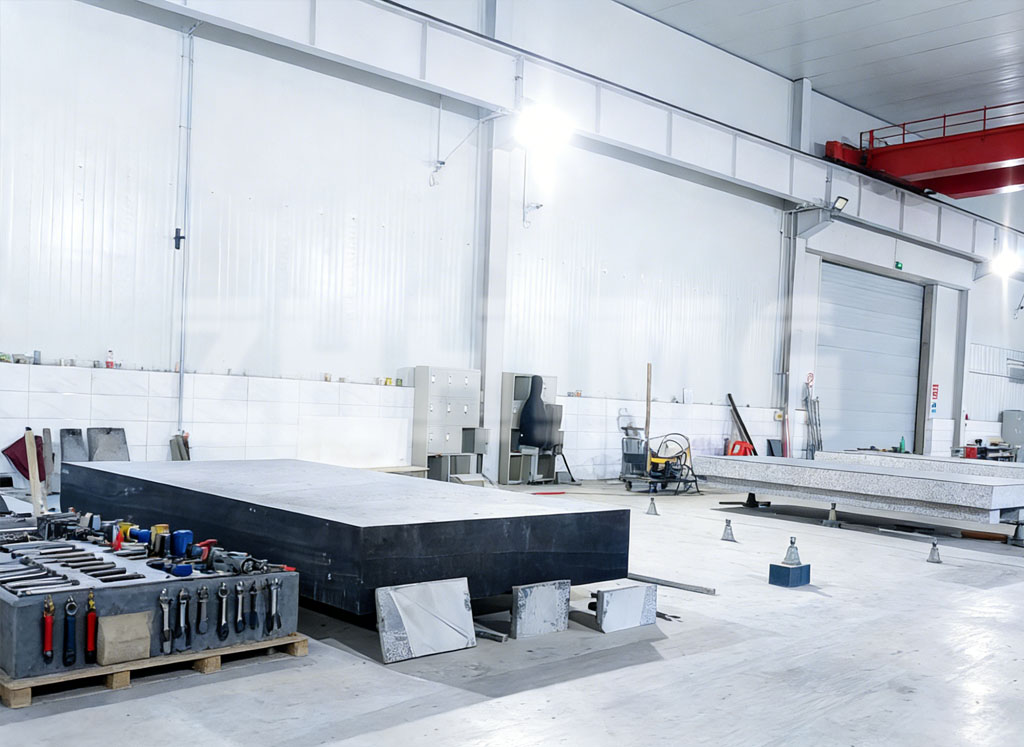
Grade 00 represents the highest precision level, with flatness tolerances of ≤0.5μm/m. These plates are engineered for laboratory-grade coordinate measuring machines, national metrology institutions, and applications requiring the lowest possible measurement uncertainty. The manufacturing process for Grade 00 plates demands controlled environments, including 10,000m² of temperature-regulated workshops with vibration-dampening foundations.
Grade 0 plates maintain tolerances of ≤1μm/m, suitable for most industrial CMM applications and precision inspection stations. This grade offers an optimal balance between manufacturing cost and performance, making it the most popular choice for production quality control environments.
Grade 1 plates accommodate tolerances of ≤2μm/m and serve general workshop purposes, tool-making applications, and educational institutions where ultra-high precision is not the primary concern.
How to Select the Appropriate Grade for Your Application
The selection between flatness grades should align with your measurement equipment capabilities and process requirements. If your CMM has a stated uncertainty of ±1μm, investing in a Grade 00 plate provides unnecessary precision headroom. Conversely, pairing a Grade 1 plate with a high-precision CMM creates a measurement bottleneck that limits your system’s overall accuracy.
Why Black Granite Outperforms Traditional Materials
The Science Behind High-Density Granite Properties
Black granite emerges as the superior material for precision surface plates due to its unique combination of physical properties. The density of approximately 3100kg/m³ contributes to exceptional vibration damping characteristics, rapidly absorbing mechanical vibrations from surrounding equipment and floor vibrations.
Thermal stability ranks among granite’s most significant advantages. Premium black granite exhibits thermal expansion coefficients below 0.001mm/°C, ensuring minimal dimensional changes when ambient temperatures fluctuate. This thermal stability proves particularly valuable in environments without precise climate control.
Comparing Granite vs Cast Iron Surface Plates
The comparison between granite and cast iron surface plates reveals fundamental differences in performance characteristics. Cast iron plates require regular maintenance, including scraping to restore flatness, while granite’s crystalline structure provides inherent stability that resists permanent deformation.
|
Property |
Black Granite |
Cast Iron |
| Density | 3100kg/m³ | ~7200kg/m³ |
| Flatness Stability | Lifetime guarantee | Requires periodic resurfacing |
| Thermal Expansion | <0.001mm/°C | ~0.012mm/°C |
| Vibration Damping | Excellent | Moderate |
| Corrosion Resistance | Inherent | Requires protective coating |
| Initial Cost | Higher | Lower |
| Total Lifetime Cost | Lower | Higher |
| Maximum Size Available | Up to 20,000×4,000×1,000mm | Typically limited to 3000mm |
Matching Plate Size to Your Production Needs
Calculating Minimum Plate Dimensions
The surface plate dimensions must accommodate the largest workpiece you intend to measure while providing adequate clearance around the perimeter. Industry standards recommend a minimum border width of 20% of the plate’s length on each side, preventing measurement errors caused by edge deflection or thermal gradients.
For CMM applications, the plate must support not only the workpiece but also the CMM’s reference structure. Ensure the plate’s thickness provides sufficient mass to resist dynamic forces during measurement cycles without perceptible flexing.
Understanding Maximum Machining Dimensions
Modern precision manufacturing demands increasingly large workpieces and assemblies. ZHHIMG® addresses this requirement with manufacturing capabilities supporting maximum machining dimensions of 20,000×4,000×1,000mm, enabling the production of ultra-large precision granite components that were previously impossible to source.
Environmental Factors and Installation Considerations
Temperature Control Requirements
Temperature variations directly impact measurement accuracy through thermal expansion of both the workpiece and the surface plate. While granite’s thermal coefficient of <0.001mm/°C represents excellent stability, extreme temperature changes or direct sunlight can still induce measurable errors.
The ideal installation environment maintains temperature within ±1°C over the measurement period. For semiconductor and aerospace applications requiring the lowest measurement uncertainties, 10,000m² of temperature-controlled workspace with precise humidity regulation becomes essential.
Vibration Isolation and Foundation Requirements
Precision surface plates require protection from ambient vibrations transmitted through building structures. Effective solutions include isolation tables with pneumatic or elastomeric damping elements, particularly important when surface plates operate near heavy machinery or busy production floors.
The antivibration trench design incorporated into modern precision workshops creates a physical barrier that interrupts vibration transmission paths from external sources.
Why Certifications Matter When Selecting a Supplier
Essential Certifications for Quality Assurance
Verifying your supplier’s certifications ensures you receive products manufactured under controlled quality systems. ISO9001:2015 certification indicates implementation of quality management principles, while ISO14001 demonstrates environmental responsibility in manufacturing processes.
ISO45001 certification specifically addresses occupational health and safety management, important when evaluating suppliers’ manufacturing environments. CE marking confirms products meet European safety, health, and environmental protection requirements.
The Importance of Traceability and Documentation
Reputable suppliers provide comprehensive documentation including calibration certificates, material test reports, and inspection records for each surface plate. This traceability enables you to verify the plate’s conformance to specifications and maintain records for quality system compliance.
Cost Considerations and Total Value Analysis
Initial Investment vs. Lifetime Value
While black granite surface plates command higher initial prices compared to cast iron alternatives, the total cost of ownership analysis strongly favors granite. Cast iron plates require periodic resurfacing every 3-5 years, with costs accumulating over the plate’s operational lifetime.
Premium granite plates from certified manufacturers maintain their specified flatness indefinitely under normal use conditions. This characteristic eliminates ongoing maintenance costs and, more importantly, eliminates downtime associated with plate maintenance and recalibration.
Bulk Purchasing and Long-Term Partnerships
For facilities requiring multiple surface plates or ongoing precision granite components, establishing relationships with manufacturers capable of consistent quality and competitive pricing delivers significant long-term value. Monthly production capacities of 20,000 sets of precision granite bed components ensure reliable supply for high-volume operations.
FAQ: Frequently Asked Questions About Granite Surface Plates
Q1: How often should a granite surface plate be recalibrated?
A: Unlike cast iron plates, granite surface plates do not require periodic recalibration when used under proper conditions. The inherent stability of granite’s crystalline structure maintains flatness specifications throughout the plate’s operational lifetime. However, periodic verification using laser interferometry or CMM comparison testing remains good practice for quality assurance documentation.
Q2: What is the difference between Grade 00 and Grade 0 granite surface plates?
A: Grade 00 plates offer flatness tolerances of ≤0.5μm/m, while Grade 0 plates accommodate ≤1μm/m. Grade 00 plates require more controlled manufacturing conditions, including temperature-stabilized workshops, and are priced accordingly. For most industrial CMM applications, Grade 0 provides sufficient precision without the premium cost of Grade 00.
Q3: Why does black granite provide better performance than gray granite?
A: Black granite typically exhibits finer grain structure and higher mineral homogeneity compared to gray varieties. These characteristics contribute to superior flatness retention, better vibration damping, and more consistent thermal properties. The higher density of approximately 3100kg/m³ found in quality black granite directly correlates with improved damping performance.
Q4: Can granite surface plates be used in cleanroom environments?
A: Yes, granite surface plates are ideal for cleanroom applications in semiconductor, pharmaceutical, and biotechnology industries. Unlike cast iron, granite does not corrode or shed particles, maintaining cleanroom integrity. ZHHIMG® supplies precision granite components to semiconductor industry leaders requiring ultra-clean manufacturing environments.
Q5: What maximum size surface plate can be manufactured?
A: ZHHIMG® manufactures precision granite components with maximum dimensions of 20,000×4,000×1,000mm, utilizing Taiwan’s most advanced ultra-large grinding machines capable of finishing surfaces up to 6000mm in length. This capability enables precision measurement of large aerospace components, automotive assemblies, and industrial equipment.
Q6: How do I verify the quality of a granite surface plate upon receipt?
A: Request the supplier’s inspection certificate showing measured flatness values at multiple points across the plate surface. Verify the certificate date, lot number, and inspection methodology. For critical applications, consider third-party calibration using laser interferometry. Check for visible defects including chips, cracks, or surface irregularities that could affect measurement accuracy.
Conclusion
Selecting the right granite surface plate requires balancing precision requirements against practical considerations including budget, available workspace, and environmental conditions. Understanding flatness grades enables you to specify appropriate tolerances without over-specifying and incurring unnecessary costs. The inherent advantages of high-density black granite—superior thermal stability, excellent vibration damping, and lifetime flatness retention—make it the clear choice for modern precision manufacturing.
Partner with certified manufacturers who can demonstrate consistent quality through ISO9001:2015, ISO45001, ISO14001, and CE certifications. Request detailed specifications, inspection certificates, and material test reports to verify your investment meets the exacting standards your quality systems demand. With proper selection and installation, a precision granite surface plate delivers decades of reliable service while maintaining the measurement accuracy your operations require.
Post time: Jun-04-2026