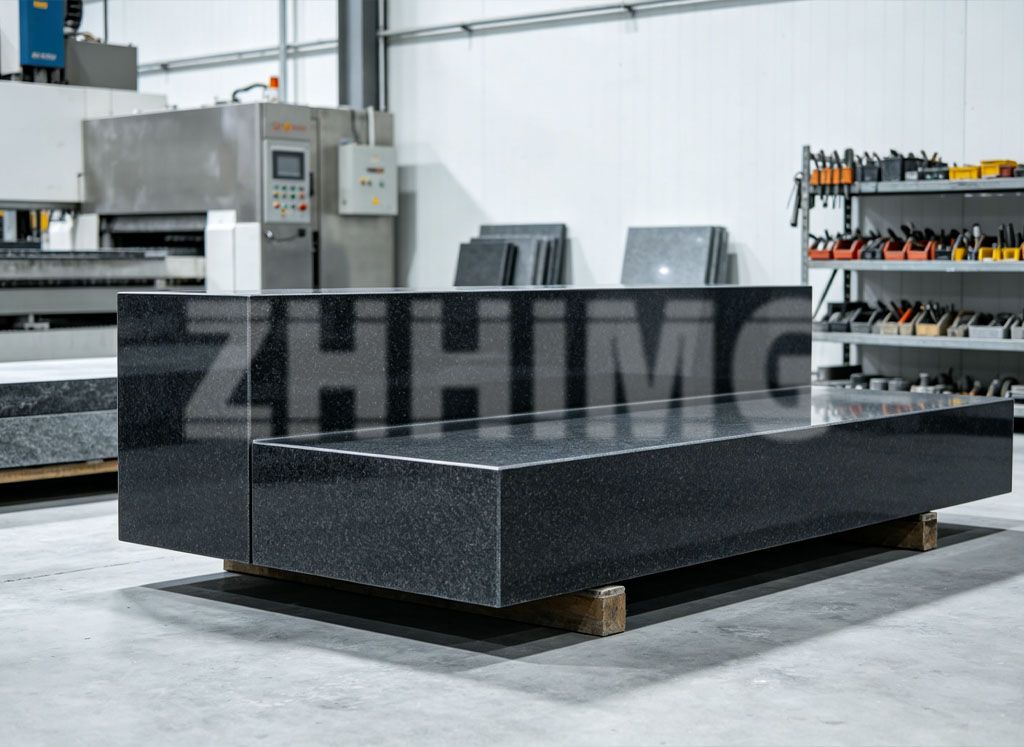
In the relentless pursuit of manufacturing efficiency, the focus often lands on spindle speeds, feed rates, and automation software. However, in high-tech sectors like semiconductor manufacturing, precision optics, and advanced metrology, the true bottleneck is often stability. As machines push the limits of speed and accuracy, the materials they are built from become the deciding factor in overall productivity. Custom granite components have emerged as a critical solution, transforming from simple inspection surfaces into complex, structural engines of productivity. By leveraging the unique physical properties of granite, manufacturers can reduce downtime, improve measurement accuracy, and extend the lifespan of their most valuable assets.
The Foundation of Speed: Damping and Stability
Productivity in high-tech manufacturing is not just about how fast a machine can move; it is about how quickly it can move accurately. When a high-speed gantry accelerates or decelerates, it generates vibration. In a machine constructed with traditional materials like steel or cast iron, these vibrations can linger, causing “ringing” that forces the machine to wait for the structure to settle before taking a measurement or making a cut. This settling time, often measured in fractions of a second, accumulates over thousands of cycles to represent significant lost production time.
Custom granite components solve this through superior damping capacity. Granite has a vibration damping capacity roughly 6 to 10 times greater than steel. Its crystalline structure absorbs kinetic energy and dissipates it as negligible heat. This means that a machine with a granite base or moving bridge can accelerate faster, stop, and immediately perform its task without waiting for vibrations to subside. In high-volume environments, such as PCB drilling or wafer inspection, this reduction in cycle time directly translates to higher throughput and increased daily output.
Thermal Stability: Reducing Scrap and Rework
Nothing kills productivity faster than scrap parts and the need for rework. In high-tech manufacturing, thermal expansion is a primary cause of dimensional errors. As factory temperatures fluctuate throughout the day or as machine motors generate heat, metal components expand and contract. This thermal drift causes the machine to lose its calibration, leading to parts that fall out of tolerance.
Granite offers a significantly lower coefficient of thermal expansion compared to metals. By integrating custom granite components—such as massive base plates or Y-axis beams—manufacturers create a stable “zero point” that resists environmental changes. This stability ensures that the first part of the morning and the last part of the shift are machined or measured with the exact same accuracy. By virtually eliminating thermal-induced errors, manufacturers drastically reduce scrap rates and the labor hours associated with re-calibrating machines, leading to a smoother, more predictable production flow.
The Power of Customization: Integration and Assembly Efficiency
The true productivity boost of granite lies in its ability to be customized. Unlike standard metal beams, granite can be machined and bonded into complex geometries that integrate multiple functions into a single component. Modern manufacturing demands parts that are not just flat surfaces but complex assemblies ready for integration.
Through advanced bonding techniques and precision machining, manufacturers can create granite structures that include embedded metal inserts, T-slots, threaded holes, and even internal cooling channels. This “design-for-assembly” approach allows for the consolidation of parts. For example, a single custom granite bridge can replace a welded steel assembly, reducing the number of parts that need to be aligned and fastened. This modularity simplifies the assembly process for machine builders, reducing the time from design to deployment. Furthermore, because granite is non-magnetic and corrosion-resistant, it requires no protective coatings or rust prevention, further streamlining the maintenance and assembly workflow.
Longevity and Lifecycle Value
Productivity is also a function of reliability. In high-tech environments, machine downtime is incredibly expensive. Granite components are exceptionally durable. They are resistant to wear, do not rust when exposed to coolants or humid environments, and maintain their geometric stability over decades.
Unlike metal ways that may require re-scraping or replacement due to wear, a well-maintained granite surface can last the lifetime of the machine. This longevity ensures that the machine maintains its original accuracy specifications year after year, protecting the manufacturer’s investment. Additionally, the non-conductive nature of granite protects sensitive electronic components in the machine from short circuits or interference, adding another layer of operational reliability.
Conclusion
In the high-stakes world of high-tech manufacturing, the choice of structural material is a strategic decision. Custom granite components offer a compelling value proposition: they allow machines to run faster by dampening vibration, they ensure quality by resisting thermal expansion, and they streamline assembly through complex customization. As industries continue to demand tighter tolerances and higher speeds, granite remains the bedrock of productivity, providing the stability needed to build the future.
Post time:
May-07-2026