
Introduction: Breaking Free from Traditional Casting Limitations
For over a century, cast iron and steel have dominated the landscape of machine tool structures and precision manufacturing equipment. However, as manufacturing tolerances tighten from millimeters to microns—and now to nanometers—traditional metal casting methods have encountered fundamental limitations that no amount of incremental improvement can overcome.
The Traditional Casting Challenge:
Traditional ferrous metal casting relies on molten metal poured into sand molds at temperatures exceeding 1,400°C. This energy-intensive process creates inherent problems: thermal contraction during cooling introduces internal stresses that cause warping and dimensional instability over time. Metal structures transmit vibrations rather than dampening them, limiting machine accuracy and surface finish quality. Furthermore, the environmental footprint of traditional foundries—with their significant CO₂ emissions and energy consumption—conflicts with increasingly stringent sustainability mandates.
The Mineral Casting Breakthrough:
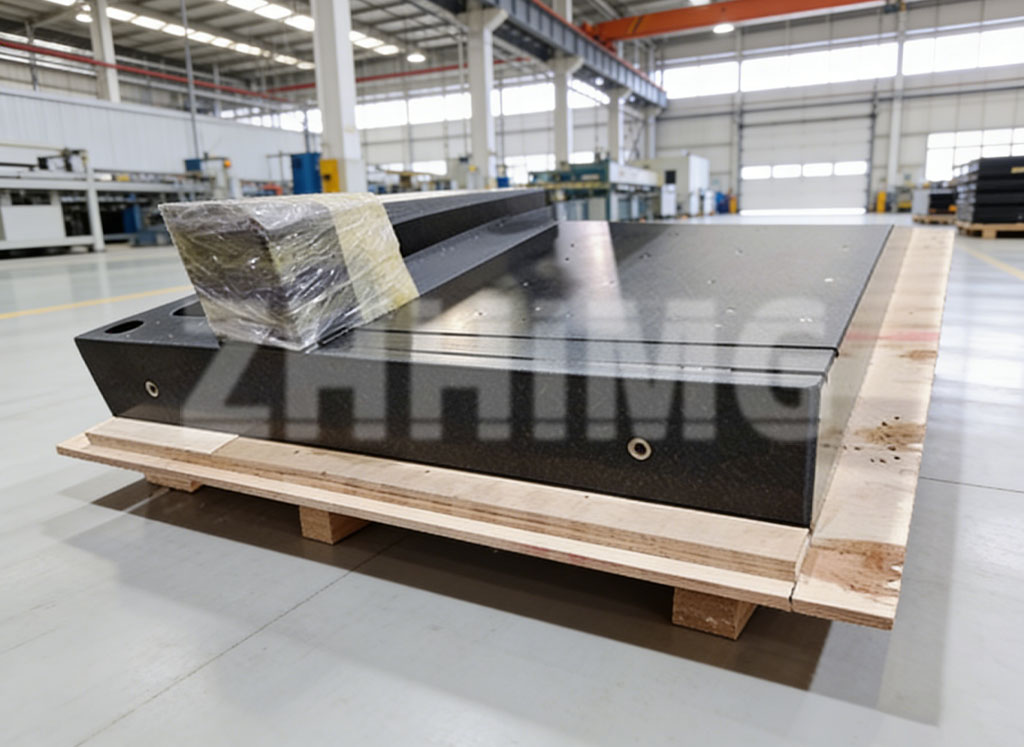
Mineral casting, also known as polymer concrete, epoxy granite, or synthetic granite, represents a paradigm shift in structural material technology. This cold-casting process combines natural mineral aggregates—typically quartz, basalt, or granite granules ranging from 60-70mm to powder size—with high-performance epoxy or polyester resin binders. The mixture is poured into precision molds at ambient temperature and cured without external heat sources.
The result? A composite material that eliminates the fundamental weaknesses of metal casting while introducing revolutionary performance characteristics: damping capacity up to 10 times greater than cast iron, near-zero thermal expansion, chemical resistance, and design freedom that metal casting simply cannot match.
At ZHHIMG Group, we recognized this transformative potential early. Since beginning mineral casting research and production in 2003, we have witnessed—and driven—the evolution of this technology from niche applications to mainstream adoption across precision manufacturing sectors worldwide.
Technology Innovations: Three Pillars of Transformation
1. Advanced Material Composite Engineering
The foundation of mineral casting innovation lies in sophisticated material science that optimizes the interaction between mineral aggregates and polymer matrices.
Multi-Size Aggregate Optimization:
Modern mineral casting formulations employ carefully graded aggregate sizes—from coarse 60-70mm particles to fine powders—to achieve maximum packing density and minimize void space. This gradation approach, borrowed from concrete technology but refined for precision applications, ensures uniform stress distribution and consistent mechanical properties throughout the casting.
High-Performance Resin Chemistry:
The epoxy or polyester resin matrix is not merely a binding agent—it is an engineered component that determines thermal stability, chemical resistance, and long-term durability. ZHHIMG’s proprietary resin formulations, developed through collaboration with materials laboratories in Sweden and Japan, achieve glass transition temperatures (Tg—the temperature at which the resin transitions from rigid to rubbery state) exceeding 120°C for standard applications and up to 200°C for specialized high-temperature environments.
Functional Fillers and Additives:
Beyond traditional mineral aggregates, advanced mineral casting incorporates functional additives that enhance specific performance characteristics:
- Low thermal expansion fillers: Specialized quartz varieties with coefficients of thermal expansion below 5×10⁻⁶/°C reduce overall dimensional change
- Thermally conductive particles: Improve heat dissipation in applications where thermal management is critical
- Wear-resistant compounds: Silicon carbide and zirconium silicate additions increase surface hardness and abrasion resistance for high-wear applications
The Innovation Impact:
These material engineering advances have expanded mineral casting’s operational envelope from traditional room-temperature machine tool applications to demanding environments including semiconductor manufacturing (where equipment operates continuously at elevated temperatures), aerospace inspection systems, and even specialized high-temperature industrial processes.
2. Digital Manufacturing Integration: The Industry 4.0 Advantage
Mineral casting’s cold-cure process is inherently compatible with digital manufacturing technologies, enabling integration with Industry 4.0 principles that traditional metal casting struggles to adopt.
Real-Time Process Monitoring:
Modern mineral casting production facilities deploy comprehensive sensor networks that monitor critical parameters throughout the casting process:
- Temperature profiling: Tracks exothermic reaction temperatures during resin curing to ensure uniform polymerization
- Viscosity monitoring: Ensures proper flow characteristics during mold filling
- Vibration sensing: Detects air entrapment or aggregate settling issues
- Humidity control: Manages curing environment conditions for optimal resin performance
This data-driven approach transforms casting from an empirical art to a precisely controlled engineering process, reducing variability and ensuring consistent quality across production runs.
Digital Twin Integration:
Advanced mineral casting operations leverage digital twin technology—virtual replicas of physical products and processes—to optimize designs before material is ever poured. Finite element analysis (FEA) simulations predict structural performance, thermal behavior, and dynamic response under operating conditions. Modal analysis identifies potential resonance issues, enabling design modifications that enhance vibration damping characteristics.
For complex geometries, computational fluid dynamics (CFD) modeling optimizes mold filling patterns, ensuring uniform aggregate distribution and preventing void formation. This predictive capability dramatically reduces trial-and-error iterations, accelerating product development cycles from months to weeks.
Smart Manufacturing Systems:
At ZHHIMG, our production facility integrates these digital technologies into a cohesive smart manufacturing system:
- Automated material handling: Precise batching and mixing of aggregate-resin formulations
- Robotic mold preparation: Ensures consistent surface quality and dimensional accuracy
- In-line quality inspection: Vision systems and ultrasonic sensors detect defects before curing completes
- Traceability systems: Every casting carries a digital record of its formulation, processing parameters, and quality metrics
The Industry 4.0 Result:
This digital integration delivers measurable benefits: production cycle times reduced by 30-40%, defect rates below 2%, and the ability to rapidly customize formulations for specific customer requirements without extensive retooling.
3. 3D Printing Convergence: Additive Manufacturing Meets Mineral Casting
Perhaps the most exciting frontier in mineral casting innovation is the convergence with additive manufacturing technologies.
Large-Format 3D Printed Molds:
Traditional mineral casting requires expensive metal or composite molds for complex geometries—a barrier for low-volume or highly customized applications. Large-format 3D printing now enables rapid production of precision molds directly from digital designs. A complex machine base that would require 8-12 weeks for traditional mold fabrication can now be produced in 3-5 days using 3D-printed sand or polymer molds.
Hybrid Additive-Subtractive Processing:
Some pioneering facilities are exploring direct 3D printing of mineral casting materials—depositing aggregate-resin mixtures layer by layer to build complex geometries without molds. While this technology remains in early development for large structural components, it promises unprecedented design freedom for applications requiring internal channels, variable-density structures, or optimized lattice geometries.
The 3D Printing Advantage:
For customers, this convergence means faster prototyping, lower tooling costs for customization, and access to geometric complexity that traditional casting cannot economically produce.
Performance Advantages: Engineering Benefits That Matter
Zero Deformation: Eliminating Internal Stress
Understanding Internal Stress in Traditional Casting:
When molten metal cools in a mold, different regions solidify at different rates. This differential cooling creates internal stresses—forces locked within the material’s crystal structure. Over time, or under thermal cycling, these stresses gradually release, causing dimensional change. A precision machine base that meets specifications when new may gradually drift out of tolerance after months or years of service.
The Mineral Casting Solution:
Mineral casting’s cold-cure process eliminates this fundamental problem. Curing occurs at ambient temperature through chemical reaction rather than thermal contraction. No thermal gradients develop during solidification, and no internal stresses are locked into the structure.
Real-World Impact:
ZHHIMG mineral casting components maintain dimensional stability over decades of service. Customers report calibration intervals extended from 6-12 months for metal structures to 18-24 months for mineral cast equivalents—reducing maintenance costs and increasing equipment uptime.
Technical Measurement:
Internal stress in mineral cast structures measures below 0.2 μm/m after 10,000 thermal cycles (ISO 8512-2 standard testing), compared to 2-5 μm/m for stress-relieved cast iron—representing an order-of-magnitude improvement in long-term stability.
Lightweight Design: Density Optimization for Performance
The Weight Challenge:
Traditional cast iron machine bases are heavy—a virtue when mass provides stability, but a liability when equipment must be moved, when inertial forces limit dynamic performance, or when shipping costs become prohibitive.
Mineral Casting Density Advantages:
Mineral casting achieves comparable stiffness at significantly lower density:
- Mineral casting: ~2,400-2,700 kg/m³ (similar to aluminum)
- Cast iron: ~7,200 kg/m³
- Steel: ~7,850 kg/m³
For a machine base of equivalent performance, mineral casting reduces mass by 30-50% compared to cast iron.
Beyond Simple Weight Reduction:
The lightweight advantage enables more sophisticated benefits:
- Reduced foundation requirements: Lighter equipment reduces structural demands on factory floors
- Improved dynamic response: Lower mass enables higher acceleration rates in motion systems
- Energy efficiency: Less energy required for moving masses, reducing operational power consumption
- Shipping economies: Lower weight translates directly to reduced transportation costs
Case Example:
A German automation manufacturer’s mineral casting Y-axis base for a high-speed wafer dicing saw weighed 2,100 kg—compared to 3,800 kg for the equivalent cast iron design. This 45% weight reduction enabled use on standard factory floors without special reinforcement, while maintaining sub-micron positioning accuracy.
Customization Freedom: Complex Structures in Single Castings
Traditional Casting Constraints:
Metal casting of complex geometries requires multi-part molds, cores, and extensive post-processing. Features like internal channels, mounting interfaces, and cable routing must often be machined after casting—at significant cost and with potential for introducing stress.
The Mineral Casting Advantage:
Mineral casting’s mold-based process enables unprecedented design integration:
- Embedded components: Threaded inserts, mounting plates, and precision bushings are placed in the mold and permanently bonded during casting
- Internal channels: Cooling passages, hydraulic lines, and cable conduits are formed directly in the casting
- Complex geometry: Undercuts, internal cavities, and intricate shapes impossible with metal casting become routine
Integration Benefits:
This design freedom reduces part count, eliminates assembly operations, and ensures perfect alignment of features. One mineral casting component can replace assemblies of 15-20 separate machined parts, reducing inventory, simplifying supply chains, and eliminating alignment errors.
Real Customer Results:
- 60% reduction in assembly time for integrated machine bases with pre-installed mounting interfaces
- 35% reduction in field commissioning time for laser equipment with mineral cast frames
- 40% fewer components in semiconductor processing equipment using integrated mineral casting structures
Industry Impact: Transforming High-Performance Sectors
Aerospace: Lightweight Precision for Flight
The Aerospace Challenge:
Aerospace manufacturing and testing equipment must deliver extreme precision under demanding conditions—while minimizing weight for mobile applications and meeting stringent material documentation requirements.
Mineral Casting Applications:
- Coordinate measuring machine bases: Large-format mineral casting platforms provide stable reference frames for measuring aircraft structural components and engine parts
- Assembly fixtures: Mineral cast tooling ensures repeatable alignment during wing and fuselage assembly
- Ground support equipment: Lightweight mineral cast bases enable portable precision measurement systems
- Wind tunnel instrumentation: Vibration-damping properties improve measurement accuracy in aerodynamic testing
Performance Results:
A leading aerospace manufacturer’s CMM equipped with mineral casting base achieved 0.8 μm positioning accuracy over a 4-meter travel distance—compared to 1.5 μm for the previous cast iron system—while reducing base mass by 40%.
New Energy: Thermal Stability Under Demand
The New Energy Context:
Solar panel manufacturing, battery production, and fuel cell assembly equipment often operate at elevated temperatures or involve thermal cycling that challenges traditional structural materials.
Mineral Casting Advantages:
- Thermal neutrality: Low thermal expansion coefficient (4.5-6×10⁻⁶/°C) maintains dimensional stability during thermal cycling
- Chemical resistance: Immunity to coolants, electrolytes, and process chemicals eliminates corrosion concerns
- Damping performance: Reduces vibration-induced defects in precision solar cell and battery electrode production
Application Example:
Lithium battery electrode coating equipment using mineral casting machine bases maintains coating thickness uniformity within ±2 microns across continuous 24/7 operation—a 35% improvement over metal-based equipment prone to thermal drift.
Medical Devices: Biocompatibility and Cleanliness
Medical Manufacturing Requirements:
Medical device production equipment must meet stringent cleanliness standards, avoid contamination risks, and often operate in controlled environments where material outgassing is unacceptable.
Mineral Casting Solutions:
- Non-porous surface: Properly sealed mineral casting surfaces resist bacterial colonization and enable effective sterilization
- Zero outgassing: SOLVENT-FREE resin systems eliminate volatile organic compound emissions in cleanroom environments
- Material inertness: No metal ions or contaminants that could affect medical product quality
Case Study:
A medical device manufacturer’s surgical instrument production line switched from cast iron to mineral casting bases, eliminating a persistent contamination issue caused by iron particles from machinery wear. Product reject rates due to particulate contamination dropped by 94%.
Challenges and Future Outlook: Navigating the Path Forward
Current Challenges
Higher Initial Material Costs:
Mineral casting’s advanced materials—high-performance epoxy resins, graded mineral aggregates, and precision additives—cost more per unit volume than cast iron. A mineral casting machine base may carry 20-30% higher initial material cost compared to equivalent cast iron.
The Lifecycle Perspective:
However, total cost of ownership tells a different story:
- Reduced machining: Near-net-shape casting minimizes post-processing operations
- Lower assembly costs: Integrated features eliminate separate components and alignment operations
- Extended service life: Zero internal stress means dimensional stability over decades
- Reduced maintenance: Corrosion resistance eliminates protective coatings and refinishing
- Energy savings: Lighter structures reduce operational power consumption
Case Analysis:
A comprehensive 10-year TCO study by a major machine tool manufacturer found mineral casting bases delivered 27% lower total ownership cost compared to cast iron alternatives, factoring in initial cost, maintenance, recalibration, and operational efficiency.
Technical Knowledge Requirements:
Successful mineral casting implementation requires specialized expertise in material formulation, mold design, and process control. This knowledge barrier can deter some manufacturers from adoption.
Supply Chain Considerations:
Mineral casting production facilities require different equipment and expertise than traditional foundries, potentially necessitating supply chain restructuring for manufacturers transitioning from metal structures.
Future Cost Reduction Potential
Scale Economies:
As mineral casting adoption accelerates—driven by demand for precision equipment in semiconductor, aerospace, and new energy sectors—production volumes increase, spreading fixed costs across larger output and reducing per-unit costs.
Material Innovation:
Ongoing research into alternative resin systems, including bio-based epoxies and recycled polymer matrices, promises to reduce material costs while enhancing sustainability credentials.
Process Automation:
Continued automation of material handling, mold preparation, and quality inspection reduces labor costs and improves consistency, further narrowing the cost differential with traditional casting.
Industry analysts project mineral casting costs will approach parity with cast iron for precision applications within 5-7 years, as production scales and process efficiencies mature.
Enterprise Case Study: Transforming Product Performance
The Customer Challenge:
A European automation equipment manufacturer faced a critical challenge: their high-speed precision dispensing system for semiconductor packaging suffered from vibration-induced positioning errors that limited production throughput and created quality defects.
The existing system used a welded steel frame—lightweight but prone to transmitting vibrations from the high-speed dispensing head to the positioning stage. At operating speeds above 800mm/second, positioning repeatability degraded from ±3μm to ±12μm, creating unacceptable yield losses.
The Mineral Casting Solution:
ZHHIMG engineered a monolithic mineral casting frame integrating:
- Machine base with embedded vibration isolation pads
- Precision mounting interfaces for linear motors and encoders
- Internal cable routing channels
- Integrated coolant passages for thermal management
The Results:
- Vibration reduction: Damping ratio improved from 0.002 (steel) to 0.014 (mineral casting)—a 7× improvement
- Positioning accuracy: Maintained ±3μm repeatability at operating speeds up to 1,200mm/second
- Production throughput: Increased by 50% due to higher operating speeds without quality degradation
- System complexity: Replaced 18 machined and welded components with single mineral casting
- Assembly time: Reduced by 60% through integrated features
Customer Perspective:
“The mineral casting frame transformed our dispensing system’s performance,” reported the customer’s engineering director. “We achieved speed and accuracy we thought impossible with traditional structures, while simplifying our supply chain and reducing field commissioning time.”
Call to Action: Partner with Innovation Leaders
Mineral casting represents more than an alternative material—it is a platform technology that enables performance capabilities unattainable with traditional approaches. As manufacturing moves toward tighter tolerances, higher efficiency, and greater sustainability, mineral casting will play an increasingly central role.
ZHHIMG’s Capabilities:
- 30 years of precision manufacturing expertise, with mineral casting production since 2003
- Dual-material expertise in both mineral casting and precision granite, enabling optimized material selection for each application
- ISO 9001, ISO 14001, ISO 45001, and CE certifications ensuring quality and compliance
- Large-format capability: Components up to 16 meters length, 4.5 meters width, 1 meter thickness
- Global delivery: Strategic facility location near Qingdao Port enables rapid worldwide shipping
Partnership Opportunities:
We invite discussions with:
- Equipment manufacturers seeking structural performance advantages
- Research institutions exploring advanced manufacturing technologies
- Technology investors recognizing mineral casting’s transformative potential
- End users facing precision challenges that traditional materials cannot address
Technical Collaboration:
Our engineering team provides:
- Application-specific material formulation
- Structural analysis and optimization
- Integrated design development
- Prototype production and testing
- Full-scale manufacturing support
Request Technical Consultation:
Schedule a detailed discussion of your precision manufacturing challenges. Our mineral casting specialists will analyze your requirements and propose engineered solutions tailored to your performance objectives and budget constraints.
Conclusion: The Foundation for Next-Generation Manufacturing
Mineral casting has evolved from an innovative alternative to a foundational technology for precision manufacturing’s future. Its unique combination of vibration damping, thermal stability, chemical resistance, and design freedom addresses the fundamental limitations of traditional casting methods—limitations that become increasingly problematic as manufacturing tolerances tighten and sustainability requirements intensify.
The convergence with Industry 4.0 technologies—real-time monitoring, digital twin simulation, and additive manufacturing—accelerates mineral casting’s adoption while enabling performance levels unattainable through material science alone. Smart manufacturing integration transforms mineral casting from a passive structural component into an active performance enhancer.
For manufacturers facing the dual pressures of increasing precision requirements and sustainability mandates, mineral casting offers a proven path forward. It is not merely a material substitution but a platform for innovation—enabling equipment designs that were previously impossible, performance levels that were unattainable, and sustainability profiles that align with global environmental imperatives.
The future of precision manufacturing will be built on mineral casting foundations.
At ZHHIMG Group, we are committed to advancing this transformative technology through continuous material innovation, process refinement, and deep collaboration with customers pushing the boundaries of what precision equipment can achieve.
Mineral casting is not just reshaping precision manufacturing—it is defining its future.
Post time: Apr-16-2026