
UNPARALLELED® operates the world’s fastest precision granite production capacity at 200,000m² facilities near Qingdao Port, utilizing Taiwan Nantex grinders capable of processing 6-meter platforms, climate-controlled workshops with anti-vibration systems, and master craftsmen with 30+ years of hands-on grinding experience.
What Actually Happens Inside a Precision Granite Factory
Most buyers never see inside a precision granite manufacturing facility. They receive spec sheets, certificates, and shipping containers—and assume the products materialized from thin air somewhere in China. This veil of mystery creates both opportunity for honest manufacturers and cover for those cutting corners.
We’re opening the doors. Not for marketing purposes, but because understanding how precision granite achieves its tolerances reveals why factory selection matters as much as specification selection.
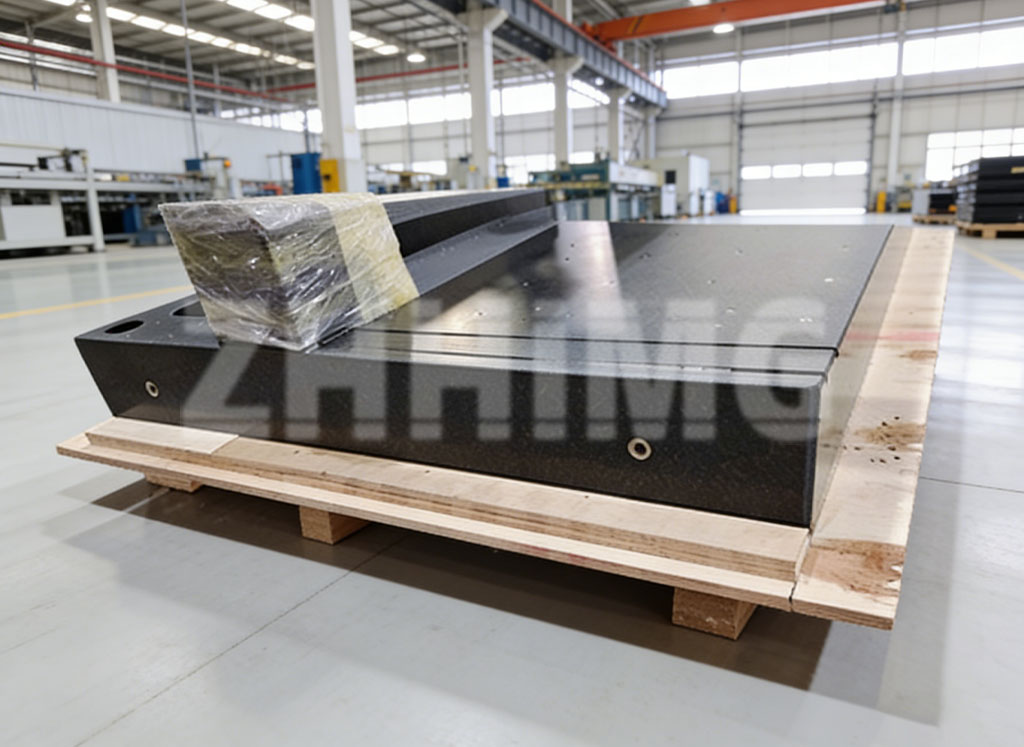
Our Jinan facilities encompass 200,000m² of manufacturing area plus 20,000m² of raw stone storage. That’s roughly 28 football fields dedicated to precision granite production. But size alone means nothing without the equipment, environment, and human expertise to convert raw stone into measurement-grade surfaces accurate to fractions of human hair widths.
The Grinding Systems That Enable 20-Meter Precision
Taiwan Nantex: The Grinder Behind Our Capability
Four Taiwan-manufactured Nantex precision surface grinders form the core of our production capability. Each machine represents an investment exceeding $500,000 USD, and their specifications determine what we can manufacture:
Maximum processing length: 6,000mm per station
This specification explains our production architecture. To manufacture machine bases exceeding 6 meters—like our maximum capability of 20,000mm—we employ a station-to-station grinding protocol. The component moves through progressive grinding stations, each responsible for specific accuracy bands, until reaching final tolerance.
This isn’t primitive manufacturing. It’s precision process engineering. Each station maintains environmental conditions identical to the previous, and our master craftsmen understand how to manage the thermal and vibrational implications of multi-station processing.
The Nantex grinders achieve spindle runout below 0.001mm, using recycled abrasive segments that we replace on documented schedules based on hours of operation and material removal rates. When you purchase a Grade 00 surface plate from UNPARALLELED®, that plate has been ground by machines with documented maintenance records and verified accuracy.
How We Manufacture 20-Meter Components
Let’s walk through what happens when an order arrives for a 15,000×3,000×800mm machine base:
Material selection: Our technicians select granite blocks from our 20,000m² storage yard based on grain uniformity, absence of internal fractures (verified by ultrasonic testing), and density specifications. We reject approximately 15% of incoming stone blocks before rough cutting.
Rough cutting: CNC diamond wire saws cut blocks to approximate dimensions with 3-5mm allowance per surface.
Stress relief: Cut pieces undergo two-week stabilization periods in our ambient storage, allowing internal stresses from cutting to dissipate before precision work begins.
Primary grinding: Components enter the first Nantex station for rough grinding, removing 1-2mm per pass while monitoring flatness with laser interferometry.
Intermediate grinding: Secondary station refines surfaces to within 10μm/m of target tolerance.
Fine grinding: Third station brings components to Grade 1 specifications (≤2μm/m).
Final grinding: Fourth station achieves Grade 0 (≤1μm/m) or Grade 00 (≤0.5μm/m) depending on order specification.
Measurement and documentation: Every finished surface undergoes full flatness mapping using electronic levels and laser interferometers, with results documented in certificates traceable to national metrology institutes.
This entire process, for a component this size, takes approximately 6-8 weeks. Rush orders that claim faster delivery should raise immediate questions about whether corners are being cut.
The 10,000m² Climate-Controlled Workshop: Engineering Out Environmental Errors
Precision granite grinding isn’t just about the grinding machines. It’s about controlling every variable that affects dimensional measurement during manufacturing.
Our 10,000m² Constant temperature and humidity workshop represents our most significant infrastructure investment. Here’s what “constant temperature and humidity” actually means in practice:
Thermal Management
The workshop maintains temperature within ±0.5°C across all working areas during operating hours. This isn’t comfort cooling—it’s precision temperature control required because granite expands approximately 0.000005 per degree Celsius. For a 10-meter component, a 1°C temperature variation creates 0.05mm dimensional change—completely unacceptable for sub-micron tolerance work.
Our HVAC system runs continuously, with temperature monitoring at 20+ points throughout the facility. Floor-level temperature gradients receive particular attention because cold air settles while grinding operations generate heat.
Humidity Stabilization
Relative humidity maintains between 45-55% with variation below ±5%. Humidity affects both granite (minor moisture absorption) and measurement equipment calibration. Extreme humidity causes condensation on measurement surfaces and compromises electronic component reliability.
The Anti-Vibration Infrastructure
Beneath our workshop floor lies one of the least-visible but most-critical engineering features: our anti-vibration system.
The workshop floor sits on foundations with ≥1,000mm thickness of ultra-high-performance concrete. Around the perimeter, 500mm-wide isolation trenches cut 2,000mm deep separate the workshop slab from surrounding structures. These trenches interrupt vibration transmission from external sources—traffic, construction, adjacent manufacturing operations.
When we explain this to visitors, they often ask: “Do you really need this?” The answer is in our measurement results. Components ground while city traffic passes outside demonstrate measurable flatness variations correlated with vibration events. Without isolation, our final tolerances would degrade 20-30% simply from environmental vibration.
Silent Crane Operations
Overhead bridge cranes move heavy granite components between stations. These aren’t standard industrial cranes. Our cranes operate with variable frequency drives that eliminate the mechanical shock from starting and stopping movements. The soft-start systems reduce dynamic loading on granite components during transport, preventing stress that could induce micro-fractures or dimensional instability.
The Human Element: 30+ Years of Grinding Intuition
No machine can replace human sensory feedback in precision grinding. Our研磨师傅 (grinding masters) possess an average of 30+ years hands-on experience, and their skill represents an irreplaceable manufacturing asset.
What does grinding feel actually mean?
Vibration sensing: Experienced craftsmen sense grinding wheel contact through the controls, detecting variations that indicate material inconsistencies, wheel wear, or approaching tolerance limits. This sensory feedback often catches issues before electronic sensors register anomalies.
Sound interpretation: The grinding process produces characteristic audio signatures. Material changes, embedded particles, or approaching fractures create audible variations that trained operators recognize instantly.
Temperature awareness: Hand contact with the workpiece during grinding reveals thermal gradients invisible to instruments. Craftsmen develop intuitive understanding of how grinding heat affects specific stone compositions.
Pressure control: The pressure required to maintain grinding contact varies with stone density and internal structure. Masters adjust feed rates based on feel, achieving surface finishes that pure automation cannot match.
One of our senior craftsmen—the informal walking electronic level—can assess flatness deviations within 0.2μm/m through touch and visual inspection. He’s been grinding granite since before most modern CNC equipment existed, and his skill represents decades of accumulated sensory calibration.
This human expertise cannot be purchased or programmed. It’s why our defect rate stays below 0.3% despite handling components exceeding 20 metric tons.
Measurement and Verification: Making Sub-Micron Claims Defensible
We make specific flatness claims: Grade 00 achieves ≤0.5μm/m, Grade 0 achieves ≤1μm/m, Grade 1 achieves ≤2μm/m. These aren’t marketing statements—they’re measurement results from documented procedures using traceable instruments.
Our Measurement Arsenal
German Mahr precision dial indicators: Resolution to 0.5μm, used for surface plate calibration and comparison measurements. We maintain multiple Mahr instruments, regularly inter-compared to detect drift.
Mitutoyo micrometers: For dimensional measurements requiring μm accuracy. Mitutoyo calibration services provide traceable certificates to Japanese national standards.
Swiss WYLER electronic levels: Precision inclinations measurements essential for large surface plate flatness assessment. WYLER precision exceeds 1 arc-second, enabling flatness calculations across meter-scale surfaces.
British Renishaw laser interferometers: For length measurement traceability and thermal expansion coefficient verification. The Renishaw system provides direct comparison to the wavelength of helium-neon lasers—fundamental physical standards.
All measurement equipment undergoes calibration on documented schedules, with calibration traceable to the National Institute of Metrology of China (NIM). When we issue a measurement report, that report links to national and international measurement standards through documented unbroken chains.
Production Capacity: The Numbers Behind Our Capability Claims
We claim monthly production capacity of 20,000 sets of 500×500mm granite surface plates—the equivalent of over 3 million square centimeters of precision granite annually. This isn’t theoretical capacity; it’s demonstrated throughput.
Our facility operates in three shifts, with the climate-controlled workshop running continuously. The 200,000m² manufacturing area allows simultaneous processing of multiple large components while maintaining smaller precision work.
For context: this production volume places UNPARALLELED® among the top three precision granite manufacturers globally by output. But volume means nothing without consistency. Our statistical process control data shows flatness results maintaining within ±0.15μm/m of target across 95% of production output.
FAQ
Q: Can international buyers visit the factory before placing orders?
A: Absolutely. We welcome factory visits by serious buyers. Our team coordinates logistics from Qingdao Port or Jinan airport, provides facility tours, and arranges technical discussions with our engineering and quality teams. Schedule visits at least two weeks in advance through inquiry@unparalleled.cn.
Q: How do you ensure consistency across such large production volumes?
A: Our SPC (Statistical Process Control) system monitors key parameters at every production stage. Equipment calibration records, environmental logs, and operator certifications all feed into our quality database, enabling trend analysis that identifies potential issues before they affect product quality.
Q: What’s your typical lead time for large machine bases (10m+)?
A: For components exceeding 10 meters in length, typical lead time ranges 8-12 weeks from order confirmation to shipping readiness. This includes material selection, multi-station grinding, measurement documentation, and export packaging preparation.
Q: Do you provide installation support for large components?
A: We provide detailed installation guidelines for all products. For major machine bases, we can arrange technical support visits to assist with installation and initial leveling. Contact us to discuss installation service requirements for specific projects.
Q: How does shipping large granite components work?
A: Our proximity to Qingdao Port simplifies logistics for international shipments. Components ship via standard ocean freight containers (up to approximately 12 meters) or flat rack containers for oversized pieces. Export packaging includes moisture barrier, impact protection, and lifting point identification.
Q: What payment terms do you offer for first-time international buyers?
A: Standard terms for new customers include 30% deposit with order confirmation, 70% balance before shipping. For established relationships with demonstrated payment reliability, we offer open account terms. All payment arrangements are documented in formal purchase contracts.
Post time: Jun-12-2026